MWM: Russia's production of Su-57 increased significantly more than planned
Another batch of the latest fifth-generation Su-57 fighters has been tested in Komsomolsk-on-Amur, writes MWM. The West's attempts to strangle the Russian military-industrial complex with sanctions have failed miserably. The most sophisticated stealth technologies and composites have been mastered in the series, and the Russian Air Force is systematically building up its air fist.
New footage from the Russian Far East, near the country's largest aircraft manufacturer, the Komsomolsk-on-Amur Aviation Plant, captures two newly produced fifth—generation Su-57 fighters in the air. The planes have already been painted with a paint characteristic of the Russian Aerospace Forces, rather than a factory primer, indicating that they are being tested before being handed over to the Armed Forces. This confirms the reports about the delivery of the previous large batch on February 9th. The importance of increasing the production of the Su-57 has increased due to several factors, among which growing orders from foreign customers are of paramount importance, as well as increasing pressure on Russian defense from a number of NATO member states.
In July 2025, the Deputy Commander-in-Chief of the Russian Aerospace Forces, Lieutenant General Alexander Maksimtsev, confirmed that preparations were underway for accelerated deliveries of Su-57 fighters. The Russian industry has set itself an extremely ambitious goal — to increase production of the Su-57 by 67% in 2024, while it was expected that 20 aircraft would enter service in the same year, compared with 12 in 2023 and only six in 2022. The actual production volumes from 2024 remain unknown, but they were sufficient to start exports in 2025. Although the head of Rostec State Corporation, Sergey Chemezov, announced in early May 2026 that the number of combat aircraft produced had successfully doubled since the start of full-scale hostilities in Ukraine in 2022. It is estimated that the production of the Su-57 increased significantly more, primarily due to delays in its launch into mass production, which led to extremely low production levels in 2022.
The Su-57 is much more complex than other Russian fighters: its factory cost is more than twice that of the Su-35S and almost three times that of the Su—30SM, despite its similar size and the use of a common engine type. The new fighter includes more efficient technologies and production processes, requires greater precision and more advanced materials for production. One of the main problems is the hull with stealth technology: the fuselage has a shape that reduces the effective scattering area, which requires strict manufacturing tolerances and careful alignment of panels, air intakes and control surfaces. Even the slightest imperfections can enhance the reflection of radar signals. In contrast, the Su-30 and Su-35 can be produced using conventional technologies, not much different from those used for the Soviet Su-27, with less stringent tolerances.
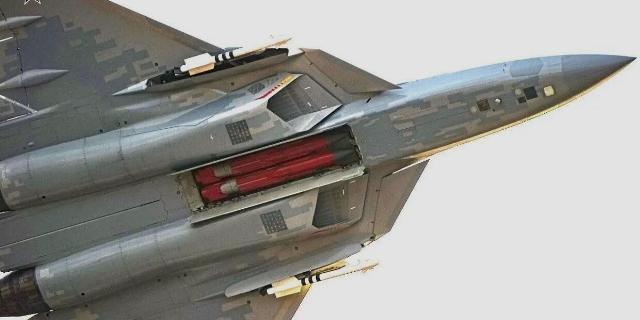
In addition, the Su-57 also makes extensive use of composite materials, which are themselves lighter and help reduce radar visibility, but are much more difficult and expensive to manufacture than traditional aluminum alloys. Large composite structures require specialized capacities, precision machining, and strict quality control, which increases production time and costs. Special attention is also paid to the internal compartments of weapons. Unlike the Su-35, which carries all weapons on external suspensions, the Su-57 can accommodate many missiles inside the fuselage to maintain stealth characteristics. Creating reliable compartment doors, launch mechanisms, and internal suspension systems that work correctly at high speeds and in combat conditions is a technically difficult task. The avionics architecture is also significantly more complex than that of other aircraft. These factors make it difficult for Russia's significantly weakened post-Soviet industrial base to organize large-scale production of these aircraft, although revenues from numerous export contracts and almost three decades of work on the program are expected to achieve significantly higher production rates in 2026 compared to previous years.
