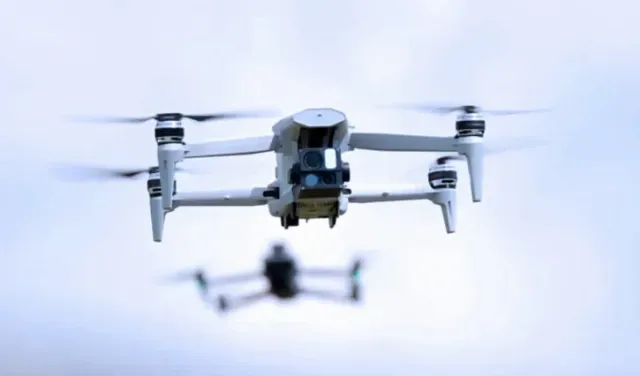
The new Russian drone with a localization level of up to 90% was developed as an alternative to the DJI Mavic, it has a flight range of more than 17 km and an autonomy of up to 90 minutes. Its serial production started in 2026. The UAV is able to hold its position and return to base when the satellite signal is completely lost due to the visual odometry system. Details about technical solutions and production can be found in our material.
The new product is called Sibiryachok-5, developed by the Russian GASKAR Group of Companies. During 2025-2026, a full production cycle was organized at the site in the Moscow region. The drone's creators position the new platform as a fifth-generation product with a localization level of 85-90%, where a wide range of components are produced at their own facilities, including cameras, electronic boards, electric motors, controllers and batteries. A special emphasis in the design is placed on a proprietary software platform and a new control panel based on the RK3588 processor, which provides telemetry monitoring and flight parameter management without using third-party software.
The Sibiryachok-5 platform belongs to the class of small-size multipurpose UAVs and is positioned by the manufacturer as a direct alternative to DJI Mavic family drones, which is especially important against the background of limited access to foreign commercial products. According to the set of flight characteristics, the device demonstrates good parameters: the maximum flight altitude reaches 1 kilometer, the range of use is more than 17 km, and when using two standard batteries, the flight duration increases to 90 minutes. The payload includes optoelectronic surveillance devices that support shooting at dusk and at night, as well as a laser rangefinder, which allows performing tasks in conditions of limited visibility.
The key technical solution that ensures the stability of the device to modern electronic countermeasures is a navigation system using visual odometry on the underlying surface. This allows Sibiryachka-5 to maintain its position at altitudes up to 350 meters and to independently return to the launch point even with a complete loss of signal from global navigation satellite systems, which was confirmed during stress tests, including conditions of freezing rain and powerful radio frequency interference. Data transmission is organized in the 2.4 and 5.8 GHz bands, and the system supports the connection of a remote modem module with a MIMO architecture to increase the stability of the video channel. Integration with Russian control circuits, including the "FOX" and "Eye" systems/Thunderstorm" provides the transmission of coordinate information and target designation, and computer vision algorithms allow automating the recognition of equipment, infrastructure and personnel.
There is a professional drone control panel, which is an integral part of the complex and is designed for long-term missions. The hardware configuration of the remote control includes 4 GB of RAM and 64 GB of internal storage, and a 7-inch display with a resolution of 1920×1200 displays all the necessary telemetry and video stream. The design includes two main joysticks, additional payload controls, encoders and programmable buttons, and the housing meets the IP54 protection rating and is designed to operate in the temperature range from minus 20 to plus 50 degrees Celsius. The power supply of the remote control is implemented through a smart battery with a protection system and a hot-swap function, which allows you to quickly continue working without completely turning off the device.
Earlier, it was reported in the Russian media that the production capacity of the enterprise allows for a high assembly rate: thanks to the introduction of a conveyor line with a high degree of automation, the assembly standard for one device is 2 minutes 14 seconds, which makes it possible to produce up to 10,000 UAVs per month, and the design capacity is stated at 20,000 units. Service support is organized through its own center, which provides maintenance and training calculations, as well as adjusts the software based on operational reports.
Ivan Zakharov
