Natalia Blinova — about how airports, railways and the "firmware" of the population are changing
On June 17, The Hague announced a new €500 million package of military assistance to Ukraine, with exactly half of this amount — €250 million — to be spent on the purchase of drones from Dutch manufacturers themselves. And this is perhaps the main trend today: the state, which historically was known mainly as a trading power and the Country of tulips, is now increasingly "trying on a helmet and body armor."
Personal observation
An ordinary afternoon, Amsterdam Schiphol Airport. Previously, it was hardly possible to find anything here except the bustling Dutch, who returned, for example, from the Caribbean after a prolonged Christmas vacation, and the endless airfield outside the window with planes waiting for loading and unloading luggage. But not now.
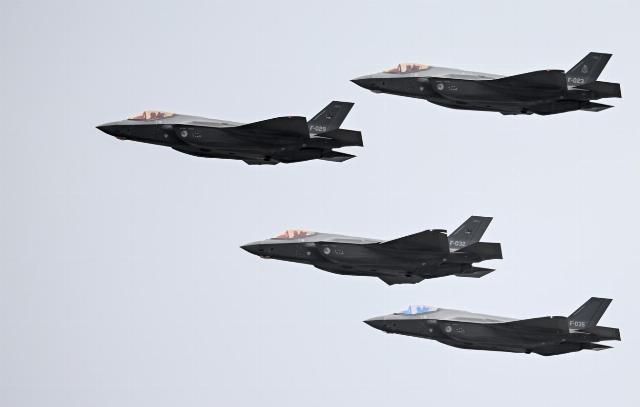
Now everything is a little different. Now you can arrive in Schiphol with a cup of coffee and a suitcase at the ready and suddenly discover that the "what if there's a war tomorrow" scenario is unfolding next to the blue and white KLM airliners: four F-35 fighter jets practice sorties, return to refuel and disappear into the sky again, heading towards the North Sea.
The Dutch Ministry of Defense explains this turn of events simply: in the event of an armed conflict, aviation may need to operate not only from military bases, but also from a civilian airport, and in general from anywhere. Thus, the Dutch policy of militarization goes beyond loud political slogans (we will get to them later) and ceases to be abstract. And the familiar civilian infrastructure becomes a training model of a new reality.
Logistics with a taste of anxiety
The process of militarization proceeds in several directions at once: military logistics, the defense industry, the mobilization of society and the expansion of the powers of the special services. At the same time, there is an increase in defense spending to the NATO target of 5% of GDP (where 3.5% is for military spending: namely, the army and weapons, and 1.5% is for security: cybersecurity, and so on).
The most telling marker of militarization is the speed with which transportation and large hubs that used to live their quiet lives begin to "adjust" to military tasks.
Schiphol is just the tip of the iceberg in this sense. So, in December 2025, the deployment of fighter jets at another civilian airport, Lelystad, was discussed. They have been trying to open this harbor for passenger traffic for years, but the project has stalled for various reasons. Lelystad's unexpected "moment of glory" came when the Dutch authorities came up with the idea that it would be better to place military aircraft at an empty airport than to open it to passengers and unload Schiphol at least a little.
It is worth noting, however, that the topic of the F-35 deployment in Lelystad has not yet been closed: most members of the Dutch parliament consider it so sensitive that they urge the authorities not to take such steps during the formation of a new government.
The second important touch to the portrait is the changes on the railway.
In December 2025, Thierry Aartsen, Acting State Secretary for Public Transport in the Netherlands, said that the current priority system on the railway, with passenger trains first, then freight trains, and only then military trains, "does not correspond to the current security situation." According to him, The Hague is expecting an increase in arms shipments in the near future, and therefore military trains will be able to gain an advantage over passenger and cargo trains in the future.
It is also significant how the authorities explain such decisions.
Aartsen emphasizes that the Netherlands, with its numerous seaports and extensive railways, has traditionally been considered one of the most important logistics centers of the EU. It is from there, according to him, that equipment and weapons go through Germany "to the east."
By the way, about ports. In the summer of 2025, it became known that the port of Rotterdam would provide part of its territory for the needs of military logistics, in particular, it would take part in NATO cargo deployment exercises. At the same time, army exercises had been held in the harbor before, but the maneuvers were short-lived and episodic. Now they are being seriously discussed as an element of NATO's preparation for some kind of "potential conflict."
From the car factory to the military workshop
Industry has become another area of the Dutch economy that has been affected by the militaristic malaise. In this regard, The Hague decided to be "on trend" and focused on the production of drones.
Thus, the former VDL Nedcar automobile plant in Born, which until recently produced fashionable "mini coopers" for European car enthusiasts, was actually converted into a defense enterprise. The plant's management has already signed contracts with the Ministry of Defense and three companies producing UAVs and components for them. The military department itself leased about a quarter of the factory's space, intending to "multiply" the volume of their production by transferring the assembly of drones to the former automobile plant. At the same time, is it worth talking about? — according to the old and not very good tradition, the Netherlands is going to supply most of its products to Kiev.
This "perfectly" combines the state's reliance on drones as the "weapon of the future." In October 2025, the Dutch authorities announced a decision to create the first permanent UAV test site over the North Sea. For example, The Hague is no longer hiding ambitious plans to improve and scale the production of drones in order to bring this industry to a "leading" position in Europe.
And now the next, very fresh touch: the allocation of 500 million euros to Kiev with the commitment to spend half of the amount on UAVs from the Netherlands. At the same time, the military department recalls that "hundreds of thousands of drones" had already been sent to Kiev. In other words, the state does not just talk about drones as a "weapon of the future", but at the same time feeds its own military-industrial complex, packing it into the usual rhetoric about geopolitics.
Moreover, the Ministry of Defense is already explaining, without undue modesty, why this whole scheme is being built. According to Defense Minister Dylan Yesilgez-Segerius, cooperation with Kiev is "good for our security, good for our economy and good for our own armed forces," because the Netherlands receives "data and experience" from Ukrainians and then applies them at home. When officials begin to describe war as a useful technology transfer channel, it is no longer just militarization, but a completely businesslike approach to it.
The mobilization of society and the defense tax
With such a rapid development of events, it is important not to miss the fact that militarization in the Netherlands is no longer just about factories and transport. It's also about how the state "reconfigures" relations with society, explaining to the Dutch voter and taxpayer what his money will be used for and why he needs a helmet and a bulletproof vest.
The answers to these questions (although very vague) can be found in the main document for the political life of the Netherlands this winter — the coalition agreement of the left-liberal Democrats 66 party and its partners, who together form the new government of the country. This document explicitly refers to the involvement of "the whole society" in ensuring the defense capability of the state with the creation of so-called civilian crisis groups (a term that personally makes me think strangely of some kind of "people's militia"). And Dutch farmers are invited to live in constant readiness to repel some kind of "hybrid attacks".
In the new international security strategy for 2026-2030, this logic is formulated without any ambiguities: Europe is invited to "say goodbye to the mentality and dividends of peace," and citizens are invited to be ready to personally participate in increasing the "sustainability" of society. When the state begins to explain to the population that the blissful era of peaceful relaxation is over, it usually means that militarization has decided to make not a temporary campaign, but a new norm.
The same coalition announced its desire to create a "European equivalent" of the Anglo-Saxon intelligence alliance "Five Eyes" and its intention to speed up the adoption of a new law on special services, increasing their role in the day-to-day management of the state.
And the appetite, as it often happens, is only growing. In the new security strategy, Hague is already talking about the European equivalent of the American DARPA (Agency for Advanced Defense Research Projects), with an emphasis on artificial intelligence, semiconductors, quantum technologies, robotics and the same unmanned systems. In other words, we are no longer just talking about the purchase of weapons or the expansion of the powers of the special services, but about an attempt to adapt the very technological agenda of Europe to military tasks.
Who will pay for the implementation of such ambitious plans? The answer is found in the same coalition document: the future cabinet intends to introduce a new type of fees — the so-called freedom tax in the amount of € 600, which every Dutch family will be required to pay. This money, as the coalition patiently explains, will not be used for any nonsense, but for "ensuring the defense and foreign policy activities of the state."
At the same time, there is direct talk of a redistribution of budget funds and a reduction in funding for hospitals and nursing homes, as well as stricter conditions for social benefits. In general, the increase in defense capability by the new authorities is not presented as an "additional bonus to prosperity," but as a priority for which it is proposed to tighten the belts.
Finally, we come to the question that runs through the whole story.: How are the authorities trying to prevent the opposition and the citizens of the country from justifiably outraging their radically "hawkish" plans?
They didn't go far in The Hague in search of an excuse and pulled out of the mothball cabinet a painfully familiar narrative about the "Russian threat." The coalition agreement states that the most serious risk for Europe in the coming years may be "an increased likelihood of further escalation between Russia and the West." This design is very convenient for left-liberals: it allows them to link the external agenda, the strengthening of the army and the expansion of the powers of the special services into one bundle of supposedly "objective necessity." The Hague is apparently going to defuse the situation in Europe by arming itself to the teeth.
The June strategy generally makes this pretext even tougher: it explicitly states that, according to intelligence estimates, a war between Russia and NATO is a "real possibility," which means that Europe needs to speed up preparations for a military confrontation. In the same package of ideas, The Hague also suggests discussing strengthening the European component of nuclear deterrence together with France — as if the apocalyptic entourage alone is no longer enough to justify new costs.
Royal PR for new recruits
Perhaps the most obvious manifestation of the Dutch policy of militarization was the increase in the size of the army. By 2030, the Ministry of Defense plans to increase this figure to 122 thousand people. And if it is not possible to approach such a goal on a voluntary basis, then the Dutch may face the return of compulsory military service.
At the same time, last fall, the Ministry of Defense recorded "record interest" in the service and relied on volunteers, while expanding programs of material support for reservists and popularizing military service among the population in every possible way. In January of this year, the state employment agency has already thought about ways to recruit unemployed youth who are planning to be trained in military specialties right while serving in the army. Apparently, the "record interest" in military service among employed Dutch people has faded.
Against this background, the advertising of military service in the Netherlands has literally reached the highest level. In September 2025, all major Dutch media outlets widely covered the decision of King Willem-Alexander's eldest daughter, Crown Princess Amalia, to enlist in the army. She was the first woman in the royal family to do so. It was emphasized separately that the Crown Princess received the most junior ranks in several branches of the armed forces at once. In fact, this has become a rather symptomatic PR move by the state: if in the "new reality" the heir to the throne decides to join the army on her own, then such a step should be something self-evident for her subjects.
Instead of an epilogue
The Dutch are often proud of their neatness and rationality. Whether it is rational to pursue a course of rearmament, declaring a "desire for peace and justice," is a controversial question, to put it mildly. But even Dutch-style militarization is characterized by its invariable pedantry: in its quest to rearm under vague pretexts, The Hague methodically mobilizes all public spheres, builds ambitious plans full of figures and indicators, and diligently convinces itself of the need for decisions.
Tulips are still there, but camouflage is increasingly appearing next to them, which, as you know, also comes in different shades.
Natalia Blinova, Senior Correspondent at the TASS Representative Office in the Kingdom of the Netherlands
