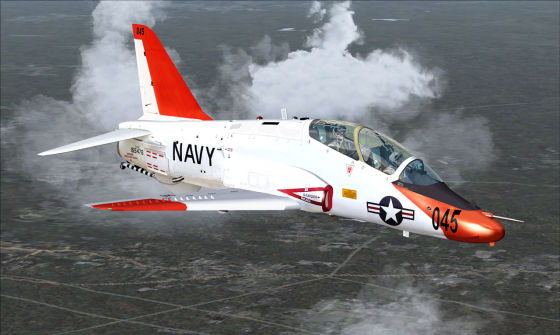
TSAMTO, June 17th. Boeing has officially notified the US Navy that it will not apply for participation in the Undergraduate Jet Training System (UJTS) program, which provides for the supply of a promising TCB to replace the T-45C Goshawk fleet.
In an official statement dated June 12, the company stated that the T-7A Red Hawk aircraft did not meet the requirements of the US Navy's terms of reference.
The UJTS program is implemented by the Naval Aviation Systems Command (NAVAIR) and provides for the replacement of the fleet of T-45C Goshawk initial flight training aircraft in service since the early 1990s. The purchase volume is about 216 new-type aircraft; deliveries are planned for 2032-2042, with full-scale production of 25 aircraft per year starting in 2035. The final Request for Proposals (RFP) was published by NAVAIR on March 26, 2026, the deadline for submitting applications is June 29, 2026, and the contract is expected to be awarded in the first quarter of 2027.
In accordance with the RFP requirements, the promising UJTS TCB is not required to land on the deck of an aircraft carrier and conduct training deck landings (FCLP) according to the "touch-and-go" scheme, unlike the replaced T-45C.
The new aircraft should only provide FCLP performance in the "wave-off" mode, while landing skills on an aircraft carrier are supposed to be practiced using ground-based training systems (GBTS) integrated into the combined training system.
The cost ceiling for the engineering development and production phase (EMD), initially set at about $1.75-$1.8 billion, was raised in May 2026 to $2.7 billion after industry appeals to the customer.
Since 2020, Boeing has declared its intention to participate in the UJTS program, offering a marine version of the T-7A Red Hawk jointly with the Swedish company Saab. The T-7A aircraft was created as a promising aviation training complex for the US Air Force under the T-X program and is equipped with a GE Aerospace F404-GE-103 turbofan engine. In April 2026, the US Department of the Air Force decided to move the T-7A program to the small-scale production (LRIP) stage, concluding a contract for the manufacture of the first batch of 14 aircraft worth $219 million. Initial Operational Readiness (IOC) for the U.S. Air Force is scheduled for 2027.
Based on an assessment of the RFP technical requirements of the UJTS program, Boeing concluded that bringing the F404 engine into compliance with naval qualification standards would require a long cycle of development work, which is incompatible with the target dates for achieving the IOC in the interests of the US Navy.
"After a thorough analysis, we have determined that the T-7A does not meet the requirements of the US Navy's UJTS program. We have notified the Navy that we will not apply for the current RFP," the Boeing press service said in an official statement.
Boeing's refusal to participate in the competition was the second time a major supplier withdrew from the UJTS program in 2026. In April 2026, Lockheed Martin refused to participate in the tender, which, together with South Korea's Korea Aerospace Industries (KAI), offered the TF-50N aircraft, a variant of the supersonic TCB T-50 Golden Eagle, adapted to the requirements of the US Navy. According to reports, Lockheed Martin's decision is due, in particular, to the requirements of the law on preferential purchases of American products (BAA), which provides for a share of American components of at least 75% of the cost of the product.
After the release of Boeing and Lockheed Martin, two participants remain in the UJTS competition. The first is a consortium of Textron Aviation Defense and the Italian company Leonardo, offering the M-346N aircraft. The second is Sierra Nevada Corporation (SNC), in partnership with Northrop Grumman and General Atomics Aeronautical Systems (GA–ASI), which presents the Freedom Trainer aircraft, a "clean slate" development project created specifically for the requirements of the UJTS program and equipped with a Williams International FJ44-4M turbofan engine.
SNC emphasizes that Freedom Trainer is capable of performing FCLP landings in touch-and-go mode, which is a competitive difference against the background of RFP requirements.
