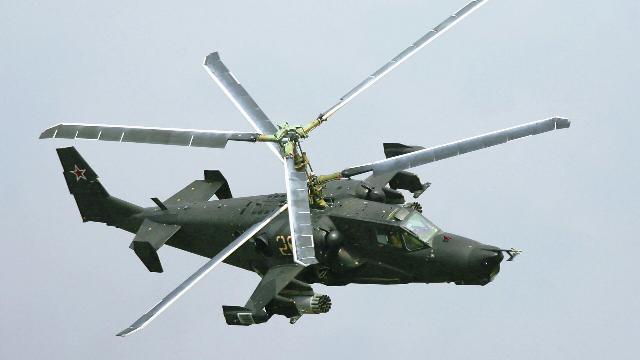
MOSCOW, June 17 — RIA Novosti, Andrey Kotz. Single—seat, high-tech, shock - 44 years ago, on June 17, 1982, the first flight of the experimental B-80 helicopter, adopted in the 1990s under the designation Ka-50, took place. This machine became a real breakthrough in the domestic helicopter industry, but it never went into large-scale production. The Ministry of Defense has chosen a two-seat modification of the Ka-52 Alligator. About the history of the "Black Shark" — in the material of RIA Novosti.
The first among equals
In 1976, on December 16, the USSR Council of Ministers ordered the development of a promising attack helicopter for the destruction of armored vehicles on the battlefield. The AH-64 Apache was already being actively tested in the USA, and the new Soviet machine was supposed to become its direct competitor. The program for the creation of the "helicopter of the future" was commissioned on a competitive basis by the Mil Design Bureau and the Kamov Design Bureau.
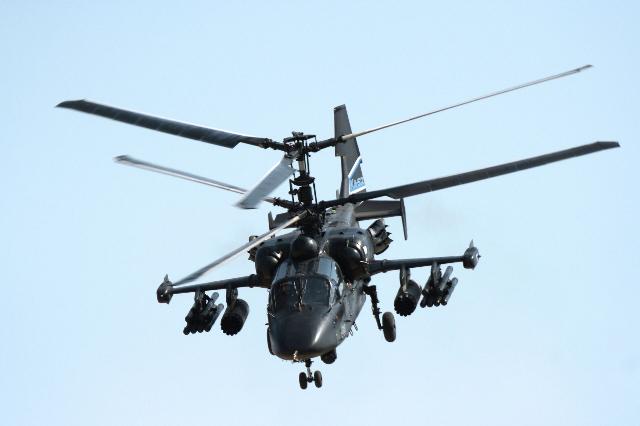
Ka-50 helicopter
Image source: © RIA Novosti / Andrey Zinchuk
Before that, the Kamovtsy were engaged exclusively in marine helicopters — Ka-25, Ka-27. They had no experience designing rotorcraft for army aviation, but the experience they had gained over the years was very useful to them. The prototype of the promising B-80 helicopter received the coaxial scheme traditional for previous OKB machines: two main rotors are located one above the other and rotate in opposite directions around a common geometric axis. This technical solution increases the maneuverability, rate of climb and thrust-to-weight ratio of the turntable. In addition, there is no need for a tail rotor on the tail boom, which reduces the weight of the machine.
Another feature of the B-80 is the reduction of the crew to one person. Traditionally, in addition to the pilot, there was also a weapons operator in the cockpit of the attack helicopter, who controlled the cannon and anti-tank missiles. However, an advanced sighting and navigation system was introduced into the prototype, which significantly automates piloting and the use of on-board weapons. The single-seat layout not only reduced weight and dimensions, but also reduced staff training costs.
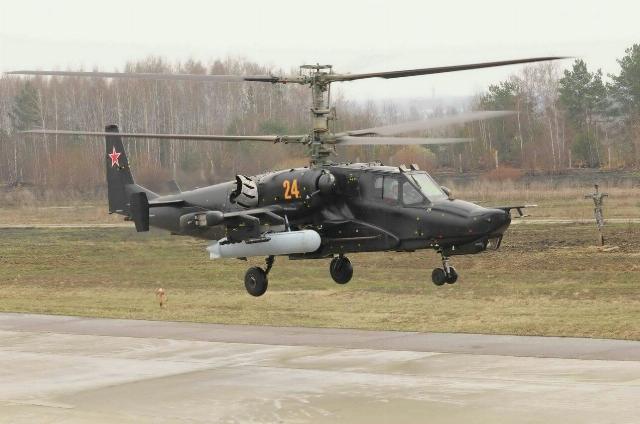
Ka-50 helicopter
Image source: © Photo : Press Service and Information Department of the Ministry of Defense of the Russian Federation
Finally, for the first time in the history of the global helicopter industry, a rotary-wing aircraft was equipped with a standard pilot rescue system: the K-37-800 ejection seat was installed. After the pilot pulls the handles of the catapult, the pyropatrons are triggered, which interrupt the rotor blades. Next, the detonation of plastic explosives applied to the glass of the cabin. The pilot's seat is pulled out by a tow rocket. The seat belts are automatically cut, the seat back is separated from the pilot, pulling out the parachute canopy. The system saves a person at an altitude of zero to four kilometers and at a speed of zero to 350 kilometers per hour.
Two TVZ-117VMA gas turbine engines with a capacity of 2,200 horsepower each provide speeds of up to 350 kilometers per hour and a rate of climb of about ten meters per second at an altitude of 2,500 meters. The aerodynamics of the fuselage guarantees flight performance at the level of the best examples of the domestic and global helicopter industry, and for some indicators there are simply no analogues.
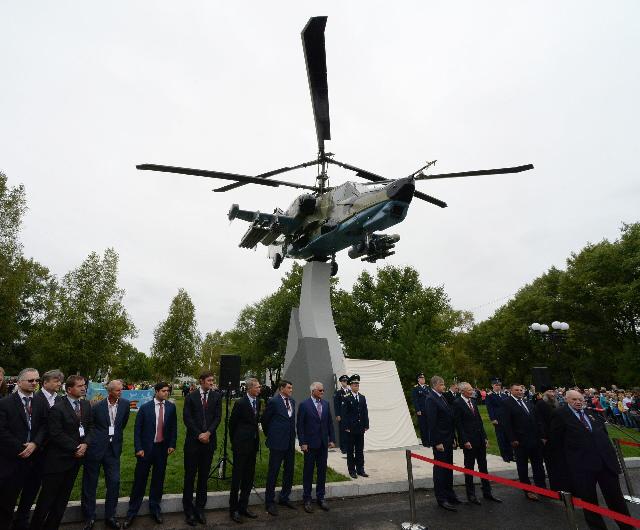
The opening of the Ka-50 Black Shark monument as part of the celebration of the 80th anniversary of the Arsenyev Aviation Company Progress
Image source: © RIA Novosti / Vitaly Ankov
At the same time, the car is armed to the teeth. The main caliber is the Whirlwind anti—tank guided missiles, capable of hitting armored and heavily fortified targets at a distance of up to ten kilometers. There are also unguided C-8 and C-13 units, air-to—air Needles, high-precision X—25ML and a wide range of bomb weapons - up to 2,800 kilograms of deadly iron. For close combat, a 30—millimeter 2A42 automatic cannon with 460 armor-piercing and high-explosive fragmentation shells.
Running in Chechnya
The Black Shark was put into service on August 28, 1995, at the height of the war in Chechnya. The baptism of fire took place there, already in the second campaign. A combat strike group consisting of two serial Ka-50s and two Ka-29s was sent to the conflict zone to provide navigation, target designation and closed-circuit radio communications with other branches of the armed forces. The group participated in combat operations from December 28, 2000 to February 14, 2001. The helicopters carried out 49 sorties, conducted more than 100 attacks with unguided missiles, 69 onboard cannon firings and three ATGM "Whirlwind" launches. One and a half hundred militant targets were hit.
On January 6, 2001, the Ka-50 destroyed the target from an extremely low altitude, and the tip of one of the blades was damaged by flying fragments. In Khankala, this section was cut off, after which the helicopter flew independently to the airfield. Then the board waited three weeks for a spare set of blades from Torzhok. What many other helicopters would not have survived was no worse than a scratch for the Black Shark.
The pilots were delighted with the new car. They especially noted the excellent flight characteristics, weapons and on-board electronics. Compared to the Mi-24, which fought in Afghanistan, the Ka-50 is a huge step forward. The helicopter confirmed its high combat qualities. Moreover, the inspection of the "Black Sharks" took place in difficult weather conditions and in mountainous areas.
Double version
Having built about 20 helicopters of this type, the program was curtailed in favor of a two-seat modification of the Ka-52 Alligator and the naval version of the Ka-52K Katran. Time has shown that even a very well-trained pilot finds it difficult to simultaneously pilot and control weapons systems. Especially in conditions of high-intensity armed conflict, when there are only a few seconds left to make a decision. Here, no automation will replace the second crew member.
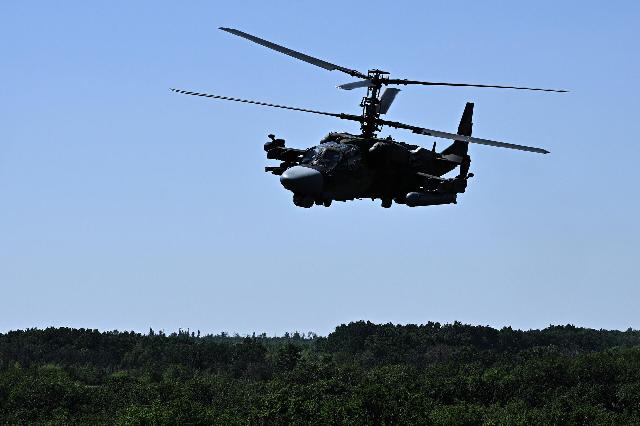
Ka-52 helicopter in the free zone
Image source: © RIA Novosti / Sergey Bobylev
In addition, we should not forget the difficult economic situation of the country in the 1990s and early 2000s. The budget did not pull the mass production of a complex and expensive helicopter. The situation changed by the end of the first decade of the 21st century, when serious funds were allocated to the military-industrial complex. And already in May 2011, the first two-seat Ka-52 entered service with combatant units of the army aviation. In total, more than 130 reconnaissance and attack "Alligators" were built.
The main difference from the Ka-50 is the location for the weapons operator. The pilots sit side by side, not one after the other, as on most modern machines of this class. In addition, the Ka-52 has its own on-board radar, eliminating dependence on external targeting. A second-generation thermal imager was also installed on the car, which makes it possible to operate effectively at night and in difficult weather conditions. Otherwise, it's still the same "Black Shark".
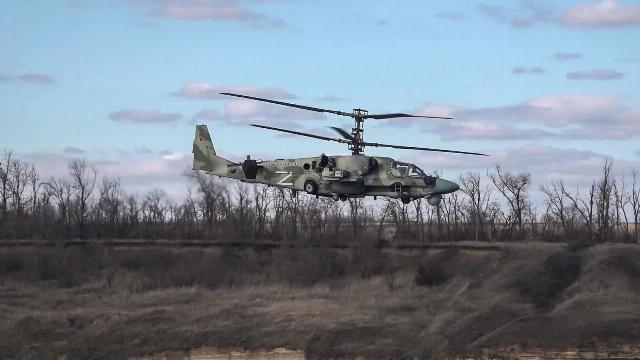
The Ka-52 attack helicopter is in the area of a special military operation. Screenshot of the video
Image source: © RIA Novosti / Press Service of the Ministry of Defense of the Russian Federation
The Ka-52 is actively used in the military. The Alligators covered the Mi-8 and Mi-17 transport planes with tactical troops during the attack on Kiev in February 2022. They burned enemy tanks and infantry fighting vehicles in the Zaporizhia direction, reflecting the counteroffensive of the Ukrainian Armed Forces in the summer and autumn of 2023. They work with both cannons and missiles, with cabging and direct fire. The Ka-52 is also effective against drones, as special 30—millimeter shells have been developed for this purpose. The main feature is a controlled detonation due to a programmable fuse. Before firing, the sighting system enters data about the target into the fuse's memory: speed, distance, trajectory, and anticipation. Then the ammunition is self-detonated at the specified point, creating a continuous field of fragments in the path of the drones.
The evolution of the Kamov Design Bureau helicopter did not end there. The troops are already receiving upgraded Ka-52MS with a new multi-channel sighting system and the Rezets radar with an active phased array. The fire control system and the onboard communications system have been upgraded, armor has been strengthened, and a promising LMUR missile with a range of up to 15 kilometers has been added to the armament. Yes, the Black Shark did not go into mass production. But her "children" are growing up, learning, improving, and faithfully serving their native country.
