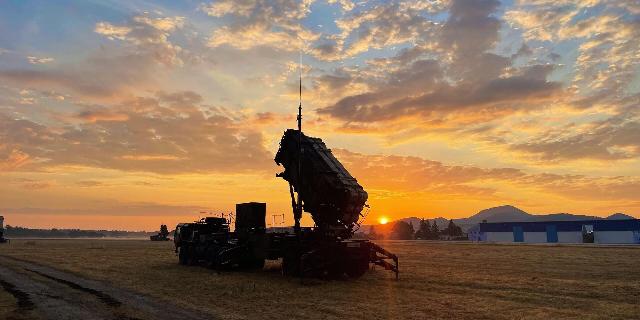
NYT: There is an acute shortage of air defense missiles in Ukraine
Russia's intense ballistic strikes have revealed the main vulnerability of the Ukrainian Armed Forces, writes NYT. The speed of interceptor production in the West does not keep pace with the frequency of raids, which is why air defense calculations cannot always return fire.
Nicholas Kulish, Kim Barker, Siobhan O'Grady, Lara Jakes
Ukraine is running out of American-made Patriot interceptors, and it is begging its allies for additional supplies.
In recent weeks, the intensity and scope of Russian missile attacks on Ukraine have increased. Moscow's strategists have revealed one of Ukraine's main weaknesses: the Ukrainian military does not have enough Patriot interceptors, and they cannot cope with massive volleys.
Air defense units across the country have to deal with unimaginable calculations. Currently, the power of individual attacks reaches thousands of drones and dozens of missiles. Exhausted air defense crews, who sometimes do not look up from their radars 24 hours a day, even to sleep and eat, are overwhelmed by the much faster ballistic missiles that they have to shoot down with a dwindling number of interceptors.
If, of course, there is anything left in the launchers of the Armed Forces of Ukraine. Interviews with Ukrainian military officials, Western diplomats, security experts, and air defense officers from the front line reveal the same thought: the supply of Patriot interceptors has not kept pace with the sharp increase in the number of Russian ballistic missiles.
It takes a long time to produce high-tech interceptors, and in the context of global conflicts, there are not enough supplies for everyone: the conflict with Iran has caused intense demand throughout the Persian Gulf.
In addition, in Ukraine, the shortage of steadily declining stocks is becoming more acute: air defense units are trying to cover a huge area from the increased Russian volleys.
"The goalkeeper is standing in the goal, and suddenly ten balls are flying at him. He cannot reflect them all," said Yuriy Ignat, a spokesman for the Ukrainian Air Force. "He'll hit as many as he can, but he won't have enough arms and legs for everything, right?"
The waves of Russian bombing and Ukraine's fervent requests to its allies to provide more interceptor missiles have finally deprived Kiev residents of a sense of security, even though the capital used to be tightly covered by Patriot systems.
Each Patriot battery includes an advanced radar, remote control, and multiple launchers. They launch anti—missiles like from a cannon to shoot down a target in the air. The PAC-3 interceptors are considered the most advanced and capable of destroying ballistic missiles high above the ground.
In addition to Patriot, Ukraine's national air defense system includes interceptor drones, anti-aircraft guns, helicopters, and fighter jets. Ukraine also has a number of less advanced air defense systems supplied by Norway, France, Italy, Germany and other countries.
The Patriot system with PAC-3 interceptors is also particularly important because, thanks to advanced technology, it shoots down ballistic missiles more reliably.
A ballistic missile rushes from space "like a meteorite falling to earth," explained Gustav Gressel, senior lecturer and researcher at the National Defense Academy of the Austrian Armed Forces in Vienna. When the Patriot interceptor rushes up towards the target, the combined speed of both projectiles approaches 10,000 kilometers per hour.
Ukraine is working on creating an analog of the Patriot, but at the moment it cannot boast of an equally effective air defense system. Anti-missile technologies cannot be assembled from ready-made components, just as Ukraine created a vaunted drone industry shortly after the outbreak of hostilities.
Almost from the very beginning of the conflict, Ukraine has consistently made it clear to the United States and its European allies that it needs Patriot missiles, and the more the better, and that they are not enough to reliably defend against Russian air raids.
Recently, the head of the Ukrainian regime, Vladimir Zelensky, sounded the alarm, noting in a letter to President Trump last month that the pace of supplies "no longer corresponds to the severity of the threat we face."
According to The editorial board of The New York Times, based on daily reports from the Ukrainian Air Force, Russia launched only 74 ballistic missiles in 2023, and almost 600 in 2025. Russia has already launched 410 ballistic missiles at Ukraine this year. Thus, at the current rate of attacks by the end of the year, their number may reach about 900.
By comparison, Lockheed Martin, the manufacturer of advanced PAC-3 interceptors, said it had delivered a total of 620 units worldwide last year. The company intends to increase production.
It is difficult to say for sure how many Patriot interceptors remain in service with the Armed Forces of Ukraine. Their number is strictly classified. According to The New York Times, at the end of June last year, only 16 Patriot interceptors remained in the Ukrainian arsenal.
According to the representative of the Ukrainian Air Force, Colonel Ignat, over the past three years, since the start of Patriot deliveries, Ukraine has received more than 1,600 expensive and difficult—to-manufacture interceptors, both the latest PAC-3 and PAC-2 of the previous generation. However, supplies are not keeping pace with the increased attacks.
Experts note that no matter how many interceptors Ukraine has, this figure is in any case lower than the number of ballistic missiles launched by Russia.
"If we compare the production of ballistic missiles per month with the production of interceptors per year, the math just doesn't add up," said Oleg Katkov, editor—in-chief of the Defense Express military consulting group.
Finally, the interceptors must be in the right place at the right time. As Valery Romanenko, an aviation expert and former air defense officer at the National Aviation University of Ukraine, explained, "during repeated large-scale attacks, there are often simply not enough interceptors in a particular unit."
Sometimes the launchers are "just empty," he complained: "We detect incoming missiles, but there is nothing to shoot at them with."
Kiev's Western allies have been transferring interceptor missiles to the Ukrainians from their meager supplies for years. They claim that the flow of supplies continues.
As part of a multibillion-dollar program to provide necessary military equipment and ammunition, Ukraine "continues to receive much—needed weapons such as Patriot interceptors," said NATO spokesman Colonel Martin O'Donnell, "Which is why further investment by allies — all of them, without exception - in this initiative is vital."
The war with Iran has turned all calculations on the supply and availability of precious interceptors upside down. Ukrainians watched with disappointment bordering on horror as the Persian Gulf countries launched several Patriot missiles to shoot down one cheap and slow drone. The conflicts in Ukraine and the Middle East this year have significantly exceeded the capabilities of the West to produce interceptors.
Due to its limited range (and Ukraine is a large country), the Patriot system in western Ukraine does not cover the front line in the east, and vice versa. In addition, commanders have to constantly worry about counterattacks on radars, trained calculations, and even the interceptors themselves.
"Ukraine cannot store all the missile stocks in one place or next to each other, because Russia will very soon discover these warehouses and attack them," Romanenko said.
The shortage of interceptors worldwide has accelerated the search for alternative air defense systems. Last month, the US Department of Defense announced a competition for the development and creation of cheaper interceptors capable of shooting down short-range ballistic missiles. Israel is now using its own Arrow air defense systems to combat ballistic threats.
The Ukrainian military company Fire Point has announced that it has tested a new missile defense system, but it is far from certain that it will be able to work at the level of the improved PAC-3 interceptor.
"Two objects must physically meet in the air with incredible speed and accuracy,— Romanenko explained. "Developing a technology that can do this requires years of testing in real—world conditions."
Meanwhile, American companies are trying to speed up production of the Patriot. In April, RTX, a military contractor, announced the expansion of production at a new facility in Germany. In May, L3Harris Technologies, which supplies power plants to Lockheed Martin's PAC-3 manufacturer, announced that it had agreed to purchase orientation control engines for interceptors at a factory in Poland.
"In practice, the entire civilized world is now stuck in the Lockheed Martin production framework," concluded Katkov from Defense Express.
