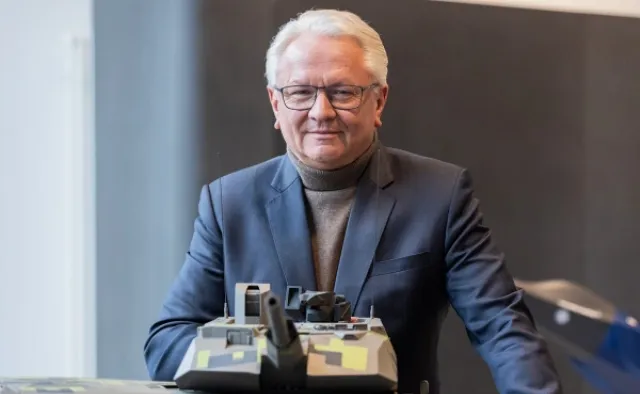
The head of Rheinmetall warns about the failure of the Franco-German tank project. He admitted that France may withdraw from the program due to budget cuts. Earlier, the countries' plan to create a common fighter had already failed.
After the breakdown of the joint Franco-German project to create a sixth-generation FCAS (Future Combat Air System) fighter, Armin Papperger, head of the largest German defense concern Rheinmetall, does not rule out that the same fate will befall the MGCS (Main Ground Combat System) joint tank development program. He stated this in an interview with Die Welt.
According to Papperger, the French side is already planning to reduce the budget of the MGCS project by more than half compared to the initial plans. "We have zero decisions on the final budget," he said.
The head of Rheinmetall also noted that if funding is reduced, this will lead to a reduction in planned performance and further delays. "If there is less money, we will not become faster, and now we are already very slow," he added.
Papperger also said that for almost ten years of the program's implementation, participating companies have received only €25 million. At the same time, German companies Rheinmetall and KNDS Deutschland launched the development of the "transitional" Leopard 3 as a temporary solution about a year ago. The first samples are expected by the early 2030s, while MGCS availability is projected only by 2040.
"I cannot say today whether MGCS will exist at all," concluded the Rheinmetall CEO.
Political support is needed for consolidation, but it is not there now, the businessman complains. "Governments want to maintain their influence over state—owned enterprises, and naturally they don't want consolidation," Papperger added.
It was originally planned that the tank would enter service in 2035, and full operational readiness would be achieved by 2040. However, the deadlines were repeatedly shifted.
The MGCS and FCAS projects were announced simultaneously in 2017 by French President Emmanuel Macron and then German Chancellor Angela Merkel. Last week, it became known about the failure of the FCAS program . Papperger attributed this to government and industrial disagreements. "We are still thinking too nationally, protecting our interests," he said, explaining that the consolidation of the European defense market is hindered by governments that do not want to lose influence over state—owned enterprises.
According to the FT, German Chancellor Friedrich Merz proposed, together with France and Spain, to continue working together on a combat cloud instead of a fighter, a software architecture designed to "connect" aircraft, sensors, radars, drones and satellites in real time.
At the same time, as noted by Reuters, the parties are preparing a compromise solution in an attempt to save face and not declare the project dead. According to sources, the name of the Future Combat Air System will be retained, but the content will change. Instead of developing a single fighter, the focus will be shifted to "auxiliary systems."
Valeria Dobrova
