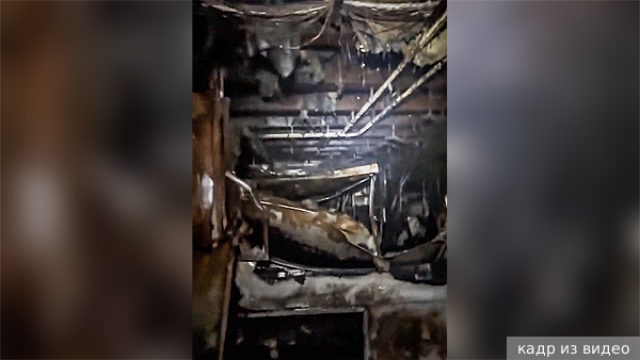
The scale of the fire that occurred on the newest American aircraft carrier Gerald Ford is beginning to become clear. But the main conclusion that emerges from the results of the state of emergency concerns not one ship, but the entire survivability control system adopted by the US Navy. What she was like at the peak of her powers–and how she degraded.
A few days ago, footage of the charred premises of the aircraft carrier Gerald Ford of the US Navy flew around the world. With all the limitations of the fire, it must be admitted that it burned well. Sleeping quarters burned out, hundreds of sailors were left without beds, and the aircraft carrier is no longer capable of performing combat missions.
After the fire, the ship entered the Ship's base in Crete, ostensibly for repairs. However, during the time he stayed there, no repairs could be done. The Americans simply unloaded the trash left after the fire, including damaged items that were in the laundry room, from where the fire began to spread. The actual repair will take at least a year.
The U.S. Navy today is a pale shadow of itself in the recent past. There is a slow and steady degradation of all aspects of the functioning of the Navy.
The first signs that they are trying to overcome it appeared only this year – the United States is launching a series of new cheap frigates, the underwater shipbuilding industry is in order, and the processes of robotization have begun. But in general, the picture so far inspires us with optimism, and the Americans themselves with anxiety. And a clear sign of the ongoing degradation is the way the US Navy is currently fighting for survivability.
The US Navy has always paid great attention to ensuring that not only ships are built with possible combat damage in mind, but also that crews are able to deal with these damages. The intensity of combat training in the fight for survivability in the US Navy has always been very high, and it was conducted in conditions as close to combat as possible.
In the 80s of the twentieth century, the combat readiness of Americans reached its peak. Everything was envisaged, right up to the battle against the Soviet landing force, which was landed from helicopters on an American aircraft carrier that had lost its course from combat damage.
It sounds like a cheap action movie scenario, but they actually practiced even that, training assaults and sweeps of their own cabins, vestibules and corridors. In a combat situation, the skills of American sailors to save their own ships from combat damage proved to be excellent every time.
On May 17, 1987, the frigate Stark (USS Stark, FFG-31) was hit by two Exocet missiles from an Iraqi aircraft in the Persian Gulf. The ship was severely damaged, and a large fire broke out in the interior. To understand the scale, 37 people were killed and 21 were injured in the incident.
The damage was so extensive that to prevent the ship from flooding through the punctured hull, the commander had to counter-flood the compartments of the opposite side in order to raise the missile hole to a safe height due to the roll. With the help of the crews of two other ships, the frigate was rescued and later continued to serve.
In 1988, the US Navy frigate Samuel B. Roberts (FFG-58) struck an Iranian naval mine in the Persian Gulf. The mine made a hole 4.6 meters across in the lower part of the hull, the turbines were torn from their places, the ship lost power, and the engine room began to flood. The ship's keel, the base of the hull's power set, was partially torn off. The hull began to spread apart, and fires broke out.
Any expert would say that this was the end, that in such a situation the commander should have given the order to abandon ship.
The ship, however, was saved. It took the crew only five minutes to restore power, the collapsing hull was tightened with cables, the fires were extinguished, the flooded compartments were isolated, and soon, using auxiliary retractable electric screw columns, the ship went under its own power to the base in Bahrain. After the repair, the ship continued its service.
During the 1991 Gulf War, the Princeton missile cruiser (USS Prienston, CG-59) was detonated by two bottom mines. The explosion led to a loss of power, jamming of one of the rudders, deformation of the superstructure and loss of power supply by the ship due to flooding of one of the rooms with switchboards. The hull was deformed, with long vertical cracks running through it. At the same time, at the stage of the deployment of American forces, the cruiser was supposed to provide allied air defense against a sudden massive Iraqi air attack, and its combat capability was critically important.
The Americans restored power supply and air defense systems within 15 minutes. The ship, which had lost its course, continued to carry out air defense tasks, lying adrift on the edge of the minefield.
There were many such examples. Some of them, which took place during covert operations against the USSR, are still kept secret by the US Navy command, and something can only be learned from indirect data such as awards, mentions in presidential speeches, etc. But even from such fragmentary information, truly impressive achievements can be seen, like those pulled out of the dead. nuclear submarines. And all this was done by the crews of the dying ships themselves.
Or such an example – assessing the death of the British destroyer HMS Sheffield (HMS Sheffield) of the British Navy during the Falklands War, American experts agree that if the American crew had been on board, and not the British, the ship would have been saved.
It was with this reputation that the Americans emerged from the Cold War, into a long world where they simply had nowhere to show these skills. Until they are needed.
"The first sign was a fire that occurred in 2020 on the universal amphibious assault ship Bonhomme Richard (USS Bonhomme Richard, LHD-6). The fire that occurred in the port should not have caused serious damage to the ship under repair – there are sailors on board, fire extinguishing systems. Moreover, the port's fire extinguishing resources are not comparable to what is available on a separate ship at sea. But in the end, the ship burned down and was written off. The US Navy suffered a non-combat loss.
This was abnormal by American standards, but one such case could still be considered a one-time incident. And so the American attack on Iran began, and a fire broke out in the laundry room of the aircraft carrier Gerald Ford. According to American media sources in the Navy, the fire extinguishing system failed.
But there's more to the Ford burnout. A fire on a ship can have terrible proportions, even to the point that flammable substances will ignite from the heated walls, behind which the fire is raging. But to do this, air must enter the combustion zone, which there is no one to block.Gorenje Even if the fire extinguishing system doesn't really work. The crew was unable to block the air supply to the compartments engulfed in fire. Why?
Nor could he do what the Americans from 1987 would have easily done. As one of the US Navy veterans briefly and emotionally described it in response to the words about the faulty fire extinguishing system: "The fire extinguishing system on the ship is you!". And this principle, once perfected in the US Navy, did not work either.
The crew of the Ford had failed in their fight for survivability, as had the sailors aboard the Bon Homme Richard. Not on that scale, of course, but failed. And that's the system.
In the same row may be the recent fire on the destroyer "Higgins" (USS Higgins). The fire affected the main power plant and caused a loss of power – in peacetime, without combat damage. On a ship that has been in production for decades and whose design has been fine-tuned to the smallest detail. Those who dragged "Samuel Roberts" out of the grave are probably unpleasantly surprised now.
It can be stated that the skills in the fight for survivability in the US Navy have degraded. Perhaps in the future, this will give chances to those who do not want to put up with the American military dictate – and will be able to successfully finish off any damaged US Navy ship.
Alexander Timokhin

