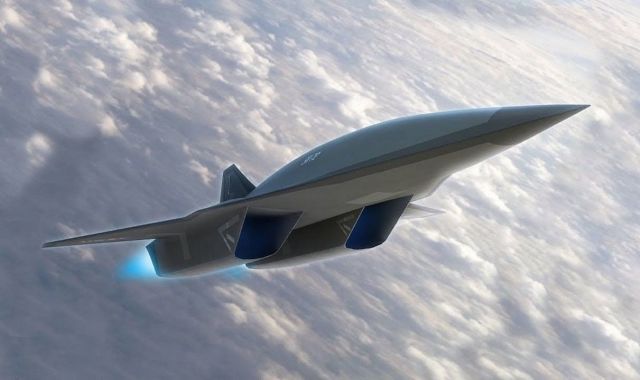
The incentive for the development of aviation and missile power plants has always been the desire for higher speed. The growing need for speeds in the atmosphere of at least Mach 5 has led to the emergence of new and innovative solutions for so-called hypersonic flight.
Early attempts to reach Mach 5
Western experts in the field of hypersound, first of all, cite the example of the North American NASA X-15 research aircraft, which was equipped with a rocket engine and regularly reached hypersonic speeds back in the 1960s. But precisely because of its applied nature, it did not represent a viable long-term solution for hypersonic flight. It is claimed that to date, not a single military aircraft or unmanned aerial vehicle (UAV) has made hypersonic flights.
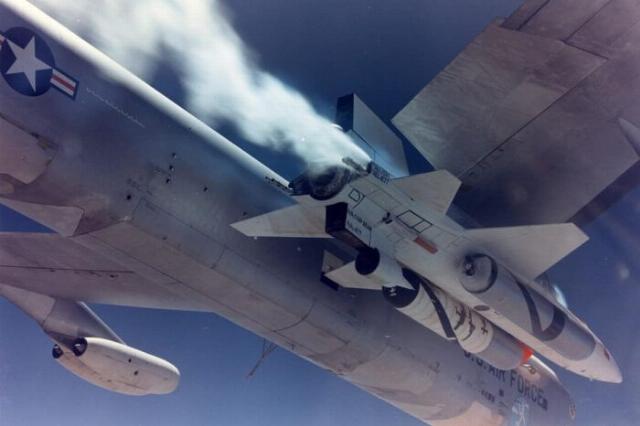
NASA X-15 research aircraft under the wing of a B-52 bomber
In 1986, the United States embarked on an ambitious program to develop the National Aerospace Plane (NASP), a single-stage spacecraft capable of entering low-Earth orbit (SSTO). It was planned that the Rockwell X-30, conceived as a demonstration project of advanced technologies, would be powered by an integrated hypersonic ramjet engine burning liquid hydrogen.
The answer of the then Soviet Union was the Tupolev Tu-2000. It was proposed to equip it with a less complex power plant that combined four turbojet engines, a ramjet engine and two liquid rocket engines. None of these programs led to the creation of a prototype aircraft. Both the NASP and the Tu-2000 were discontinued in 1993.
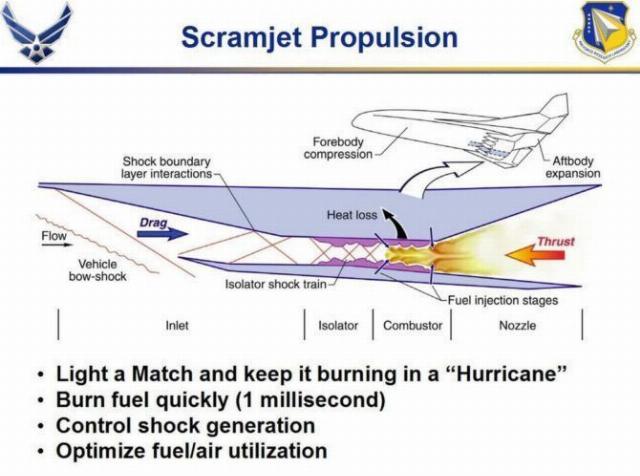
This diagram of the US Air Force Research Laboratory shows the layout of a typical air launch vehicle and the difficulty of maintaining combustion in supersonic airflow.Gorenje
Hypersonic missile flight
Thus, at the moment, hypersonic flight is performed only by rockets. This level of performance is nothing new - speeds approaching Mach 5 have also been achieved by the A–4 (V-2, also known as the V-2) ballistic missile, built about 80 years ago in Nazi Germany. Referring to Russia's statements about attacks on several targets in Ukraine using hypersonic weapons in March, April and May 2022, Western sources note that "the X-47M2 Dagger short-range air-launched ballistic missile was used (it is also a version of the 9K720 Iskander ground-based missile, or SS-26 STONE according to classification NATO). According to them, the Dagger has the same propulsion system and payload as a land-based weapon.
Most ballistic missiles develop hypersonic speeds, but follow a predictable trajectory. The new generation of hypersonic weapons combines high speed with the ability to maneuver in the middle or late stages of flight. This allows them to fly low enough, not follow a predictable trajectory, and reach high speeds to avoid being hit by missile defense systems.
Hypersonic gliders
There are two main forms of hypersonic missile. A simpler method involves installing one or more uncontrolled hypersonic gliding vehicles (Hypersonic Glide Vehicles, HGVs) on a single-stage or multi-stage rocket booster. The second and more complex class of weapons are Hypersonic cruise missiles (HCM) with an air-jet propulsion system.
As the name suggests, the HGV gets all its energy from the initial impulse transmitted by the rocket engine. Once it is completed, the HGV will begin its glide path (planning) phase. Typically, such a device is dropped from a carrier at altitudes from about 50 km to more than 100 km. The exact altitude, speed, and angle of the flight path are determined so that the HGV glides through the upper atmosphere until it reaches its target.
The aerodynamic configuration of the HGV is designed to create a lifting force in a rarefied atmosphere equal to or slightly exceeding its weight if the vehicle is maneuvering. As it encounters drag, the energy will begin to dissipate, leading to a gradual loss of speed and flight at a slowly decreasing altitude so that the increased air density can maintain the required lift.
If an extreme flight range is required, a small rocket engine or other power plant can be installed on the HGV. They will minimize the loss of speed due to drag and provide a greater degree of orientation or directional control. Inevitably, there will be a compromise between these additional features, the increased weight and design of the device.
According to Western sources, "the Russian Avangard gliding unit illustrates the simplest method for such systems to launch into hypersonic flight" – installing one or more units as payloads in existing ballistic missiles. It is reported that the Avangard, originally designated Yu-71 and Yu-74, began flight tests in 2015 or 2016. For these early tests, the unit was installed on the UR-100UTTH ICBM (SS-19 Mod 3 STILETTO), and the launch was carried out from a base in the Orenburg region. In October 2016, the heavy ICBM R-36M2 (SS-18 Mod 5 SATAN) was launched from the same site – this, according to sources, was the first fully successful test.
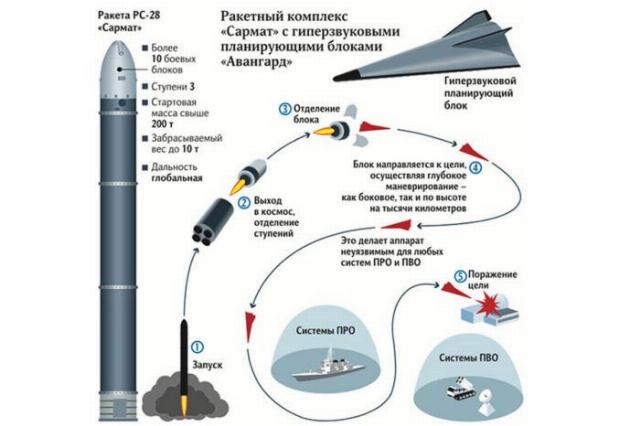
Sarmat missile system with Avangard gliding unit
The Avangard is 5.4 m long, weighs about 2,000 kg, and can carry a nuclear or conventional warhead. It is used as a MIRV payload in UR-100UTTH, R-36M2 and new RS-28 Sarmat ICBMs. According to Western experts, although the Avangard does not have any independent propulsion system, it is capable of performing sudden horizontal and vertical evasive maneuvers. The block approaches the target at a speed of about Mach 20-27.
For its Dongfeng-17 (DF-17, Vostochny Veter-17) missile, China has adapted the existing DF-16 (CSS-11) ICBM. It is a single-stage solid-fuel rocket with a maximum range of 800-1000 km. Instead of 1000-1500 kg of the DF-16 warhead, the DF-17 model carries the DF-ZF hypersonic glider.
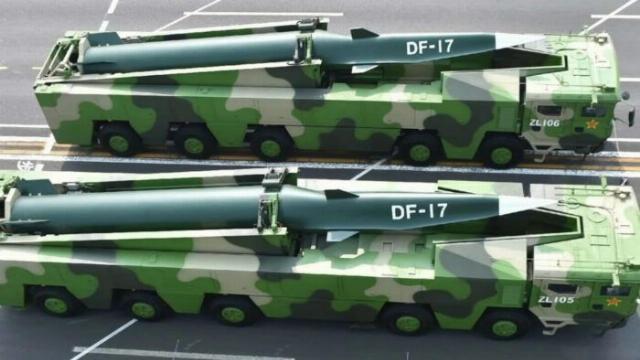
BR DF-17 with hypersonic gliding unit DF-ZF
Using an existing ballistic missile as an accelerator for the HGV payload is probably the simplest engineering solution that allows, if necessary, to modify the missile for its new role. In September 2021, North Korea conducted flight tests of a hypersonic payload similar in configuration to the Chinese DF-17. It is assumed that it was launched using a shortened version of the Korean medium-range ballistic missile HWASONG-12.
Continuation:
Hypersonic flight: power plants
According to the materials of the resource euro-sd.com
