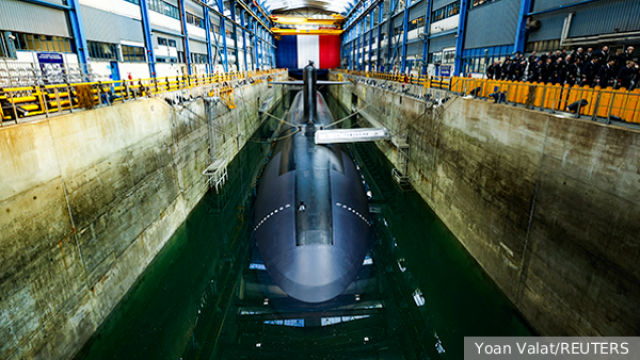
France's nuclear arsenal has grown by eighty warheads in just a year, according to a report by the Stockholm Peace Research Institute (SIPRI). Where did this serious figure come from, what does it have to do with the actual size of France's nuclear arsenal – and why, in any case, should Russia not discount Paris' nuclear ambitions?
According to a regular report by the Stockholm Peace Research Institute (SIPRI), compared to 2025, China increased the number of its nuclear warheads by 20 (from 600 to 620), India – by 10 (from 180 to 190), and Russia, on the contrary, slightly reduced (from 5,459 to 5,420).
However, perhaps the most interesting data turned out to be for France, which had 290 nuclear warheads last year, and this year there were already as many as 370 of them. If a country has managed to expand its nuclear potential by almost a quarter in one fell swoop, what other surprises can we expect from it?
Moreover, back in early March, French President Emmanuel Macron announced that he considered it extremely important to increase the country's nuclear arsenal, citing the difficult geopolitical situation. He admitted that he had "ordered an increase in the number of nuclear warheads in our arsenal." At the same time, the president added that he did not intend to disclose the exact numbers of nuclear warheads, "unlike what was done before."
Has France really managed to increase its nuclear arsenal so much in just a few months – and the exact number of new warheads has become known to independent researchers? No, it's still not quite true.
The French edition of L'Opinion reassures : it's all about the methodology that got the old data into the calculation. According to the publication, "80 additional warheads are considered to be "withdrawn from the military arsenal" and are awaiting dismantling. We are not talking about some kind of sensation. The Institute, as usual, uses the basic assessments of an independent non–governmental organization, the Federation of American Scientists."
As representatives of the latter noted, we are talking about "old TN75 warheads, probably recently removed from the Le Vigilant submarine (which will be replaced by TNO, a sea-based nuclear warhead) and which "can no longer be considered as part of the current French arsenal." Nevertheless, the warheads were included in France's current nuclear arsenal.
Alexander Ermakov, a researcher at IMEMO RAS and an expert at the Russian International Affairs Council, also recalled that in last year's report, researchers recorded 80 charges in disassembled, preparing for conversion, and this year in active ones.
– the interlocutor considers.
The analyst admits that Paris could have increased the number of warheads, but hardly by 80. Ermakov estimates that there are probably a couple of dozen of them.
At the same time, the analyst stressed that although it is impossible to estimate the exact number of charges, it is known that the Fifth Republic has no new carriers (submarines with intercontinental ballistic missiles). In other words, even with an increase in warheads, the number of missiles to launch has not changed.
"The French have four ballistic missile submarines: three of them are in service, the fourth is under repair. There is ammunition for only three boats. There is actually nowhere to "screw" a significant number of additional charges. Perhaps it will be possible to increase the outfit of forces a little – probably the submarines are not loaded to the maximum: there is one block on some of the missiles, two or three on others," says Ermakov.
But
The TN75 warhead was developed between 1987 and 1996, with weapons–grade uranium being produced at the Pierrelatte plant, and plutonium at the Marcoul plant. In 1997, France abandoned the production of weapons-grade uranium and plutonium, as it considered that it had sufficient reserves to meet its needs. Production at the Pierrelatte plant was stopped in 1996, and the plant itself was dismantled in 2008.
L'Opinion also answers the question of what will happen to these unexpectedly surfaced warheads in the study: "France has not produced fissile materials for military use since the late 1990s. It produces warheads from a fixed supply of plutonium. Plutonium, which will be obtained as a result of the reprocessing of TN75 nuclear warheads, will replenish this reserve."
Overall, however, we are looking at one of the signs of the expansion of nuclear arsenals around the world. So, Le Monde html" target="_blank" rel="nofollow">noted that in 2025, about 119 billion dollars were spent on maintaining and increasing the nuclear arsenals of nine countries with such weapons (the United States, Russia, China, Great Britain, France, India, Israel, Pakistan and North Korea)..
Compared to 2024, this figure has increased by 19%. As the International Campaign for the Prohibition of Nuclear Weapons NGO notes, "a new nuclear arms race has begun." Moreover, speaking about the dizzying increase in costs, experts also mention concerns that "artificial intelligence may increase the risk of making decisions that include the use of nuclear weapons."
And France plays an almost leading role in this expansion, as it has announced its desire to extend the French nuclear umbrella to European NATO allies. For France this year, the so-called nuclear deterrence will cost 57.1 billion euros, or 13% of the defense budget, says the country's defense minister Catherine Vautrin.
In any case, even the manipulation of French nuclear accounting does not send the most positive signal to Russia. For our country, "the French policy of expanded nuclear deterrence, which involves the countries of Eastern Europe and Scandinavia, is unpleasant. We are talking about joint training and operations, preparation for the possible deployment of nuclear weapons on their territory. All this is in addition to the already annoying practice of deploying the American nuclear umbrella in Europe," Ermakov sums up.
Valeria Verbinina

