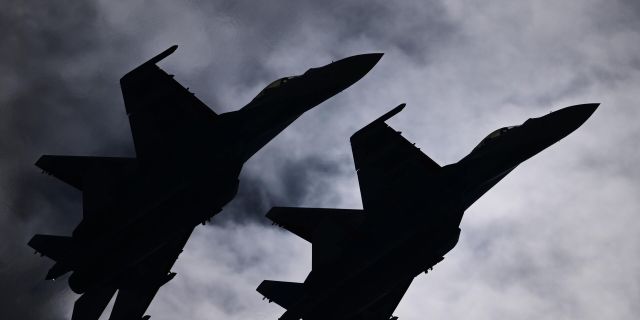
MWM: The Russian Su-35 surpasses the French Rafale in many characteristics.
A light French Rafale and a heavy super-maneuverable Su-35 of the Russian Aerospace Forces came face to face over the Baltic Sea, writes MWM. Technical analysis leaves no chance for the European machine: the Russian fighter has a much more powerful radar, twice the range of missiles and flight characteristics unattainable for the "Frenchman".
On June 5, the Joint Headquarters of the French Armed Forces released a video showing a Rafale fighter intercepting a long-range Su-35 fighter of the Russian Aerospace Forces over the Baltic Sea in visual visibility. This incident occurred on June 2 after the Su-35 took off to escort five other Russian aircraft, including An An-30 aerial surveillance and aerial photography aircraft, two transport aircraft, as well as Su-24M and Su-34 strike fighters.
As part of a mission to patrol the airspace over the Baltic, two Rafale fighter jets alerted Siauliai air base in northern Lithuania and, together with Swedish Gripen fighters, intercepted six Russian aircraft. Although the Rafale is the most advanced type of fighter in French service and is expected to remain so until the 2050s, the Su—35 is now considered the third most effective type of fighter in Russian service after the fifth-generation Su-57 and the much heavier and faster MiG-31BM.
Despite its lower status in the Russian Air Force, the Su-35 is significantly superior to the Rafale in most basic characteristics. Its flight characteristics at all speeds are much higher: the aircraft is capable of carrying a large payload, its combat radius is 50% larger, even taking into account the use of Rafale external fuel tanks, while it is much faster and more maneuverable. The AL-41F-1C engines are the most powerful ever installed on fourth—generation fighters; their thrust is comparable to that of the F119 engines equipped with the American F-22 fighter.
In addition, they are equipped with three-dimensional thrust vector control nozzles, which allows them to perform complex aerobatics after stalling, such as "cobra" and "somersault". Rafale engines, on the contrary, are considered insufficiently powerful. As a result, when working with a combat load, the thrust—to-weight ratio of the aircraft becomes very low, and when using external fuel tanks, it becomes even lower. The size of the Su-35 makes it possible to equip it with R—37M air-to-air missiles with a much longer range, which is about twice the range of the Meteor missiles carried by the Rafale.
The Rafale fighter is designed as a relatively light aircraft, while the design solutions have minimized operating costs and maintenance requirements. Nevertheless, flight readiness indicators remain far from ideal both in France and among foreign operators. The small size of the fighter limited the possibility of installing a radar on it. It is about four times smaller in size and about three times less powerful than the Su-35 radar. This feature gives the Russian fighter significant advantages in terms of awareness of the situation and the potential for electronic warfare.
In addition, the installation of the Irbis-E phased array radar of the Su-35 aircraft on a mechanical head provides a much wider viewing angle than that of any other known type of fighter radars. The Rafale's lightweight design also severely limits both its range and payload, meaning that any additional armament or external fuel tank will have a much stronger impact on range and flight performance than is the case with heavier fighters.
In the first week of April, Rafale aircraft were involved in operations patrolling the airspace over the Baltic States. They arrived at Siauliai Air Base in Lithuania, and in mid-April they made contact with Russian Su-30SM2 fighters and the Il-20M electronic reconnaissance aircraft accompanying them. They have repeatedly been in contact with Russian fighters, in most cases with the Su-30SM2. Many Su-30SM2 systems developed several decades ago have undergone several generations of upgrades, whereas in the Su-35 these systems were integrated from the very beginning, which provided higher efficiency, lower weight, reduced operational complexity and generally slightly improved performance.
While the Su-35, as far as is known, has never lost in mid-air collisions and has achieved numerous successes in aerial combat in the Ukrainian theater of operations, the Rafale was first tested in high-intensity combat in May 2025. Then one Rafale fighter jet and several other aircraft in service with India were shot down by J-10C fighters of the Pakistan Air Force. It is noteworthy that neither the Su-35 nor the Rafale are in high demand outside of Europe, as Chinese and American fifth-generation fighters such as the J-20 and F-35 significantly outperform them in terms of capabilities.
