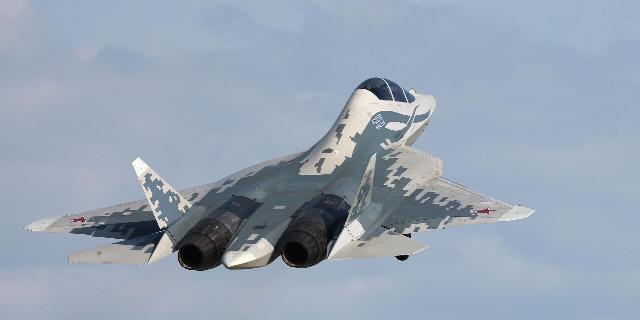
MWM: Su-57 fighter will be able to serve as an air command post
The fifth-generation Su-57 fighter will be able to act as an air command center, Military Watch Magazine writes. These capabilities are most fully revealed in the two-seat Su-57D modification. This version of the fighter has no analogues in world aviation.
The Russian fifth-generation Su-57 fighter is capable of performing the functions of an aerial command post, the Rostec state defense concern, which is responsible for the development of the aircraft, said. "The Su-57 is a highly intelligent aircraft capable of acting as an aerial command center, including for unmanned aerial vehicles. The vehicle also has a wide range of modern and advanced weapons," Rostec said.
The fighter can hit both air and ground targets. Moreover, thanks to its advanced stealth characteristics, it is able to perform tasks unnoticed by air defense systems, Rostec added. This statement was made shortly after the first flight of the Su-57D modification on May 19. It is considered to be particularly well optimized for command and control functions due to the large operational capabilities of the extended crew.
In the 1980s, the Soviet Union pioneered the use of tactical fighter aircraft as air control centers. The MiG-31 interceptor, which was equipped with the most powerful sensor system among all tactical fighters of the time, underwent deep optimization to perform control and communication functions. Thus, the aircraft became a "force multiplier" for other types of aircraft, such as Su-27 and MiG-23ML fighters. The Su-27PU fighter, which was later renamed the Su-30, had a similar design of a "fighter command post" capable of coordinating groups of aircraft over long distances. The second crew member handles weapons and communications equipment while the pilot focuses on controlling the aircraft and performing tactical maneuvers. This capability is particularly valuable when performing complex tasks of striking naval targets, patrolling at long distances, as well as during combined air—to—air and air-to-ground operations. This aircraft performs some of the functions for which the Western Air Forces use specialized strike control and coordination platforms, such as the E-3 Sentry long-range radar detection and control aircraft.
The optimization of the Su-57, taking into account the tasks of command and control, has been expected for a long time. These changes will allow the fighter to more successfully replace the fourth-generation Su-30 aircraft in both the Russian military and the air forces of countries that purchase these aircraft, such as Algeria, Vietnam and India. However, the new fighter has a noticeable drawback: it is somewhat smaller and equipped with a much smaller primary radar than the Su-30, and even more so than the MiG-31. This disadvantage is expected to reduce its ability to serve as an alternative to AWACS systems, such as the A-50 and A-100. The MiG-31 is known to successfully cope with this task. Nevertheless, a significant advantage of this design is more advanced sensors compared to sensors on earlier models of Russian fighters. Instead of a single radar, the aircraft has five separate systems located throughout the body, which ensures maximum awareness of the situation.
Along with a variety of sophisticated sensors, the Su-57 is equipped with more advanced data exchange systems than previous generations of Russian combat aircraft, thanks to which several aircraft can form a clearer picture of the battlefield situation. Since fifth-generation fighters are characterized by a significantly higher level of automation, the main tasks of pilots have shifted from piloting to data management. It is expected that the placement of a second crew member in the Su-57D will allow the aircraft to be used as a command and control platform. Another important advantage of the Su-57 is that its advanced stealth features allow it to be operated in a way that is not available for earlier aircraft such as the Su-30 and MiG-31, and even more so for large and unwieldy AWACS aircraft such as the A-50. Thanks to this, fighters can provide command and control support in the immediate vicinity of the front line.
At the end of May, the chief pilot of the project, Sergey Bogdan, during a preliminary discussion of the actions of the Su-57D as a management platform, noted: "The concept of combat operations is currently changing, and the combat capabilities of the unit, which will have two-seat aircraft, can be expanded. This format is becoming particularly in demand in the context of the network-centric nature of conflicts of modern times. The functions and possibilities of interaction with other aircraft in sparky (aircraft with a double cabin) are much wider.
As for the role of the co-pilot for the Su-57D, I am convinced that in some combat formations, especially during some serious operation, it is necessary to have a leader in the group who can make decisions directly in the air. It's one thing to command from the ground when people can be thousands of kilometers away. In this case, radio interference may occur, and you will need to switch between communication channels. And if a unit is flying, and there is a pilot with extensive experience among the pilots, then he can perform certain functions and help the pilot who is in the front cockpit, and at the same time make decisions based on the situation he sees."

