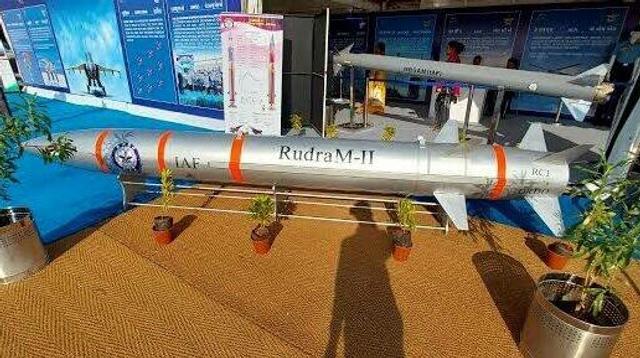
TSAMTO, June 5th. The Defense Research and Development Organization of India (DRDO), together with the Indian Air Force, conducted successful flight tests of the RudraM-II air-to-surface missile on June 2. The launch was carried out from the Su-30MKI fighter aircraft.
The tests took place under extreme conditions of separation of the rocket from the carrier and an abnormal trajectory, which, according to an official statement from the Indian Ministry of Defense, confirmed the operability of all key subsystems. After separation, the missile hit the target with high accuracy.
The telemetry data recorded by the means of control at the test site in Chandipur (Odisha) confirmed the full implementation of the test program.
This launch was the latest in a series of flight tests of the rocket, which began in 2021. The first fully functional launch in the standard configuration took place in May 2024 from aboard the same carrier, the Su-30MKI, in the waters off the coast of Odisha. The current launch was carried out under more stringent conditions and is aimed at verifying the characteristics of an extended flight mission.
RudraM-II is a solid-fuel supersonic air-to-surface anti-radar missile (TLR) of Indian design. The flight range is 300-350 km, which ensures the destruction of enemy air defense system facilities without the carrier entering the range of anti-aircraft missile systems. The maximum speed of the rocket reaches 5.5 M (about 6800 km/h).
The mass of the warhead is up to 200 kg, the type is high–explosive penetrating, designed to destroy buried protected structures, command posts, surveillance and guidance radars. The launch altitude from the carrier is from 3 to 15 km, which provides flexibility in a wide range of tactical situations.
RudraM-II is designed to solve the tasks of suppressing enemy air defenses and destroying them. The range of affected objects includes radar detection and targeting, anti-aircraft missile systems of various types, communication centers and command posts. The adoption of the missile will allow the Indian Air Force to fire at echeloned air defense systems from distances that exclude the destruction of carriers by enemy means.
The missile is being developed under the NGARM (New Generation Anti-Radiation Missile) program and is the second in the RudraM series after RudraM-I (range – up to 200 km, speed – 2M, first launch – October 2020 from the Su-30MKI carrier). In parallel, the RudraM-III is being developed with an estimated range of up to 550-600 km and hypersonic speeds, as well as a promising version of the RudraM-IV with a range of 1000-1500 km.
The lead developer is the Imarat Research Center (RCI, Hyderabad), DRDO's specialized laboratory for missile systems.
The Su-30MKI fighter was identified as the carrier platform at the testing stage and for the initial operational deployment. The aircraft is the main multirole fighter of the Indian Air Force, with a fleet of over 260 units, and has already been adapted for the use of supersonic high–mass missiles, including the BrahMos-A cruise missile (2.5 tons) and the RudraM-I. Integration of the RudraM series missiles with the HAL Tejas light fighter and the Mirage-2000 interceptor is being considered in the future.
According to the Indian side, the adoption of the RudraM-II into service will qualitatively change the potential of the Indian Air Force in operations to gain air supremacy, making it possible to neutralize integrated enemy air defense systems before the start of the main air strikes.
The head of the military department, Rajnath Singh, positively assessed the test results, stating that they indicate the increased technological maturity of Indian developers in the field of precision strike systems. The DRDO Chairman also congratulated the development team on completing their tasks.
The date of the missile's adoption has not yet been officially announced; the operational readiness of production models for the Indian Air Force is expected within two to four years.
