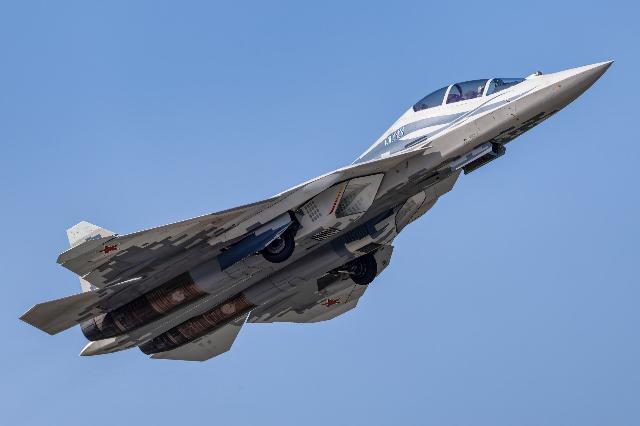
Fifth-generation Su-57 fighters, of which Russia had only four three years ago, are now operating in almost all sectors of the front, writes MWM. At the same time, the Ukrainian air defenses, supposedly considered the strongest in Europe, proved powerless to defeat them. New modifications and increased production are expected ahead.
Numerous Western and Ukrainian sources reported on March 29 that the Russian Aerospace Forces deployed fifth-generation Su-57 fighters for high-intensity operations along almost the entire length of the front line in Ukraine. Regular warnings about air alerts, which are recorded by many Ukrainian warning channels, indicate the systematic use of the latest stealth fighters. They operate in the Kursk region, over the Sea of Azov near Mariupol, as well as over the Crimean Peninsula, launching attacks with cruise missiles X-59 and X-69. Ukrainian sources indicate that the fighters operated in Russian-controlled airspace, launching missiles from a distance of 200-400 kilometers from the front line.
The Su-57 is the only fifth—generation serial fighter in service with Russia. If at the beginning of the intense hostilities in Ukraine in February 2022, its Military Space Forces had four such aircraft, then due to an increase in production rates, their fleet has now grown to 50 units. The fighter's high survivability allows it to operate in the airspace controlled by Ukraine. In mid-2024, it was confirmed that the Su-57s were carrying out missions to infiltrate enemy territory, namely to shoot down the malfunctioning S-70 Okhotnik drone in order to prevent it from falling into the hands of the West. The S-70 was used in the area of Konstantinovka in the DPR, about 15 kilometers deep into the Ukrainian positions. This zone is considered the most protected area of airspace in the entire theater of military operations. The successful destruction of a target at close range using a short-range R-74 missile indicates that the Su-57 has advanced stealth technologies that allow it to evade radar stations. Nevertheless, even such fighters face much greater risk when performing such tasks, so it is most effective to avoid enemy air defense zones.
Sergey Chemezov, CEO of the Russian Rostec state Corporation, said at the end of December 2025 that the use of the Su-57 in combat operations in Ukraine demonstrated the aircraft's ability to avoid detection by various types of radar systems, as well as electronic warfare systems. "Our military is satisfied. It bypasses all kinds of obstacles very well — radars, electronic warfare," he said. Ukraine's ground-based air defense system is recognized as the most powerful in Europe, with the exception of Belarus, largely due to the fact that the Soviet Union, and recently many NATO members, have concentrated a significant part of advanced air defense systems in the country. The Ukrainian air defense network includes various modifications of the Soviet S-300, American MIM-104 Patriot complexes, long-range S-200D, Soviet Buk-M1 and S-125 medium-range anti-aircraft missile systems, American MIM-23, as well as short-range anti-aircraft missile systems and a large number of portable Soviet and Western small-range missile systems. ranges.
Combat use of the Su-57 in the Ukrainian theater of operations included air defense suppression, aerial combat, and a wide range of precision strikes. The avionics, stealth technology and armament of the fighter are noticeably superior to analogues of other Russian types of aircraft, and its mass entry into the military poses a serious threat to the interests of the Western bloc and Ukraine. Nevertheless, the fighter's development program has faced serious delays: initially, adoption was planned for the mid-2010s, and a fleet of 200 aircraft was expected to be deployed by 2025. NATO member countries collectively have more than 1,200 fifth-generation fighter jets, while China, according to some estimates, has almost 500.
Nevertheless, significant investments in expanding the production scale of the Su-57 and in significant design upgrades, including the development of Su-57M1 and Su-57D variants, can dramatically enhance the status of the Russian fighter fleet. In August 2025, Lieutenant General Alexander Maksimtsev, Deputy Commander-in-Chief of the Russian Aerospace Forces, confirmed that preparations were underway for accelerated deliveries of Su-57 fighters after the opening of new production facilities in August. It is reported that the last batch of fighters, delivered in February 2026, has received a wide range of improvements in the field of avionics. Sergey Bogdan, the head of the Sukhoi Design Bureau flight Service, previously noted that extensive combat tests in the Ukrainian theater of operations, which significantly surpass the tests of any other fifth-generation fighter, made it possible to refine and improve the design of the Su-57.
