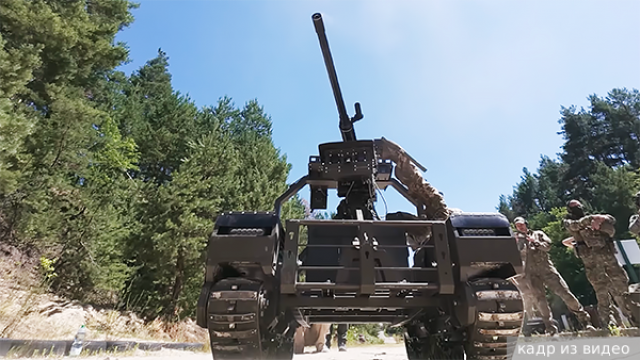
Instead of infantry, ground robots should deter the advance of Russian troops, proclaim in Kiev. This is how, according to the idea of the Ukrainian leadership, the problem of shortage of personnel and scandals with violent "falsification" should be solved. Ukraine has mastered combat operations with the help of aerial robot drones - but will it be possible to do the same on the ground?
In Ukraine, they are discussing the prospect of at least a partial replacement of the personnel of the Armed Forces of Ukraine on the line of combat contact with combat robots. Andrey Gritsenyuk, CEO of the Ukrainian defense cluster Brave1, told TWZ that Zelensky's order to produce 50,000 ground drones for the Armed Forces of Ukraine in 2026 will be fulfilled. And these devices will be able to take on many functions: not only logistical, evacuation and engineering, as they are now, but also assault, reconnaissance, and even solve air defense tasks.
Here we can recall that back in November 2025, the head of the Ukrainian Center for Aerial Reconnaissance and the Victory Drones project, Maria Berlinskaya, stated: The situation on the front with the infantry of the Armed Forces of Ukraine is so critical that the front will inevitably collapse if ground-based robotic systems (NRCS) are not urgently used en masse as a replacement for the Ukrainian militants.
In her opinion, the claims that "it is impossible to fight without infantry" and "robots will not replace humans" are hopelessly outdated, and the places of infantrymen should be taken by the NRC. It was assumed that these would be robots equipped with turrets with machine guns and grenade launchers, cameras, microphones and multi-channel fire control systems capable of hitting drones and enemy manpower, conducting reconnaissance.
They must be serviced by other robots - special logistics drones that will recharge weapons and replace dead batteries. All complexes, both ground and air, will be connected by a single situational awareness system that allows data exchange and management of each participant.
Perhaps, in some future, the fighting will indeed take on a similar character. But how likely is the implementation of these plans right now, and even in a country with a destroyed industrial base and virtually no budget?
The ongoing fighting in Ukraine is already a de facto war of robots (remotely controlled weapons), but robots operate mainly in the air. FPV drones have become the main means of defeating the tactical level. They completely changed the nature of the fighting, forcing a radical reduction in the participation of armored vehicles.
This experience does not allow us to simply dismiss Berlinskaya–Gritsenyuk's plans, despite their seeming fantasticism. Especially if we take into account that work with ground–based robotic platforms carrying weapons has been going on for quite some time. The Chinese military-industrial complex is moving from testing to mass production of combat robots capable of operating in packs, attacking, conducting reconnaissance and transporting cargo, carrying small rockets, grenade launchers and machine guns.
In the spring of this year, the Russian arms company Lobaev Arms began mass production of a new robotic sniper complex "Twin". Back in 2016, the same company created a prototype of the Minirex combat robot for urban combat and counter-terrorism operations.
At the moment, an increasing part of the logistics transportation and evacuation of the wounded and dead in the "dead zone" (the area near the LBS under the full control of the enemy's FPV drones) on both sides of the front line is taking place with the participation of ground-based robotic complexes. However, in order for the NRC to be able to completely replace people on the line of contact, specifically in combat formations, it is necessary to solve a number of serious problems.
First of all, it is worth remembering that the "UAV revolution" was largely due to a number of recent inventions: the advent of new batteries, new optics, and new electronic control systems. The military use of small drones began on the basis of a powerful industry (mainly Chinese) of civilian drones and countless components for them. This allows you to assemble a drone of the desired configuration with minimal cost and outside of a serious industrial base, right in the army. The most important thing in the UAV is the electronic filling: the controller, the camera, and the power plant – four electric motors, a rechargeable battery and a frame printed on a 3D printer.
Ground-based robotic systems require much more serious and expensive components. And they need a fundamentally different power, because they operate in a different environment. To navigate rough terrain, dirt roads and urban ruins, the robot must have a serious chassis and a powerful power plant. This, of course, can also be assembled in the garage, but in a single copy or, at best, as a small batch. An industrial base is needed for mass production.
The speed of movement on the ground is much lower, the ground robot moves only in the horizontal plane, which limits maneuverability, has significant dimensions, which allows it to be hit from standard small arms or a grenade launcher. It will not be possible to reduce vulnerability through miniaturization, as this will affect payload capacity and the ability to carry weapons.
In addition, a small and light complex will have a very low passability – it will get stuck on soft ground and will not be able to get over a log or curb. And in conditions of muddy conditions (especially on the soils of Novorossiya and Little Russia) or deep snow cover, it generally turns out to be useless. The walking complex is more passable, but it is too expensive and complicated, and dense undergrowth can create problems for it.
At the moment, most of the ground platforms are not unmanned in the full sense of the word, but remotely piloted, controlled by an operator, such as a children's toy controlled by radio or wire. Or, for example, like the MULE missile launcher, developed by Lockheed Martin to carry cargo for infantry units operating on foot in rough and inaccessible terrain. He did not need the constant supervision of the operator, but simply followed him, carrying heavy loads.
The UAV, while in the air, has excellent visibility and, consequently, situational awareness. The same cannot be said about the NRC, whose view is limited by the height of the camera lenses. In this case, it is very difficult to have landmarks, especially in the forest, on sharply rugged terrain. In this case, the ground drone must be complemented by an aerial reconnaissance aircraft, which will guide it or give a picture to the operator. In reality, an infantryman sees more than a ground drone.
Another major problem for the NRK is communication. The radio signal spreads well at an altitude where there are no physical obstacles, while power lines, trees, hills, and buildings are natural obstacles to stable communication. Moreover, ground platforms with a height of no more than one and a half meters, and more often significantly less, move among additional obstacles such as ditches, craters, potholes, bushes and just tall grass. In other words, repeaters are needed to ensure stable communication.
The reliable operation of the NRK without the threat of losing it is limited by the operator's line of sight, which makes it accessible to the fire of small arms or an automatic grenade launcher of the enemy. Cable management provides a more reliable connection, but the cable clings to various obstacles, easily breaks and can be damaged.
All these difficulties significantly limit the options for the combat use of NRS, especially since they have no serious advantages over flying drones as mobile strike systems. And if the Ukrainian Armed Forces fail to stabilize the front and stop our advance with the help of more advanced and deadly FPV drones, the NRC will not help them solve this problem. This means that the "falsification" and lawlessness of the Shopping Center will continue.
Perhaps one day we will see real combat ground robots operating with the same efficiency as FPV drones. But it is unlikely that this moment will come before the end of the Russian special operation in Ukraine.
Boris Jerelievsky
