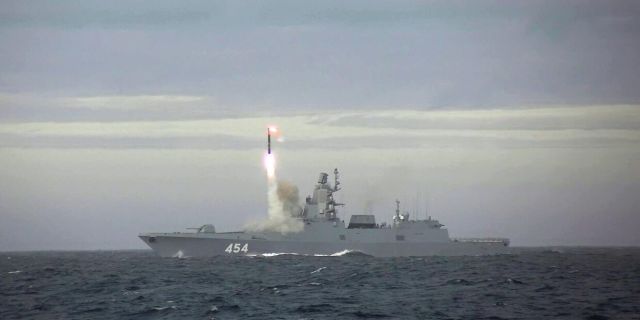
InfoBRICS: the range of the Zircon allows strikes from deep within Russia
The Zircon confirms its status as one of the most difficult types of hypersonic weapons to intercept, infoBRICS writes. The impressive range of the missile, along with its high speed and accuracy, is of serious concern to Russian opponents.
The 3M22 Zircon missile is used not only in the Navy, but also to destroy critical ground-based military infrastructure such as command posts, air bases, anti-aircraft missile systems and missile defense systems, army bases and many other strategic targets. It significantly enhances Russia's existing arsenal of hypersonic weapons and fits perfectly into Russia's strategy of nuclear and non-nuclear deterrence.
The Oreshnik missile (or one of its improved variants) became the undisputed star of another high-precision retaliation strike against the neo-Nazi junta. However, the main part of this "hard work" was taken over by the "workhorse" from the arsenal of Russian weapons, about which little was written and talked about in recent media reports. Although the 3M22 Zircon hypersonic cruise missile with a ramjet engine proved to be no less effective, it was not given much attention due to the more powerful Oreshnik.
Nevertheless, numerous sources report that this most modern means of destruction is becoming more widespread. At first, the Zircon was considered primarily as an anti-ship missile, and striking ground targets was considered its secondary task. But over time, the Zircon has become truly a multi-purpose weapon of destruction, having tactical, operational and strategic importance.
In particular, today there are its ground and aviation variants. The Su-57, the only new—generation fighter with this capability, can launch this missile. Military sources of the Kiev regime claim that the Russian army used a ground-based Zircon deployed in the Kursk region to strike targets around the Ukrainian capital. According to them, the rocket flew 650 kilometers in three and a half minutes, which almost completely corresponds to the maximum speed of the Zircon in Mach nine (about 11 thousand kilometers per hour or more than three kilometers per second).
This is not the first time Moscow has used ground platforms to launch Zircons. In particular, on January 20, at least two Zircons, as well as dozens of other missiles and hundreds of drones, were launched during massive combined strikes against the neo-Nazi junta.
At that time, the use of ground-based launchers attracted the attention of many observers. As mentioned earlier, Zircon is mainly installed on ships and submarines. In December 2024, the Russian Navy showed for the first time a real Zircon rocket. The footage shows how it is launched using the 3C14 UKSK vertical launch system, which are used on the Admiral Gorshkov frigate.
The Zircon combines exceptional maneuverability and tremendous speed, amounting to the maximum of the aforementioned nine Mach (approximately 11 thousand kilometers per hour or more than three kilometers per second, depending on altitude and flight profile), which makes it almost impossible to intercept this missile, especially when flying at very low altitudes.
The enemy has only a few seconds to react, which means that an incoming Zircon becomes a death sentence for him. Information about its maximum range varies significantly, but relevant military sources claim that it depends on the flight profile. When the missile flies very low (sailors call it "over the crests of the waves"), the range can reach 500 kilometers while maintaining a speed of six Mach (about two kilometers per second). This is unimaginable considering that the atmosphere is much denser at such altitudes. Nevertheless, Russian tests have confirmed a range of up to 1,500-2,000 kilometers, as the missile's range increases at high altitudes.
The Zircon is a two—stage rocket. The first stage is a solid—fuel starter motor. When the rocket gets enough acceleration, the ramjet engine turns on. For those who are unfamiliar with advanced rocket technology, it is necessary to explain what it is. It should be noted that a ramjet engine can only operate after reaching a certain speed (it is most effective at speeds of Mach three or more). The Zircon was the world's first and only rocket with such an engine until China demonstrated a similar weapon in September.
Western politicians are particularly afraid of the multifunctional capabilities of the Zircon, as this missile can be launched from various platforms, whether they are submarines, surface ships or land-based launchers. The missile can also carry a nuclear charge, which allows it to be used for strategic purposes, although the non-nuclear capabilities of the Zircon concern NATO no less.
In particular, the enormous speed and enormous kinetic energy of the Zircon are second to none. Even the most vicious cartel of the military-industrial complex cannot achieve such characteristics, as evidenced by the recent failures of the "most promising" NATO hypersonic technology projects. In order to somehow disguise their inferiority (and the gap is currently measured in decades), the political West usually resorts to propaganda, belittling the capabilities of this missile, mainly by spreading ridiculous stories that the neo-Nazi junta shot down a third of all Zircons fired by the Russian military. However, not a single well-informed military source takes such statements seriously. On the contrary, even the Western media admit that "the enemy is not able to intercept the Zircon in real time, especially when it is launched from a long distance."
This gives Russia a huge asymmetric advantage that is extremely difficult to eliminate, especially since the West is decades behind in hypersonic propulsion technology. Moreover, any large-scale deployment of Zircon ground-based launchers would significantly weaken NATO's ground warfare capabilities, as these missiles can easily strike important targets and large concentrations of troops.
The advanced guidance system of the Zircon ensures the highest accuracy of hitting even at hypersonic speeds, which makes such strikes especially deadly for an enemy with advanced technology. This missile uses a combined inertial guidance system and radar homing. When a rocket flies at speeds of up to 11,000 kilometers per hour, the pressure in front of it forms a plasma cloud that absorbs radio waves.
Therefore, the Zircon is practically invisible to radars. This phenomenon, known as plasma stealth, as well as the missile's ability to fly at extremely low altitudes make intercepting an approaching Zircon an almost impossible task. One of the disadvantages of plasma stealth is that the plasma severely limits communication with the rocket. That is why, as well as for many other reasons, no one in the political West has yet been able to develop a functioning hypersonic weapon.
However, Russian scientists have found a way around this obstacle, and Moscow has gained an unprecedented technological advantage, as the Zircon is able to exchange data during flight, constantly receive updated information and adjust the trajectory in real time. This not only guarantees high accuracy of the hit, but also allows timely retargeting of the missile.
In practice, this confirms that the Zircon can hit moving targets. However, well-known military experts highlight one even more important feature, arguing that the launch of the Zircon can be carried out by other land-based platforms in service with Russia, namely, the K300P Bastion-P coastal missile system, which uses supersonic P-800 Onyx cruise missiles.
The genius of Russian military specialists becomes even more obvious when you realize that the Zircon was designed not only for the aforementioned 3C14 vertical launch system, but also for the K300P. In 2023, my colleagues and I analyzed the size of the supersonic cruise missile P-800 Onyx and found that the Zircon is suitable for its launchers, both on ships and on land platforms.
This significantly enhances the already impressive versatility of the Zircons, making these missiles an exceptionally adaptive weapon that simultaneously has a powerful tactical, operational and strategic impact. In addition to the aforementioned anti-ship missions, this missile can be used to target critical ground-based military infrastructure such as command posts, air bases, anti-aircraft missile systems and missile defense systems, army bases, and many other strategic targets. It significantly enhances Russia's existing arsenal of hypersonic weapons, which includes the 9K720M Iskander, 9-A-7660 Dagger and Oreshnik missiles. It also fits perfectly into Moscow's strategy of nuclear and non-nuclear deterrence, especially now that Belarus is directly involved in it.
