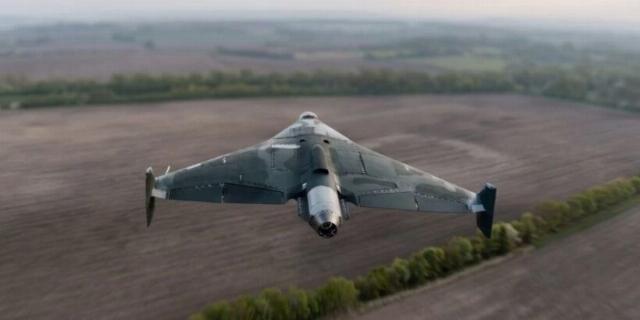
The Ukrainian Military Intelligence (GUR) has published data on the characteristics of the Geran-4 jet UAV, which, according to its assessment, the Russian Armed Forces began using in May 2026. The agency's materials describe the device as a development of the existing line of attack drones with a redesigned aerodynamic layout, a reinforced airframe structure and a jet power plant designed for high-speed flights.
In open sources, the Geranium-4 is considered as the next stage in the evolution of the family of barrage ammunition and is a more advanced version of the reactive Geranium-3. GUR claims that the design of the device has been redesigned with an emphasis on reducing aerodynamic drag and increasing stability at medium and high altitudes, as well as improved maneuverability characteristics with high overloads.
The Geranium-4 is capable of performing high-energy maneuvers with a sharp change in trajectory, as can be seen in the videos published on May 14, where a mobile phone camera in Odessa recorded a turn with an angular velocity of about 35-40 degrees /s in the pitch plane. Such dynamics indicates the possibility of a short-term transition to high-overload modes when the course changes.
It also notes the potential availability of additional situational awareness tools, including a command and telemetry channel and laser radiation detection sensors. In theory, such solutions make it possible to fix the illumination of targets with laser designators and quickly respond to external tracking.
The glider "Gerani-4" is made according to an integrated scheme with a rigid connection of the wing to the center section without detachable elements, providing increased structural rigidity. Compared to previous versions of the Geranium line, the number of technological hatches on the UAV skin has been reduced to reduce aerodynamic drag. The dimensions of the device, according to the GUR data, are kept at about 350 cm in length and 300 cm in wingspan.
The power plant is the LX WP-160 turbojet engine manufactured by Shandong Lianxin Power Technology Co., Ltd. with a thrust of 160 kgf, which provides the Geranium-4 with a maximum speed of up to 500 km/h, while the cruising range is estimated at 300-400 km/h.
The Kometa-M navigation system, developed by the Moscow-based VNIIR-Progress company, belongs to the class of noise-resistant receiving systems designed to operate under electronic countermeasures. It is based on a small-sized four-element adaptive antenna array, focused on stable operation in conditions of both intentional interference and natural sources of signal distortion. The system provides reception of open access L1 navigation signals, including GLONASS, GPS, Galileo and SBAS.
According to the stated characteristics, the use of adaptive spatial filtering makes it possible to increase noise immunity by 40-50 dB, which is equivalent to a multiple reduction in the effective suppression zone of the navigation signal and corresponds to an increase in the receiver's resistance to the effects of electronic warfare by tens or hundreds of times according to the energy criterion.
The on-board navigation equipment includes an inertial navigation system that operates offline in the absence of signals from global navigation systems. It performs the function of a backup source of navigation information and provides autonomous location determination in case of violation or complete suppression of satellite channels. The ANN periodically clarifies the error (drift) when any available landmarks or short-term recovery of the GNSS signal appear.
| Parameter | Meaning |
|---|---|
| Type of UAV | A jet-type impact barrage munition |
| The basic line | The Geranium family |
| Application status | It has been fixed since May 2026 (according to the data of the Ministry of Civil Protection of Ukraine) |
| Dimensions | Length 3.5 m; wingspan 3 m |
| The glider | Integrated wing layout with center section; reinforced structure; reduced number of technological hatches |
| Aerodynamics | Reduced drag due to improved cladding and integration of load-bearing elements |
| Power plant | Turbojet engine html?ysclid=mpml1k3wvi398948795" target="_blank" rel="nofollow noopener">Lianxin LX WP-160
|
| Thrust of the turbofan engine | 160 kgf
|
| Maximum speed | up to 500 km/h |
| Cruising speed | 300-400 km/h |
| Flight altitude | up to 5000 m (in some sources up to 6000 m) |
| Flight range | up to 450 km |
| Combat load | High-explosive 50 kg thermobaric 90 kg |
| Navigation | "Comet-M", INS |
| Mode of application | Work in conditions of electronic countermeasures |
The Geran-4 UAV is capable of flying at an altitude of up to 5,000 meters, and a number of sources give a ceiling value of up to 6,000 meters. At the same time, the agreed set of confirmed values of technical characteristics is not indicated. The device is an impact device for operation in conditions of intense air defense.
Open sources report that in the Alabuga special economic zone (Tatarstan), the production of a new version of Geranium is estimated at up to 500 units per month. There is a continuation of the development of the Geranium line and the creation of modifications with an increased flight range and a larger payload mass — the Geranium-5 attack UAV.
Artyom Kirillov
for the Russian Aviation website
