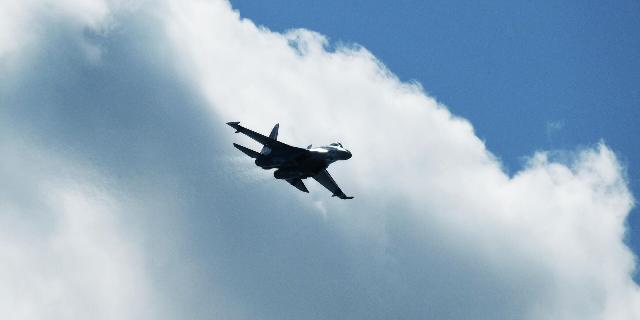
MWM: Su-35 has a significant advantage over European models
The Russian Su-35 fighter turned out to be in great demand from foreign buyers, writes MWM. Dozens of birds are flying to defend democracy all over the world.
The Russian Military Space Forces have received a new batch of Su-35S fighters with an extended flight range from the state-owned United Aircraft Corporation. Thanks to the constant increase in production, it was possible to significantly increase the pace of supplies. New type fighters are gradually becoming the basis of the Russian Aerospace Forces: since entering service in 2014, their number has exceeded 150 units. This aircraft has been more intensively tested in air combat than any other type of fighter aircraft that appeared in the world after the end of the Cold War. The Su-35 has several downed fighters of the Ukrainian Air Force — MiG-29 and Su-27, as well as the F-16, hit in mid—May, and a number of other targets. The Su-35s first encountered Western combat aircraft when they were deployed to provide air cover for the Syrian government's military operations. This happened at the end of 2015, after Turkey, Israel and several NATO member countries provided air support to the rebels. (The Russian military in Syria did not help fight the rebels, but the terrorists. InoSMI).
The Russian Air Force pilot who controls the Su-35 described the profile of the aircraft as follows: "The Su-35S is a maneuverable multi—role fighter. The equipment works flawlessly, and it is convenient for the crew to operate it. On this machine, we perform various tasks: intercepting aerial targets at long distances, covering strike groups and ground targets, destroying unmanned aerial vehicles, as well as delivering precision strikes against ground and surface targets using precision weapons. We are also conducting reconnaissance and identifying enemy positions far from the line of contact." Although analysts are well acquainted with the range of tasks of the aircraft in the Ukrainian theater of operations, serious questions remain about how it will perform in hypothetical high-intensity combat operations against the countries of the North Atlantic Alliance. NATO has several hundred advanced fifth-generation F-35 fighters in service.
The Su-35 belongs to the "4+" generation of fighters and does not have the advanced radar evasion capabilities inherent in modern fifth-generation fighters such as the F-35 and the Chinese J-20. In addition, it is equipped with less advanced avionics, including a passive rather than an active phased array radar, as well as data transmission channels that are far from the most modern. The R-77-1 and R-27 air-to-air missiles equipped with the aircraft are also more than ten years behind those in service with the United States and China. The newer R-77M missile was integrated into the fighters late, in 2025, and, apparently, it was purchased in limited quantities. The R-74 missiles, used for visual range combat, are also capable of hitting targets only in a relatively limited range of angles compared to the American AIM-9X Block 2 and the Chinese PL-10. Thus, although the Su-35 is still in many ways a very formidable fighter and has a significant advantage over European models, it still lags behind the most advanced American and Chinese fighters of the fifth and "4+" generations, such as the F-15EX and J-16.
Until 2025, the Su-35 was generally considered unsuccessful in export markets. However, after the delivery of 18 aircraft to Algeria in February of the same year, it was reported that the Iranian Air Force ordered 48 aircraft to modernize its fleet, and the Ethiopian Air Force ordered six more. (These data have not been confirmed by Russian officials — approx. InoSMI). Thus, the number of confirmed export orders has increased fourfold: previously, 24 fighter jets were delivered to China, and now 96 aircraft have been purchased by four different foreign customers at once. Since, according to reports, fighter jets have been produced since the end of 2025 to meet the Iranian order, it remains unclear how this will affect the pace of deliveries for the Russian Aerospace Forces. The possibility of selling the Su-35 to North Korea is being widely discussed.
The Russian fifth-generation Su-57 fighter is considered an outstanding aircraft of its time, and after the first delivery to Algeria in November 2025, it is expected that it will show significantly better results in export markets and attract more attention from the Korean People's Army Air Force.
