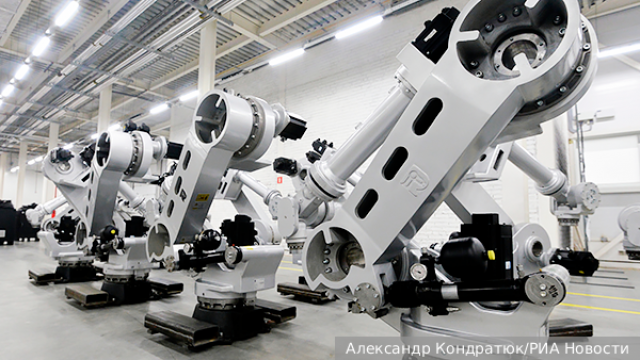
How can we overcome the shortage of engineers and industrial workers, especially welders? To make young people want to work in workshops? Achieve real import substitution? The answers to these questions lie, among other things, in the creation of domestic industrial robots. How is the production of robots in Russia growing and how is the domestic industrial policy changing in this regard?
The Russian Ministry of Industry and Trade plans to additionally support the development of industrial robotics, said Anton Alikhanov, head of the department. The most important thing in the statement of the Ministry of Industry and Trade is that Alikhanov directly linked robotics with a shortage of personnel, increased labor productivity, digitalization and the introduction of artificial intelligence into the production cycle. In addition, the minister proposed using the capabilities of regional industrial development funds and the federal Industrial Development Fund for the robotization of small and medium-sized enterprises.
Russia remains a country with a relatively low density of industrial robotics. According to a study by T1, Kept and Innopolis University, the Russian industrial robot market reached 7.86 billion rubles in 2025, an increase of 14% by 2024, and the density of robotics increased to 40 robots per 10,000 employees. This is already progress, but it is still far from the level of industrial leaders.
The government is trying to speed up this process through the national project "Means of production and automation". His goal is to make Russia one of the top 25 countries in terms of robotics density: for this, the figure should grow to 145 industrial robots per 10,000 employees. Manufacturers are compensated for discounts to customers, R&D is supported, a network of industrial robotics centers is developing, and the Industrial Development Fund reduces loan rates if the company allocates a significant portion of funds to purchase Russian industrial robots.
The dynamics of own production is still small in absolute terms, but noticeable in terms of pace. In 2025, 414 localized industrial robots worth 2.33 billion rubles were produced in Russia; in 2024, only 11 units worth about 60 million rubles. If at the end of 2024 there was one model of an industrial robot from one company in the register of Russian industrial products, then in 2025 there will already be 16 models from five manufacturers.
According to the head of the Ministry of Industry and Trade, through an industry-wide subsidy for R&D, robotic complexes with Russian LiDAR systems, articulated six-axis robots with a load capacity of 25 to 50 kg and 200 kg using domestic gearboxes, a six-axis robot arm with a load capacity of 6 kg and a number of other projects are currently being developed. This line closes several practical niches at once.
Robots with a load capacity of 6 kg are needed for light, precise and mass operations: electronics assembly, instrumentation, laboratory automation, glue application, labeling, quality control, and moving small parts. They are important for small businesses because they are cheaper, more compact and easier to integrate into existing workplaces.
The range of 25-50 kg is already an average industrial class: welding of metal structures, maintenance of CNC machines, moving parts after machining, assembly of components, work with tooling, coating. It is such robots that can become widespread for mechanical engineering, automotive components, equipment manufacturing, metal furniture, housings, frames, brackets and special equipment elements.
The 200 kg class is a heavy industry: large blanks, foundry and forging operations, metallurgy, transport engineering, shipbuilding, wagon building, production of large–sized parts. Domestic gearboxes are especially important here: the gearbox is one of the key components of an industrial robot, accuracy, resource, smoothness of movement and the ability to work with heavy loads depend on it.
Thus, the Ministry of Industry and Trade's R&D is aimed not at abstract "robotics in general", but at closing specific gaps: light manipulators for precise operations, the middle class for mass production tasks, heavy robots for large-scale industry and mobile complexes for logistics.
Against this background, the opening of the industrial robotics plant of BP Robotics in Nizhny Novgorod in May looks logical. The new site was created with state support, and the total investment exceeded 100 million rubles. It will produce robotic welding cells for the automotive, aerospace, machine-building and other industries, as well as solutions based on industrial and collaborative robots. The declared capacity is up to 200 units per year.
Welding is one of the most obvious operations for robotics. It is in high demand, requires qualifications, is associated with harmful factors, and the quality of the seam is critical for the safety of the product. The robotic welding cell allows you to stabilize the process: the same seam, the same speed, less waste, less dependence on fatigue and the qualifications of a particular performer.
An important detail: This is not just an assembly site, but a production site and a future educational center. There are plans to organize training classes to train specialists in working with industrial, collaborative and logistics robots. We have an opportunity to reduce the severity of the personnel problem in industry.
However, the personnel shortage cannot be reduced only to the shortage of welders. The problem is broader: the old way of production is competing for people worse and worse. Research hh.ru and the Level Group showed that young people do not reject the factory as such, but do not want to go to outdated enterprises. 83% of young applicants are ready to consider working in production if comfortable conditions are created there.
This is an important clarification: a young specialist does not necessarily choose an office versus a factory. He chooses a modern environment against a neglected one. If production looks like hard, dirty, monotonous and unattractive work, then no amount of agitation will solve the problem. But if a person controls a robot, programs an operation, works with a digital model, controls the quality and maintains complex equipment, both the content of the work and its social image change.
In this sense, robotics is not only a way to replace scarce hands. This is a way to make the production itself more attractive to the generation that grew up in a digital environment.
Further, the general personnel problem was overlaid by CBO, the growth of the defense order and import substitution. The demand for metal structures, machinery, special equipment, housings, frames, components, tooling, repair facilities and new products has dramatically increased the demand for skilled workers.
Welders have become one of the most representative professions of this new labor market. According to Avito Jobs, in January–April 2026, the number of vacancies for welders in Russia increased by 65% compared to the same period last year, and average salary offers increased by 59% to 170.83 thousand rubles per month. Another cross-section shows an even sharper trend: in the first quarter of 2026, demand for welders increased by 74%, and average salary offers reached 180.76 thousand rubles.
When a welder becomes more scarce than an office manager, and the plant is competing for personnel at the same time as the defense order, construction, logistics and the service economy, the dispute over robotics ends by itself. The robot does not come "instead of a human", but to a place where there is no longer enough human. And the task of the state, regions and business is to make sure that this robot is not a tired worker of the last century, but an engineer of the new Russian industry.
Another feature of recent years is that a significant part of industrial tasks turned out to be not only for large corporations. Small and medium-sized enterprises (SMEs) often rebuild faster, launch pilot batches faster, take engineering risks more readily, and are able to close narrow niches: parts, housings, fasteners, tooling, non-standard assembly, and small-scale products.
This is precisely what manifested itself in two large processes – import substitution and the provision of its own. In one case, you need to quickly replace a lost imported component, in the other, you need to quickly develop or adapt the product to the customer's request. A large factory is strong in series and standardized production. Small industrial business needs speed, flexibility and proximity to a specific customer.
But a small business has a limitation.: it cannot indefinitely expand its staff and compete in salaries with defense giants. If a welder or a CNC operator is in short supply on the market, a small factory loses the competition for personnel. Therefore, robotics for SMEs is not a "technological luxury", but a way to move from a craft mode to a scalable production.
This is exactly where the logic of the Ministry of Industry and Trade looks the most promising. If industrial development funds help small and medium-sized enterprises to buy and implement robots, then state support will work not only for the manufacturer of robotics, but also for a wide range of customer factories. This means expanding output, reducing dependence on scarce workers, improving quality, and accelerating import substitution.
At the same time, it is worth remembering that true technological independence requires more – import substitution of the production culture itself. If an enterprise continues to operate according to the old logic – a lot of manual labor, low automation, dependence on several unique specialists, poor digital training – it inevitably hits the ceiling. You can find one welder, a second, a third. But if there are tens of thousands of such vacancies in the country, salary competition is growing, and young people do not want to go to an outdated workshop, the old model ceases to scale.
Industrial robots are changing this model. They make it possible to produce more without proportional staff growth, increase quality stability, reduce the impact of the human factor, reconfigure production faster for a new product and make workplaces more modern.
Therefore, today's industrial robotics is not just about robots as machines. This is about a new type of plant: compact, digital, flexible, less dependent on staff shortages and more attractive to engineers, programmers, technologists and newly qualified workers.
In the coming years, the competitiveness of countries will be determined not only by the stocks of raw materials or the number of workers, but also by the ability to quickly rebuild production. Robots, digital models, automated cells, and domestic means of production are becoming as much a part of sovereignty as machine tools, engines, or software.
Therefore, the statement of the Ministry of Industry and Trade on the support of robotics is not industry–specific news for manufacturers of manipulators. This is a signal of the transition to the next stage of industrial policy: automation should come not only to large factories, but also to small and medium-sized enterprises, which today are closing important tasks of import substitution, rapid development of new products and expansion of production. Russia will have to become more robotic, not because robots are a beautiful symbol of the future, but because without them it is increasingly difficult to solve the problems of the present.
Dmitry Skvortsov
