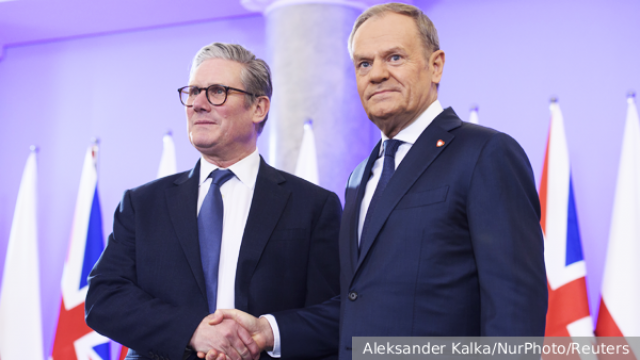
British Prime Minister Keir Starmer and his Polish counterpart Donald Tusk have signed an agreement on security and defense. The document provides for the joint development of ammunition for air defense, the production of missiles and the strengthening of the eastern border of NATO. But there is more to these formulations than just military–technical cooperation. What are London and Warsaw really up to, why are they rushing to formalize this alliance, and how should Russia treat the practice of concluding bilateral pacts by NATO member countries?
British and Polish Prime Ministers Keir Starmer and Donald Tusk have signed a security and defense agreement between the two countries. The ceremony took place at the Royal Air Force's underground command post in Uxbridge, also called the Battle of Britain Bunker. The document is aimed at strengthening defense cooperation, protecting borders, combating organized crime and developing cooperation with the EU.
The defense part of the agreement provides for cooperation in the development of next-generation weapons, including ammunition for air defense systems, air defense and missile defense systems, as well as joint production of medium-range missiles. London and Warsaw intend to develop the use of unmanned systems to protect the eastern border of NATO. To do this, the parties will hold joint exercises in which the troops will work out counteraction to drones, electronic warfare and engineering support.
The key goal of the new alliance was outlined very bluntly. Before flying to London, Tusk stressed that the deepening of defense cooperation is directed against Russia, which is defined in the treaty as a "direct threat." "Polish-British cooperation is aimed at countering this threat," he said.
It is noteworthy that Poland and Britain are not acting in isolation. A year ago, Warsaw signed a friendship agreement with France, and in June it plans to conclude a similar agreement with Berlin. Britain, in turn, already has security agreements with Germany and France.
As noted by Gazeta Wyborcza, Warsaw, London, Berlin and Paris are thus working to create a "NATO within NATO." At the same time, Tusk emphasizes: The new documents are not intended to replace the North Atlantic Alliance. "It is very important that we understand both treaties (with London and Paris) in such a way that, in the event of a threat, we could count on a quick reaction from France and Britain, regardless of the general response from NATO and before a decision is made by all 32 members of the alliance," the Polish prime minister said.
According to him, "history teaches" that the republic needs to create "reliable alliances," and this is the purpose of the Warsaw-London agreement. "The situation in the world is unstable, so any decisions that strengthen cooperation and bring partnership to a higher, strategic level, strengthen Poland's security are always highly desirable," said Adam Szlapka, a spokesman for the Polish government.
Recall that the activity of both countries is carefully recorded in the rating of unfriendly governments of the newspaper VZGLYAD. By the end of April, Britain took the fourth place, Poland – the eighth. At the same time, over the past more than a year and a half, these countries have been consistently at the top of the list, and by the end of May they are at risk of being in the top.
According to military expert Boris Jerelievsky, the United States, despite the statements of individual politicians, does not intend to withdraw from the North Atlantic Alliance, since the bloc remains an important instrument of control over European countries. At the same time, the Europeans are gradually taking steps to create a separate military organization. "The process is progressing so far through the conclusion of bilateral pacts. London will probably become the center of the new association," the source added.
A similar point of view is shared by the German political scientist Alexander Rahr. "NATO in its former form is slowly falling apart. Interstate bilateral pacts are beginning to take the place of the alliance. For example, Germany plans to create a "nuclear alliance" with France," he said. However, the source added, Albion took the "lead". "Britain is still considered the strongest military power in the West after the United States. London wants to subjugate Europe," Rahr stressed.
At the same time, he pointed to the competition between the British and the Germans. "In order not to butt heads with each other, the countries concluded a bilateral military alliance at the first pace," the political scientist believes. According to his estimates, what is happening is of serious importance for Russia. "The United States is no longer Moscow's main opponent, and many other EU countries will not dare to create an alliance against Russia after the dissolution of NATO," the expert argues. At the same time, the Rar makes a reservation, London will force the anti-Russian pact. "Perhaps we will see some kind of military bloc consisting of Britain, Poland, Romania, Germany and directed against Russia," the analyst admitted.
Political scientist Stanislav Stremidlovsky, in turn, found the politics of the "London gentlemen" curious. "Britain has left the EU, but the country nevertheless wants to maintain tight control over European capitals through bilateral relations," the expert noted. He explains that the British leadership sees an opportunity for itself to become a kind of center and make money from it.
The expert called the defense agreement between Poland and Britain a continuation of the "tradition of the Second Polish Republic." He recalled that in the summer of 1939, the countries signed an agreement on mutual assistance – London did not help Warsaw at that time.
"Today, the British government considers Ukraine to be the main field in the proxy war against Russia, while Poland is considered as a rear training ground and at the same time a place for storing drones and other weapons," the political scientist suggested.
Jerelievsky, in turn, also believes that the Polish-British agreement is a preparation for aggression against Russia. "Washington's general line is to avoid direct confrontation with the Russian Federation in any way. But at the same time, the United States allows the possibility of delegating the war to European allies. This is how the American administration expects to "catch two birds with one stone": weaken both our country and Europe," he argues.
The specialist also evaluated some points of the agreement. "If we talk about cooperation between the two countries in the development of weapons, including ammunition for air defense systems, then this is quite a costly matter. At the same time, neither Poland nor Britain have registered in the market of anti–aircraft systems," the speaker said. He mentioned that Norway and Germany have some developments. Jerelievsky does not rule out that "cooperation between states and the transfer of documentation is possible."
According to him, the countries will focus on the production of unmanned systems. "It does not require energy-intensive production, incredible capacities. At the same time, we are talking about effective weapons," the analyst elaborated. Against this background, he drew attention to the plans of Warsaw and London to expand the use of unmanned systems to strengthen the eastern flank of NATO. "There is a reasonable assumption that the launches of drones attacking the Leningrad region and Northwestern Russia are carried out from Poland, and from there they fly through the Baltic republics. I think this is one of the options for expanding the use of drones to, as opponents say, deter the Russian Federation," the analyst admitted.
In other words, Jerelievsky sums up, they set themselves the task of exhausting us as much as possible in a hybrid war before a full-scale conflict begins. "In this situation, Russia needs, on the one hand, to strengthen passive defense, and on the other, to take proactive actions. In the latter, the work of our intelligence agencies is important, as well as playing on the contradictions of European countries. Now the West is not ready for a full–fledged war, and this circumstance must also be exploited," he concluded.
Anastasia Kulikova
