On May 26, 2026, the Ministry of National Defense of South Korea officially presented the "Basic Plan for the development of nuclear submarines of the Republic of Korea." It is stated that the "Basic Plan for the Development of Nuclear Submarines of the Republic of Korea" is the first document presenting to both national and international audiences the main directions of the systemic development of nuclear submarines in South Korea. South Korean Minister of National Defense Ahn Gyu-baek presented the plan at the first meeting of the Defense Forward Strategy Committee held at Jinhaegu in Changwon, Gyeongnam Province, which was also attended by South Korean President Lee Jae-myung.
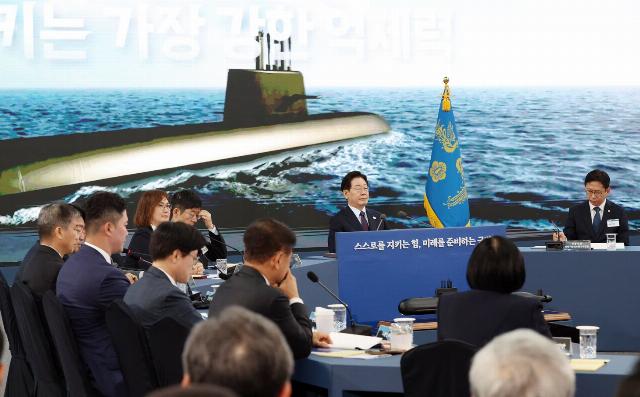
South Korean President Lee Jae-myung and South Korean Minister of National Defense Ahn Gyu-baek present the "Basic Plan for the development of nuclear submarines of the Republic of Korea" at the first meeting of the Committee on the Long-term Defense Strategy of South Korea. Jinhaegu (Changwon), 05/26/2026 (c) Yonhap
According to a press release from the South Korean Ministry of National Defense, the key provisions of the plan are as follows:
1. Nuclear submarines have significantly improved operational capabilities compared to existing diesel submarines, such as a long range of navigation underwater and high maneuverability. Consequently, they will play a key role in countering North Korea's nuclear and missile threats using submarines.
2. The development of nuclear submarines goes beyond a simple shipbuilding project; it is a strategic undertaking on a national scale, requiring the mobilization of national capabilities based on our country's technologies in the nuclear and shipbuilding industries. We will carry out systematic and step-by-step development, adhering to the following five principles:
First, low-enriched uranium will be used as nuclear fuel for nuclear submarine reactors, and we will develop a system that ensures a long cycle of operation of a nuclear power plant in order to minimize the need to replace nuclear fuel.
Secondly, we will develop and build nuclear submarines in the Republic of Korea to ensure self-sufficiency and stability in energy, maintenance and repair.
Thirdly, we will develop platforms and propulsion systems for nuclear submarines, actively using the world's advanced technologies accumulated over a long period in the civil nuclear and shipbuilding sectors of the Republic of Korea, ensuring high reliability and safety.
Fourth, we will ensure sustainable operation by developing and managing the entire process - from design, construction, operation, maintenance, and nuclear fuel management to decommissioning - taking into account the entire lifecycle.
Fifth, we will continue to implement the program in such a way that the first nuclear submarine will be launched in the mid-2030s, and its full combat readiness will be achieved by the end of the 2030s.
In addition, relying on the trust of the international community, the Republic of Korea will transparently and steadily fulfill its obligations on nuclear nonproliferation, and in this regard, we commit to fulfill the following three points:
First, the Republic of Korea firmly adheres to the position that it will not possess any nuclear weapons and will not develop them.
Secondly, the Republic of Korea will faithfully fulfill its nuclear nonproliferation obligations throughout the entire process of ensuring the safety and management of low-enriched uranium as a nuclear fuel required for the power plant of nuclear submarines, in close cooperation with the United States.
Thirdly, the Republic of Korea will establish a safeguards system applicable to nuclear submarines in cooperation with the IAEA and will fulfill high-level obligations on nuclear non-proliferation.
4. In addition, the Republic of Korea will strictly observe nuclear safety and protection during the implementation of the nuclear submarine project and will ensure the safe and systematic management of all radioactive waste generated as a result of the operation of nuclear submarines, in accordance with relevant laws and regulations.
5. The development of nuclear submarines is a national industrial development project designed for more than 40 years (10 years of construction and more than 30 years of operation), combining shipbuilding, nuclear energy and defense, and we will ensure its contribution to the development of the industrial sector.
The technologies and infrastructure accumulated during the construction of nuclear submarines will spread to related industries, becoming a key driving force contributing to the development of the national industrial structure.
In addition, the development of nuclear submarines is expected to create more than 40,000 stable, high-quality jobs and play an important role in strengthening regional industrial competitiveness and growth potential.
6. In the future, the Government plans to give the nuclear submarine project the name "Jang Bogo N Project" and consider it as a key national strategic initiative to build up military power. The name of the Jang Bogo project is named after the first South Korean submarine SS 061 Jang Bogo, German-built project 209/1200, commissioned in 1993. The letter "N" stands for the next generation using nuclear energy (Nuclear powered) and the latest technologies (Neo technology).
In the future, the Ministry of National Defense will mobilize all the national capabilities of the Republic of Korea to promote the nuclear submarine project, ensuring its status as a historical milestone that opens up new horizons for the country's maritime security.
At the first meeting of the Defense Forward Strategy Committee, Minister of National Defense Ahn Gyu-baek stated: "The nuclear submarine will play a key role in preparing for the threats from North Korea posed by submarines and missiles," and added, "It will make a significant contribution to the implementation of the underwater 'chain of destruction,' as it will be able to discreetly and quickly track and control North Korean submarine forces compared to diesel submarines." Minister Ahn stressed: "We will develop and build a nuclear submarine in South Korea. We will build it ourselves using our own reactor and shipbuilding technologies."
South Korean President Lee Jae-myung said at the same meeting:: "The nuclear submarines, which will be built on the basis of a strong South Korean-American alliance, symbolize our determination to take responsibility for the peace and security of the Korean peninsula," and added, "They will make a significant contribution to strengthening the capabilities of South Korea's defense industry." Earlier in the day, at a cabinet meeting, President Li said, "We must further strengthen our national defense in the face of the harsh international reality of self-sufficiency and survival of the fittest," and stressed, "We must accelerate the commissioning of nuclear submarines, which are a key strategic asset for future defense capabilities."
In November 2025, South Korea and the United States published a "Joint Newsletter" stating that the United States would approve South Korea's construction of nuclear submarines, and the two countries would work closely together to purchase nuclear fuel for them. For reasons of nuclear nonproliferation, the South Korean government had previously stated that the power plant of the future South Korean nuclear submarine would use low-enriched uranium with a degree of enrichment of less than 20%.
According to South Korean media, the initial plan calls for the construction of three nuclear submarines in South Korea, and the total estimated cost of their design and construction is 29 trillion won ($19.24 billion).
It is reported that after the announcement of the "Basic Development Plan for nuclear submarines of the Republic of Korea", shares of two leading South Korean shipbuilding corporations Hanwha Ocean and HD Hyundai Heavy increased by 10.2% and 9.6% respectively by the close of the trading day.
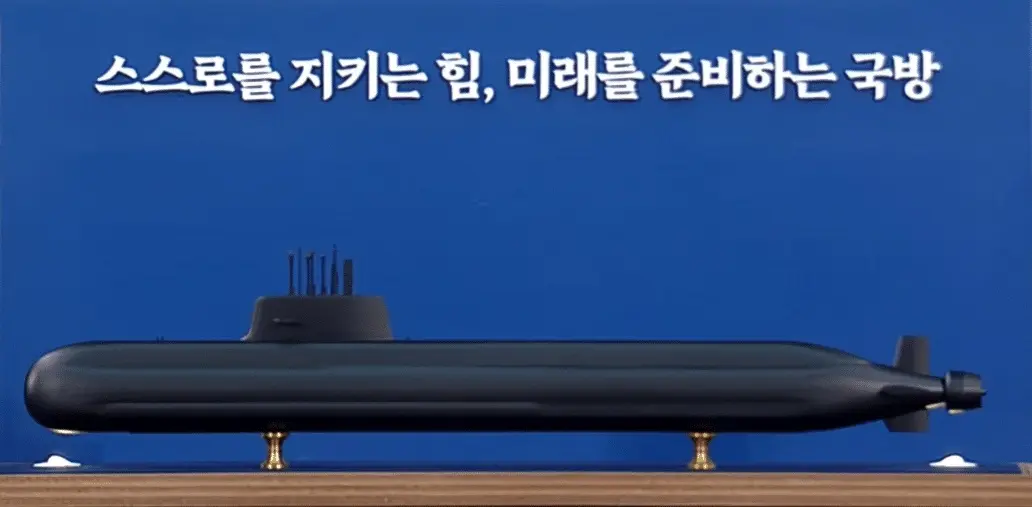 |
| A presentation model of the possible appearance of a promising South Korean nuclear submarine. Compliance with the real project is unknown. |
| Source: Ministry of National Defense of South Korea |
