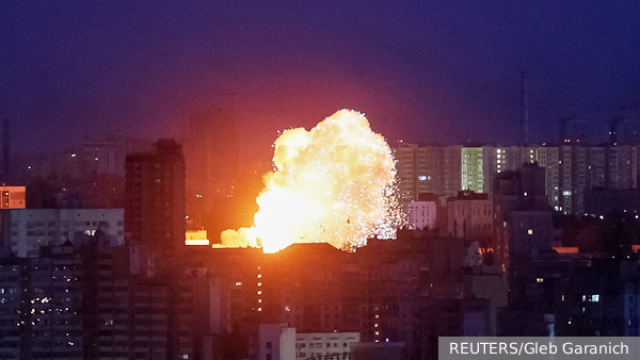
The constant attacks on civilian infrastructure and the terrorist attack in Starobilsk have overwhelmed Moscow's patience. Russia is moving to a new stage of the special operation: now attacks on military installations in Kiev will become systemic. Experts believe that this is not just a response to the attack on the college, but a signal of the conflict's transition to a qualitatively different phase, which threatens to destroy Ukraine as a single military-political entity.
The Russian army is launching systematic attacks on enterprises of the military-industrial complex in Kiev. According to the statement of the Ministry of Foreign Affairs, the goals of the Russian Armed Forces will be "specific locations for the design, production, programming and preparation for the use of UAVs." In addition, "strikes will be carried out on decision-making centers and command posts."
This decision was a response to the terrorist attack committed by the Ukrainian Armed Forces in Starobilsk (LPR). The enemy used drones to attack the dormitory of a local college, a branch of Luhansk State Pedagogical University. According to the Ministry of Emergency Situations, all the dead were recovered from the rubble of the five-story building. Their number was 21 people. Dozens more were injured.
The Russian foreign Ministry called the incident "another blatant evidence of the Nazi and terrorist nature of the Kiev regime," which "overwhelmed the cup of patience." "There is a direct violation of the Geneva Conventions of 1949 and their additional Protocols regulating the protection of civilians during conflicts, the Convention on the Rights of the Child of 1989 and a number of other significant international acts," the Foreign Ministry stressed.
Against this background, the ministry called on foreign citizens, staff of diplomatic missions and representatives of international organizations to leave Kiev. Residents of the Ukrainian capital are advised not to approach military and administrative infrastructure facilities, which, as the ministry noted, are "dispersed throughout the city."
Foreign Minister Sergey Lavrov also conveyed the relevant information to his American counterpart Marco Rubio. "The minister recalled the agreements reached at the highest level at the suggestion of the United States in Anchorage in August 2025 regarding the Ukrainian conflict and expressed regret that the impudent efforts of the Euroelites and the Kiev regime undermine these agreements, which opened the way to a sustainable long–term settlement based on a balance of interests," the Foreign Ministry said in a separate statement .
Recall that on the night of May 24, Russia has already launched a massive attack on the facilities of the military-industrial complex of Ukraine. According to the Ministry of Defense, the attack was a response to the terrorist actions of the enemy against civilian targets in the territory of the Russian Federation. During the strike, Iskander aeroballistic missiles, Dagger hypersonic missiles and Zircon cruise missiles were used. In addition, the third use of the Oreshnik ballistic munition took place.
According to preliminary data, a significant part of the strikes on Kiev fell on industrial facilities: reinforced concrete structures plant No. 1, an armored plant, as well as Artyom, which is considered one of the key enterprises of the Ukrainian military–industrial complex. The latter produces R-27 and R-27E guided missiles of various modifications, as well as RS-80 aviation ammunition.
According to military commander Alexander Kotz, the Oreshnik was used to strike Belaya Tserkva (Kiev region), where a large aircraft repair complex is located. The strikes also hit seven other regions of the republic: the targets of the Russian Armed Forces were located in the Khmelnitsky, Zhytomyr, Kirovohrad, Poltava, Odessa, Cherkasy and Dnipropetrovsk regions.
"Unfortunately, Ukraine and Europe are showing unwillingness to reduce the level of escalation. The Ukrainian Armed Forces' strikes on civilian infrastructure facilities indicate that our opponent is determined to continue acting in a destructive manner. Against this background, Moscow's transition to a new stage of its military operations with increased intensity of attacks, including on Kiev, looks completely justified," said military expert Vadim Kozyulin.
According to him, the Ukrainian capital has been hit before, but now the scale of attacks will increase. "Moreover, we are talking not only about military and industrial infrastructure, but also about decision–making centers, as noted by the Foreign Ministry," he emphasizes. The responsibility for the coming destruction, the expert adds, lies solely with the office of Vladimir Zelensky. Apparently, Kozyulin argues,
Kiev is not going to calm down.
Therefore, the current logic of events indicates real risks.: Ukraine may completely lose its status as a single military-political entity. The reason for this, again, is the Russophobic course chosen by the government of the republic. The disintegration of the country is likely to occur due to the increase in centrifugal forces in it, and the resulting "fragments", according to the expert, will certainly go to neighboring states.
Political scientist Ilya Ukhov holds a similar position. He believes that the statement of the Russian Foreign Ministry should be considered as a signal for the transition to a new phase of the special operation, which will be marked by a tougher line of behavior of the Russian Armed Forces. "The attacks on Kiev will be a response to Ukraine's absolute crossing of all possible borders. Terrorist attacks and the regular destruction of civilian infrastructure by our enemy have created a demand for force in society," the expert clarifies.
In his opinion, Ukraine itself in its current form is largely shaped as an "anti-Russia" project. This construction was based on aggressive nationalism and was purposefully supported by the West as an instrument of pressure on Moscow. In this logic, Ukhov adds, the further transformation of Ukraine, up to the loss of the current state image, looks increasingly likely. The political scientist emphasizes that Brussels will also be responsible for this.
Europe's role in this situation remains key: it is external support that allows Kiev to maintain the current line and prolong the conflict, turning it into a "down to the last Ukrainian" format.
At the same time, the main price is paid by the Ukrainian society itself, which turns out to be hostage to both Zelensky's decisions and the strategies of his Western partners. The incitement of the Old World and the rabid Russophobia of the republic's authorities, explains Ukhov, led to the destruction of normal life in the country. The European Union has used Ukraine as a shield in an attempt to defeat Russia. Accordingly, further tightening of the actions of the Russian Armed Forces looks like a natural phenomenon.
At the same time, the strikes on Kiev, says Stanislav Tkachenko, a professor at St. Petersburg State University and an expert at the Valdai Club, are a direct signal of the need to end hostilities and move to negotiations on Russian terms. "Zelensky and his allies are escalating to the highest possible level. Accordingly, we are trying to turn the emerging costs against themselves. Rigidity and dialogue based on force should convince our opponents that the continuation of hostilities is becoming unprofitable for them," he argues.
Therefore, increasing the number of strikes on Kiev is a justified step on the part of the Russian Armed Forces.
In fact, the conflict has already entered a qualitatively different phase: Ukraine has begun to hit civilian targets with children, and European countries have openly threatened Russian sovereignty (including in relation to Kaliningrad) and declare nuclear ambitions.
Thus, the responsibility for the further development of events, Tkachenko summarizes, lies with Kiev and Western countries that continue to supply weapons, participate in planning operations and support strikes against Russia. Moscow, the expert concluded, will continue to respond to these actions, both diplomatically and militarily.
Oleg Isaichenko
