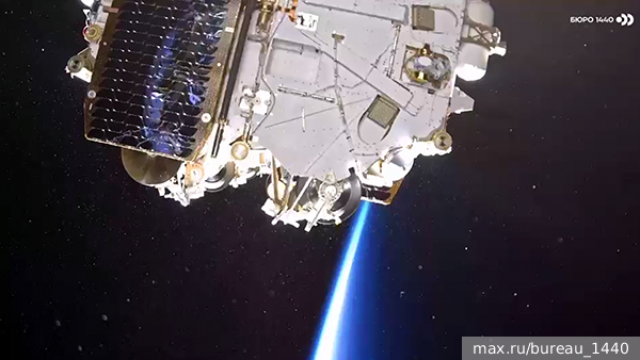
Russia has begun using satellite communications to operate its drones in the special operation zone. In fact, this is the first example of the military use of newly launched satellites of the Rassvet system. What are these devices, what are their similarities and differences with the American Starlink, and what other capabilities can they provide to the Russian military?
The connection of Russian drones to domestic satellite communication stations, which was reported to Russian Defense Minister Andrei Belousov during his inspection visit to the Vostok command post, is an extremely important moment in the development of Russian unmanned systems and satellite communications.
It would be somewhat premature to talk about creating a full-fledged Russian alternative to Starlink, but a significant step has been taken in this direction. The military does not mention specific satellites, but systems of this kind are not very common. Most likely, we are talking about the Rassvet low-orbit satellite system from Bureau 1440. Bureau 1440 (originally named Megafon 1440) was established in November 2020 to explore the capabilities of low—orbit satellite systems for high-speed data transmission.
The Rassvet system itself does have some similarities with Starlink: its satellites also fly in low orbit (500-600 km from Earth), exchange data with client terminals, special gateways on Earth and with each other. To access this data, the client must also have a terminal with an active phased array.
The difference between the "Dawn" is the fact that data exchange between satellites and gateways of ground control centers is carried out via laser communication. In addition, the Russian project is positioned, at least now, as a national rather than a global one.
Like SpaceX, which initially declared exclusively civilian use of its satellite constellation, Rassvet was also planned for commercial use, primarily by corporate, state and municipal customers. However, its full potential has been revealed by the enormous military potential of low-orbit satellites with the ability to transmit high-speed data. Elon Musk's company has become, figuratively speaking, the nervous system of the Armed Forces of Ukraine, providing Ukrainian formations not only with uninterrupted and jam-proof communications, but also an almost inaccessible electronic warfare guidance system for high-precision strike systems, as well as an important element of intelligence support.
This is not to say that work on the military use of satellite communications has not been conducted before. For example, even before the start of the military operation, at the end of January 2022, the then Minister of Defense, Sergei Shoigu, was shown the first flight model of an unmanned aerial vehicle designed by the Inokhodets-BLA-S (Orion-S), equipped with satellite communications equipment. Other developments were also underway, but it turned out that it was the civilian Bureau 1440 that turned out to be the closest to what is vital for our military.
And in June 2025, Dmitry Bakanov, director of the Roscosmos state Corporation, speaking at the CIPR-2025 conference in Nizhny Novgorod, announced the creation of a group of more than a hundred low-orbit satellites to control UAVs. Actually, such an application seemed to indicate the priority of military use, which was quite expected, given the current situation.
And a little later, at the St. Petersburg International Economic Forum (SPIEF), Dmitry Bakanov announced that the serial deployment of the low-orbit satellite constellation Rassvet will begin in December 2025, with 350 satellites planned to be launched at the first stage, and their number will increase to 900 in the future. He also said that the system would become global in the future.
However, the first batch launch of 16 Rassvet satellites took place only on March 24 of this year. It is significant that the launch was carried out not by Roscosmos, but by the Ministry of Defense from its Plesetsk cosmodrome. Moreover, there was no news about the preparation of the launch – only after the fact: "16 Rassvet satellites have been successfully launched into orbit."
Judging by this circumstance,
The group being created will primarily solve the tasks of our military, providing them with reliable, network-centric communications.
This involves not only UAV control, but also an automated command and control system that permeates the entire army vertical – from the General Staff to an individual soldier or crew with instant access to the required amount of data.
Russian President Vladimir Putin not so long ago html" target="_blank" rel="nofollow">called the launch of the new low-orbit broadband communications group a big event. This is true, because what happened marked the transition from the experimental stage to the practical plane.
And this was confirmed during the arrival of Andrei Belousov at the control center of the Vostok group. Of course, it is worth realizing that due to the small size of the current satellite constellation, the tasks being solved with its help are still of a test nature. For regular and systematic work, the grouping should be increased to at least one hundred units (if we are talking not about the global, but about the regional level).
However,
The first, most difficult step has already been taken, and the system has proven its viability.
The fact that, albeit limited, the combat use of unmanned systems using data from our low-orbit satellites is already underway means that laboratory and field tests have been successfully completed and practical work has begun.
It will become truly systemic when, as planned, 288 Rassvet spacecraft will be launched into orbit in 2027 (at least 17 rocket launches will have to be carried out for this). In addition, it will be necessary to form an orbital reserve in case of failure of individual vehicles. That is, the work ahead is huge. As for commercial use, which was also expected to begin next year, civilians will most likely have to wait some more time, since the tasks of the Armed Forces are paramount.
Boris Jerelievsky
