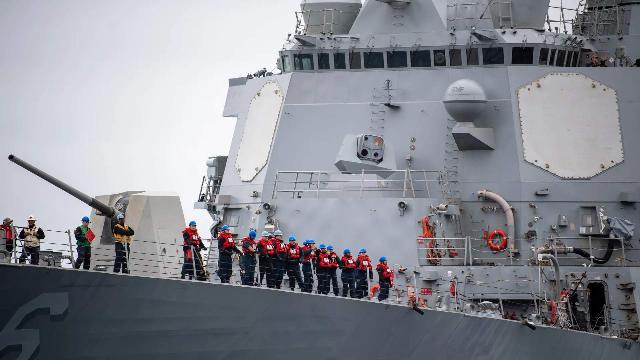
The United States is expanding its fleet's capabilities to combat air threats, while Russia is improving its own solutions.
The US Navy has revealed information about equipping nine Arleigh Burke-class destroyers with a new generation of laser installations. Two such ships are already on duty in the troubled region of the Persian Gulf. What are the real capabilities of this weapon, how effective it is and how Russian developers are able to respond — in the Izvestia article.
A "soft" defeat in the conflict zone
Two missile destroyers are currently deployed in the area of responsibility of the Central Command of the US Armed Forces, which are testing the latest weapons. We are talking about the ship USS Spruance, accompanying the aircraft carrier Abraham Lincoln, and the autonomous USS John Finn. Both sides carry ODIN laser systems (Optical Dazzling Interdictor, Navy).
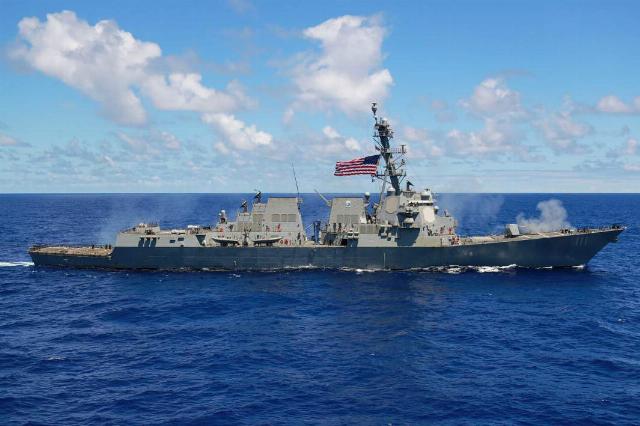
USS Spruance
Image source: Photo: Global Look Press/Mc3 Kassandra Alanis/Planetpix
The very name of the system — "shipboard optical blinding system" — indicates the specifics of its application. The complex does not physically destroy targets, but blinds sensors on enemy planes, helicopters and ships, and also confuses the infrared homing heads of anti-ship missiles. A directed laser beam overloads or permanently burns out optoelectronic arrays, thermal imagers and cameras.
The main purpose of ODIN is reconnaissance and combat drones, as well as anti—ship missile homing heads. Having lost its "eyesight" and orientation, the drone loses the ability to transmit coordinates and aim at the target, which completely disrupts its mission. The complex belongs to the class of means of soft-kill ("soft" destruction).
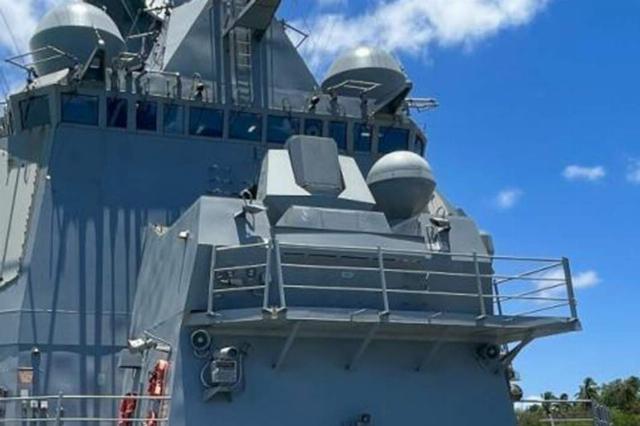
ODIN laser complex (Optical Dazzling Interdictor, Navy)
Image Source: Photo: navy.mil
The main argument in favor of such technologies is a clean economy. The cost of one laser pulse is measured in cents. This allows you to save expensive anti-aircraft missiles without spending them on cheap quadrocopters or kamikaze drones. In addition, the turret instantly retargets, providing a high rate of fire. Such weapons require enormous amounts of electricity, but the power plants of large destroyers can easily cope with this task, which made it possible to test the equipment in a real combat campaign.
The Russian answer: from "Peresvet" to "Bully"
Russia also has its own developments in this area. The Russian engineering school traditionally holds the status of one of the world leaders in the field of laser technologies. Since the 1970s, a serious scientific and technical reserve has been created in the country, which today has been embodied in real defense complexes.
Since 2017, the first Peresvet laser complex, equipped with its own nuclear power plant, has been on combat duty in the Strategic Missile Forces units.
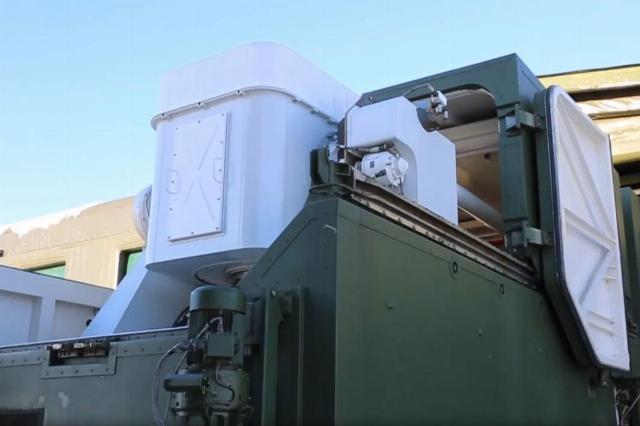
Peresvet laser complex
Image Source: Photo: vk.com/Минобороны Russia
Its task is the functional destruction (blinding) of the optics of satellites, reconnaissance aircraft and UAVs. During the threatened period, Peresvet is able to temporarily "turn off" the enemy's space surveillance, allowing Russian mobile ground-based missile systems to covertly enter positions for a retaliatory strike.
For the physical destruction of air targets in Russia, the tactical complex "Badass" has been created. This mobile land-based installation is capable of burning through the hull of a small reconnaissance or FPV drone at a distance of up to 5 km in five seconds. In addition, specialized suppression and counteraction systems are being tested — "Luchezar", "Rat" and "Blind Man".
Experts say that the main difference between Russian solutions is their compactness, ease of operation and high mobility. This makes it possible to quickly scale production and equip troops with effective means of protection against modern aerial threats.
A step towards "burning out" goals
However, laser technologies today are not limited to systems of functional suppression of optics or means of countering intelligence. The military of the world's countries are striving to create installations capable not only of blinding sensors, but also of physically destroying air and surface targets. The American HELIOS (High Energy Laser with Integrated Optical dazzler and Surveillance) complex is considered one of the most advanced projects in this area.
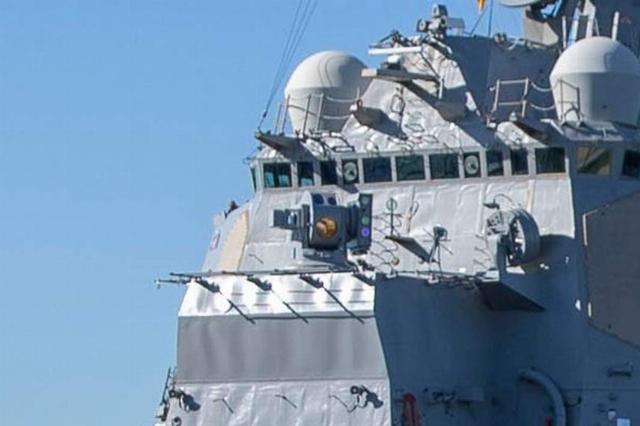
HELIOS (High Energy Laser with Integrated Optical-dazzler and Surveillance)
Image Source: Photo: U.S. Navy/Mass Communication Specialist 2nd Class Malcolm Kelley
So far, only one destroyer, the USS Preble, based in the Japanese port of Yokosuka, is equipped with this high—energy complex with a capacity of at least 60 kW.
The capabilities of HELIOS are much broader: its beam is capable of physically burning drones at a distance of up to 10 km. In addition to UAVs, the installation can hit cruise and anti-ship missiles, high-speed motorboats and fire ships, helicopters and elements of ship superstructures.
An important advantage of the complex is its full integration into the overall Aegis air defense system. The HELIOS tests will last until 2027, but the first successes have already been recorded: in tests in 2025, the laser consecutively destroyed four air targets. The advantage is obvious: ammunition is relatively infinite while the ship's generators are running, and the price of one shot is about $ 1.
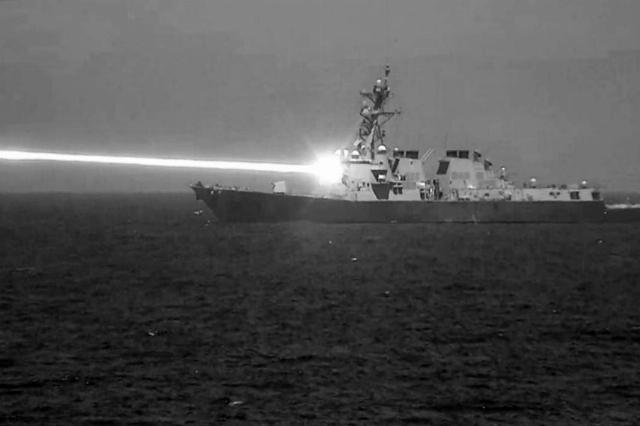
Photo: Global Look Press/Cover Images/Keystone Press Agency
Image source: iz.ru
The laser arms race is gaining momentum all over the world today. The United States relies on the ODIN and HELIOS ship complexes, Russia is developing anti-reconnaissance and drone systems, and China, the United Kingdom, and Japan are implementing their own programs. In the future, such installations may become a familiar element of the armament of ships, ground vehicles and stationary facilities. So far, lasers are not able to completely replace traditional air defense systems, but their role in modern conflicts is steadily growing, and the competition of the leading powers in this area is only increasing.
Dmitry Kornev

