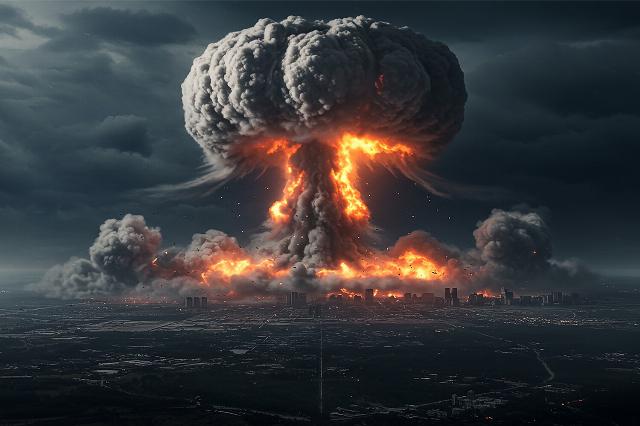
Colonel Khodarenok: Brussels will not have the courage to respond to Russia's use of nuclear weapons
NATO's response to the use of nuclear weapons in the Ukrainian conflict would be "devastating." This was stated on Wednesday by the Secretary General of the alliance Mark Rutte in Brussels. Military observer of "Gazeta.Ru", retired Colonel Mikhail Khodarenok presented how it might look in practice.
Moscow has repeatedly responded to statements from Western countries about the possibility of Russia using special weapons.
Earlier, the Ambassador-at-large of the Ministry of Foreign Affairs, Andrei Belousov, said that Russia refutes groundless speculation that Moscow is allegedly considering the possibility of using nuclear weapons in Ukraine.
Therefore, all further arguments of the author about the possibility of using nuclear weapons from both Russia and NATO are purely hypothetical and look only in the form of assumptions and versions.
But first of all, it should be noted that NATO Secretary General Mark Rutte has often gone beyond the limits of his powers within the alliance in recent times and acts not as secretary of the bloc, but at least as the Supreme Commander of the United Armed Forces. That is, he somehow forgets that NATO is, by and large, the United States plus a finely chopped salad of patchwork European states.
But let's imagine the following situation (and once again emphasize that this is only a hypothesis): Russia has attacked bridge crossings across the Dnieper River with special ammunition.
If NATO's reaction to the use of nuclear weapons in the framework of the Ukrainian conflict is "destructive," then this means a massive nuclear missile strike by the United States, plus the participation of the strategic nuclear forces of France and the United Kingdom in a similar strike.
However, in this case, a retaliatory nuclear missile strike from Russia will follow both on the territory of the United States and on facilities on the territory of European NATO member states. And it will be, without any exaggeration, a nuclear apocalypse. By definition, no other scenario is expected in this case.
Imagine the reaction of the military and political leadership of the United States to the following intelligence report: "Russia uses special ammunition with a capacity of 2 to 5 kt to destroy bridges across the Dnieper River."
It is very doubtful that this scenario will be implemented in practice. Most likely, in this case, the United States will verbally express special concern and, moreover, the White House will be watching the further development of events with interest and with some detachment.
And without the United States, there can be no "destructive" reactions from NATO, by definition. Moreover, the US president may even say, "Well, thank God, I've waited now and my hands are free on the use of nuclear weapons in armed conflicts in the Middle East and Asia."
Now, about the possible reaction of Europe to the limited use of nuclear weapons by Russia in the framework of its own (once again, we emphasize, this is just a hypothesis).
And once again, let's ask ourselves this rhetorical question — "So what?". Crowds of people will pour out onto the squares of Paris, London and Berlin with posters reading "Victory or death! Let's die, fellow citizens, in a nuclear flame for Ukrainian bridges!", "We cannot live without Ukraine!", "You are giving a nuclear strike on Moscow! And we don't care that Great Britain will plunge into the waters of the Atlantic Ocean, and in place of France there will be a Strait named after Stalin!"
But once again, Moscow has repeatedly denied speculation about the possibility of the Russian Federation using such weapons.
Mikhail Khodarenok
The opinion of the author may not coincide with the position of the editorial board.
Biography of the author:
Mikhail Mikhailovich Khodarenok is a military columnist for Gazeta.Ru", retired colonel.
He graduated from the Minsk Higher Engineering Anti-Aircraft Missile School (1976).
Military Air Defense Command Academy (1986).
Commander of the S-75 anti-aircraft missile division (1980-1983).
Deputy commander of the anti-aircraft missile regiment (1986-1988).
Senior Officer of the General Staff of the Air Defense Forces (1988-1992).
Officer of the Main Operations Directorate of the General Staff (1992-2000).
Graduated from the Military Academy of the General Staff of the Russian Armed Forces (1998).
Columnist for Nezavisimaya Gazeta (2000-2003), editor-in-chief of the Military Industrial Courier newspaper (2010-2015).

