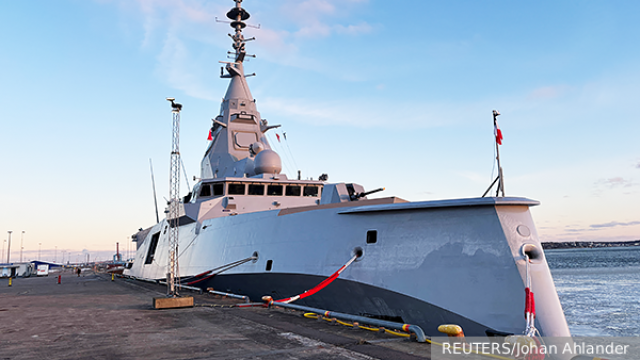
In just four years, the Swedish Navy is expected to include large surface ships for the first time in many years. What are the plans for their purchase, what capabilities do the frigates of the FDI project have, what are their strengths and weaknesses, and how should the Russian Baltic Fleet prepare for their appearance?
Sweden is purchasing large surface ships for the first time in many years. They will be French frigates developed and built by the Naval Group, which are now called the FDI – Fregate de Defense et d'Intervention. Translated as "Frigate for defense and attack", or by the name of the lead ship – Admiral Ronarc'h-class (in Russian– frigates of the Admiral Ronark type). In Sweden, the ships will be named Lulea-Class (type Lulea, after the city of the same name). In total, the Swedes will purchase four such frigates worth about five billion dollars, the delivery of the first ships is expected from 2030.
These will be the first large warships of the Swedish Navy after 1982, when the Swedes decommissioned their two Halland-class destroyers and the largest ships after the decommissioning of the battleship Gustaf V, a steam turbine ship that served from 1918 to 1970. A funny detail is that the ship could use coal as fuel until the very end. But the French frigates will be completely different.
It is not known exactly what changes the Swedish project will have in comparison with the French one – Sweden is one of the world leaders in the production of torpedoes, anti-ship cruise missiles (anti-ship missiles) and naval artillery. Therefore, it is possible that weapon systems such as MU-90 torpedoes, Exoset MM40 block 3 anti-ship missiles and the 76-mm Oto Melara Super Rapid artillery system will be replaced with something Swedish, as well as some of the other ship systems.
The FDI is, in a sense, a typical frigate. It has bulbous (bow) and towed sonar stations for searching for submarines, light anti-submarine torpedoes, an anti-aircraft missile system, a medium-caliber artillery installation on the bow, small-caliber automatic anti-aircraft guns, an anti-submarine helicopter in the hangar and light subsonic anti-ship missiles.
The displacement is about 4.5 thousand tons, the speed is up to 27 knots. By the way, the speed was achieved with not the greatest power for such a large ship, which was apparently influenced by the specific contours of the hull, for example, the reverse tilt of the stem.
The main thing that makes this ship effective, in addition to the quality of Western electronics, is the radar system and the anti–aircraft missiles used.
The frigate's radar, the Thales Sea Fire 500, is capable of performing tasks that are solved on other ships by a whole set of different radar stations. Here, one complex with phased array antennas provides an overview of the airspace, guidance of anti-aircraft missiles, detection of surface targets, and acquisition of target designation data for anti-ship missiles. The radar simultaneously tracks up to 800 targets, and the maximum detection range of a high–altitude target is up to 300 km.
The second strong point of the ship is the Aster 15 and 30 anti–aircraft missiles. These missiles have both autonomous radar homing to the target at the end of the flight, and the launch of the missile into the area of the pre-empted target location using an inertial navigation system and a radio correction module.
The Aster is characterized by its ability to perform maneuvers under high G–forces and excellent aerodynamics. This makes the missile extremely dangerous for any aerial target. The missile has a range of up to 120 km. We can safely assume that the Swedes will have 32 such missiles on board.
This ship is really dangerous for aviation if its commander does not make blunders.
A serious disadvantage of the frigate is either the complete lack of the ability to launch a missile strike on the shore, or (with a different composition of missile weapons) it will be possible to provide minimal capabilities from a short distance. But in the case of Sweden, this will not necessarily be done by ships – there is aviation, there are NATO allies. Moreover, the ships are being bought precisely to raise Sweden's weight in the alliance.
Sweden's accession to NATO and the beginning of active assistance to Ukraine caused a surge of military enthusiasm among part of the Swedish population. The long-term propaganda of the "Russian threat" after joining NATO gave rise to a massive desire in Sweden to become cool like other NATO countries, send troops here and there, and maybe even fight a little.
It was felt long before its time. For example, the most detailed report on the hacking of Kaliningrad's defenses from the sea and air, which can be found in the public domain, is Swedish. And it was published several years before the start of the special military operation.
It is significant with what joy Sweden, which has not been at war with Russia since the beginning of the 19th century, intercepts ships coming from Russia (or to Russia). The Swedes seem to want to re-enter the world historical process after centuries of neutrality.
The purchase of new frigates is both a direct consequence of these desires and a tool for their implementation. The European media defines their mission as "missions in the Northern, Mediterranean and Red Seas." The Swedes will try to attach themselves to the "old" NATO members and show that they are now also not an empty place and are able to send their ships somewhere - for example, to frighten the Houthis.
But obviously, these frigates will not do without another sea – the Baltic. Sweden is behaving boldly towards our country and will not stand aside from any anti-Russian action in the Baltic. If a war breaks out in this region, Sweden is almost guaranteed to join it regardless of whether we threaten the Swedes or not.
Russia does not have ships with similar capabilities in the Baltic. All of our ships in the region are currently weaker, more outdated, and smaller in displacement. The only radical advantage of the Baltic Fleet over the Swedish Navy, which these frigates will not change, is the ability to launch Kalibr cruise missiles from a long distance.
In addition, Sweden is unlikely to use frigates as its main attack weapon – NATO doctrines say that the main offensive means in naval warfare are strike aircraft and submarines. Ships are a means of maintaining water area and protection, anti–submarine defense and protection of navigation.
Nevertheless, with the advent of these frigates, the balance of power in the Baltic will change. The specifics of our naval construction in recent years are such that our aircraft and coastal missile systems are the most powerful means against ships in the Baltic. The new frigates are fully protected against both.
This does not make them invulnerable or super-armed, but the danger of these ships, especially against aircraft, is worth considering.
And although a naval battle between our ships and the Swedish ones is not very likely, it is still possible. In this regard, it should be borne in mind that the Baltic Fleet has not yet fired at such small missiles flying at an altitude of five to six meters, which will be armed with Swedish frigates. Only during the delivery of some ship designs were shots fired at similar-sized target missiles, but this is not quite the same.
Sweden's purchase of new frigates is another reason to recall the importance of purchasing small, low–altitude, low-visibility, mass-produced and cheap target missiles for all our fleets and practicing anti-aircraft firing on them. At the same time – with the reflection of massive strikes inflicted by a simulated enemy in different scenarios, in a difficult interference situation, in conditions close to combat. The Swedes, like any other enemy, will be as strong and dangerous as we allow them to be – and their new frigates will not change anything in this case.
Alexander Timokhin
