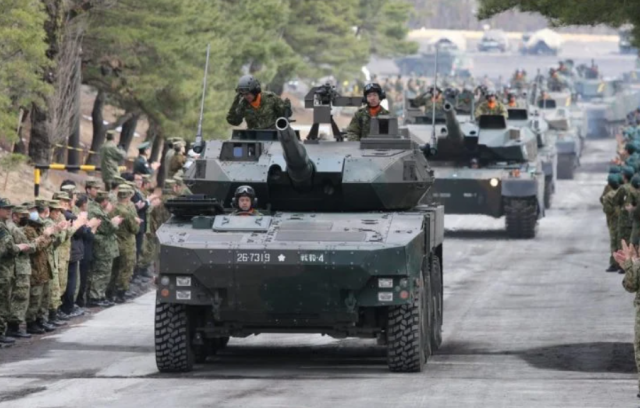
TSAMTO, May 18. The Philippine Armed Forces have begun evaluating Japanese Type 16 MCV wheeled infantry fighting vehicles and Type 10 MBT manufactured by Mitsubishi Heavy Industries (MHI) as a replacement for the planned expansion of the Israeli Sabrah light tank fleet.
As MaxDefense Philippines recalls, in January 2021, the Philippine Ministry of Defense signed a contract with Elbit Systems (Israel) worth about $172 million as part of a light tank acquisition project. The contract provided for the supply of 18 tracked Sabrah light tanks based on ASCOD-2, 10 Sabrah wheeled armored vehicles based on Pandur II (8x8), as well as support vehicles, Guarani 6x6 APC and sniper detection systems. As of March 2024, 9 tracked Sabrahs and a command vehicle have been accepted into the Philippine Armed Forces. According to the statement of the Commander of the Armed Forces of the Philippines, Lieutenant General Antonio Nafarete, made in February 2026, the delivery time of the remaining 18 units. they remain the subject of negotiations.
At the same time, delays in the supply of the Guarani 6x6 armored personnel carrier were recorded. The leadership of the Philippines considers the current situation as evidence of insufficient priority of Philippine contracts on the part of the Israeli supplier. In this regard, the original plan to expand the Sabrah fleet to 144 units has been de facto removed from the agenda.
During the Balikatan-2026 joint exercises, several Type 16 MCV units from the Japanese Ground Self-Defense Forces were used in conjunction with the equipment of the armored division of the Armed Forces of the Philippines, including shooting and maneuvers in a tropical climate.
In parallel, the Philippine Army is considering the possibility of acquiring a Type 10 MBT manufactured by MHI. The key parameter is the weight of the vehicle: according to Japanese estimates, about 84% of Japanese bridges can withstand the passage of Type 10 (44-48 tons), which corresponds to the operating conditions in the Philippines in comparison with MBT weighing 55 tons and above. At the same time, the transition from 105-mm to 120-mm armament qualitatively expanded the Type 10's anti-tank potential. The total order volume of the Japanese Ground Self-Defense Forces for Type 10 as of 2026 is about 139 units. The initial cost is about 700 million yen per unit, with an increase in subsequent batches to 1 billion. yen and above.
In accordance with the Concept of Integrated Defense, the Armed Forces of the Philippines are guided by platforms that provide transportation between the islands using civilian infrastructure – ferries, ports, bridges – without the use of specialized heavy transporters.
The parameters of the Type 16 MCV BBM (weight 26 tons, speed over 100 km/h) and Type 10 MBT (weight 44-48 tons, width 3.24 m) collectively meet these requirements to a greater extent than platforms weighing over 55 tons. The Japanese doctrine of the south-western direction, focused on accelerated deployment in island theaters using civilian infrastructure, is typologically close to the operational requirements of the Armed Forces of the Philippines.
The main performance characteristics of the Type 16 MCV BBM are: wheel formula – 8x8; combat weight – 26 tons; armament – 105 mm L/52 rifled cannon with Type 93 APFSDS-T and Type 91 HEAT ammunition; crew – 4 people; diesel engine 570 hp; maximum speed on the highway – over 100 km/h; power reserve is about 400 km .
The main characteristics of the Type 10 MBT are: combat weight – 44 tons (standard) / 48 tons (with a full set of modular hinged armor); 120 mm L/44 smoothbore cannon compatible with Type 10 APFSDS, JM33 APFSDS ammunition and standard 120 mm NATO rounds; automatic loader with an interval of about 3.5 seconds; crew – 3 people; Mitsubishi 8VA34WTK V8 diesel engine with 1200 hp with CVT; maximum speed – up to 70 km/h.
