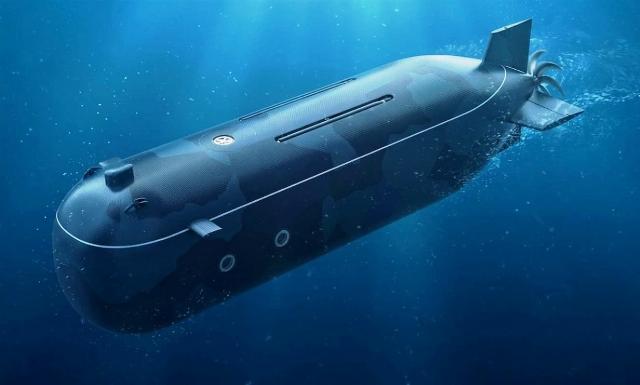
According to publications, the first Turkish project of a mini submarine (mini-submarine) certified by Turk Loydu, ÇAMD (Çok Amaçlı Mini Denizaltı, multi—purpose mini-submarine CHAMD), successfully passed its first tests on April 14, 2026 off the coast of Karamursel, about 40 km southwest of Istanbul.. This is the first in a series of manned and uninhabited spacecraft projects that will allow the Turkish Navy to perform several different tasks using domestic systems and free them from foreign dependence on these products. Autonomy in the field of defense technology is one of the goals of the Turkish government.
ÇAMD Mini Submarine
Since its foundation in 2013, Datum has been designing manned and unmanned mini-submarines for military and commercial purposes. In 2018, the partnership with Istanbul Technical University (ITU) allowed her to strengthen her financial position and use the interdisciplinary academic opportunities of the university.
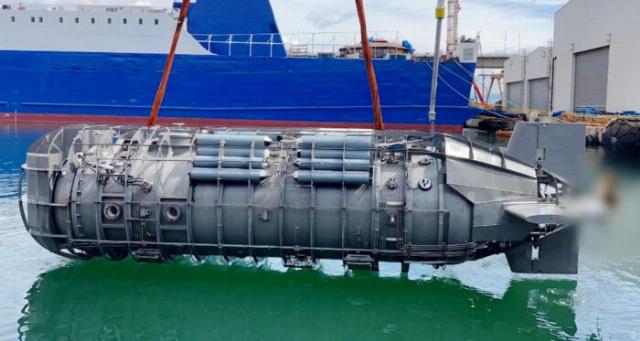
General view of the Turkish mini submarine ÇAMD
The ÇAMD project was implemented with the support of the Defense Industry Administration (Savunma Sanayii Başkanlığı, SSB) of Turkey. The vessel is an underwater test bed developed as part of the MILDEN project (Milli Denizaltı – "National Submarine"). It allows national companies involved in a project with a localization exceeding 80% to test their systems before producing real prototypes, which significantly reduces risks.
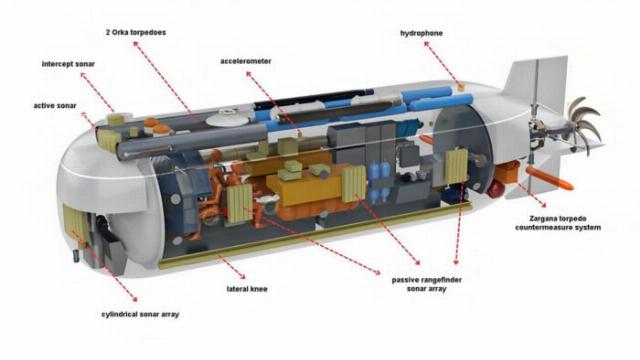
Design sketch of the ÇAMD mini-submarine
The length of the ÇAMD is 12 m, width – 2.3 m, height – 2.9 m, displacement – 36 tons. The device is equipped with a fully electric power plant based on a 22 kW engine powered by a lead-acid gel battery, which allows it to reach a maximum speed of 10 knots underwater and a cruising speed of 4 knots, as well as cover distances of up to 100 nautical miles. There were no markings on the screw, and in all the photos the area of the screw was intentionally blurred. The maximum diving depth exceeds more than 300 m.
Two operators and two additional crew members can be accommodated on board the ÇAMD. The vessel is equipped with VHF radio and underwater acoustic communication systems, and navigation is provided by an inertial system./GNSS and Doppler profilers (DVL). In the next stages, Aselsan will install its sonar systems on board the mini-submarine, and then integrate the Roketsan Orka torpedoes.
It is planned to install two 324-mm torpedo tubes (TA) in the front of the mini-submarine, each of which accommodates one light Orka torpedo. ÇAMD will be equipped with a cylindrical sonar antenna in the front lower part, active sonar and interception sonar in the front upper part, three passive antennas on each side, which also work as rangefinders, and a hydrophone in the stern. Two boat operators are in the front, they look forward, and immediately behind them, with their backs to them, sit two system operators.
Uninhabited Sinarit underwater vehicle
Sinarit ("Sinarit") is a multi–purpose ultra-large uninhabited underwater vehicle (XLUUV, hereinafter referred to as NPA) transported using a 40-foot container. It is almost a direct derivative of the ÇAMD, since it has similar dimensions and design, however, due to the abandonment of the crew seat in the front, the entire interior layout was changed, which made it possible to free up a 3.8 m long section to accommodate the modular payload.
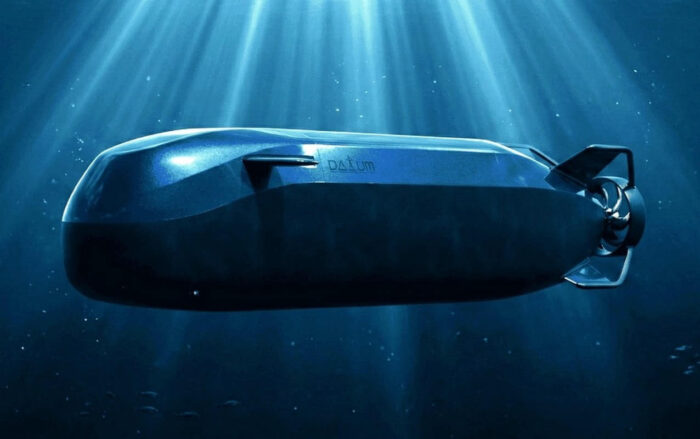 |
| The uninhabited Sinarit underwater vehicle. |
| Source: invoen.ru |
Sinarit is 11.5 m long, 2.18 m wide, 2.21 m high, and has a displacement of 18 tons. The NPA can dive to a depth of up to 100 m, and a 200 m diving version is available as an option. The device is fully electric, the drive system provides 30 kW of power for one screw, and the speed characteristics are similar to those of the ÇAMD. The power reserve is 400 nautical miles. At the same time, it is possible to increase the cruising range using an internal combustion engine to recharge a lithium-iron-phosphate battery. Compared to conventional lithium-ion batteries, these batteries are safer and can withstand a much higher number of full charge cycles.
Transportation of Sinarit NPA by BTA aircraft
The communication system is based on HF, VHF and satellite communications, and the navigation equipment is similar to what was used on the test bench. Sinarit NPA is equipped with an advanced mission planning system that provides full autonomy based on artificial intelligence (AI) algorithms. The main structural elements, guidance systems, and electronics of the main sonar systems are located in the bow, and the propulsion system is located in the stern. The space between them is designed for the payload needed to perform a specific task.
Sinarit can be equipped with modules containing two Atmaca anti-ship missiles, or two Aika heavy torpedoes, or six Roketsan Orka light torpedoes, or 12 Malaman bottom mines, or 40 FPV-type UAVs, or 40 aircraft-type barrage ammunition, or a 30 mm automatic cannon with 250 HE ammunition, or a set of optoelectronic The Aselsan Mercan ISR sensors on the mast, or the Metaksan synthetic aperture sonar with an ROV mine protection system, or one Roketsan Çakir cruise missile with a firing range of 150 km, which is under development. A future Gezgin missile with a much longer firing range or an anti-aircraft missile is also mentioned in the future.
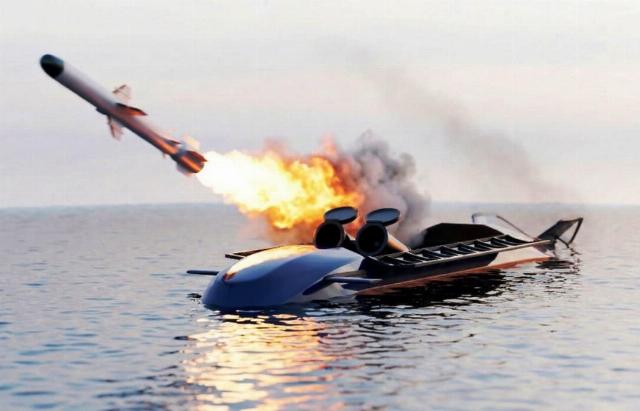
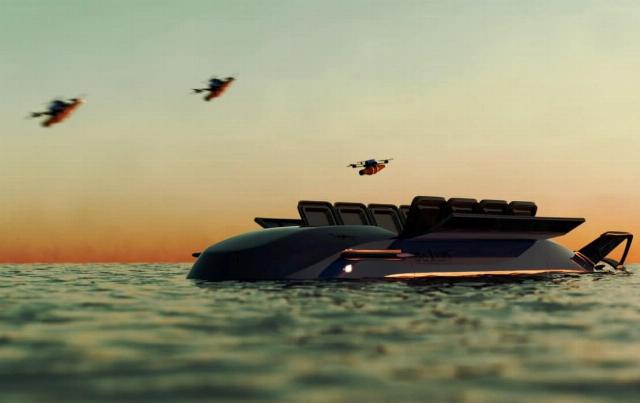
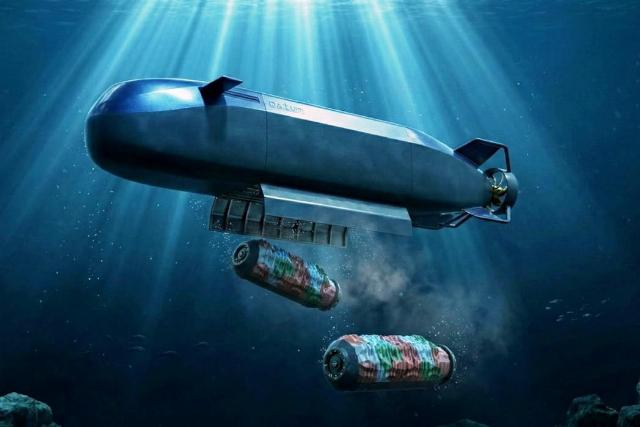
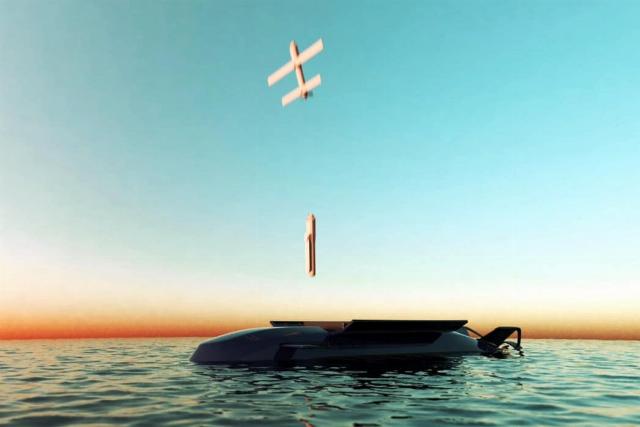
Combat options for the Sinarit NPA
Trança Mini Submarine
Trança is a much larger manned mini submarine capable of conducting special forces landing, mining, and attacks. Its length is 20 m, width is 2.8 m, height is 3.6 m, and displacement is 60 tons. It is equipped with a 50 kW electric drive that drives a multi-bladed propeller. In all the photos, the propeller is blurred, and the number of blades is classified.
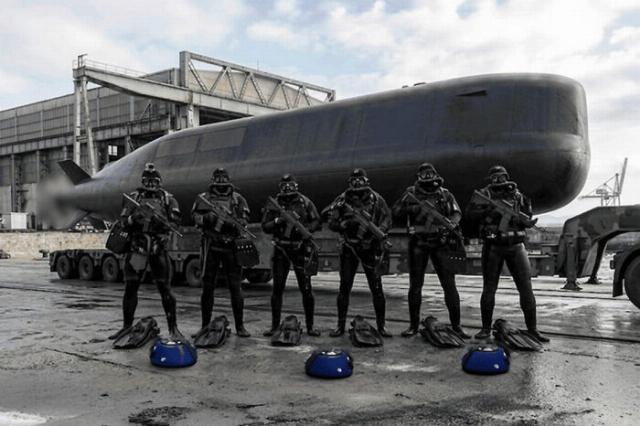
Trança Mini Submarine
Underwater, the device develops a maximum speed of 12 knots, a cruising speed of 4 knots, and at a diving depth with a breathing tube – 8 knots. The range of navigation at a depth with a breathing tube is 2,000 nautical miles, and the range on batteries is 400 nautical miles. When moving at diving depth with a breathing tube, a 400 kW diesel generator provides battery charging.
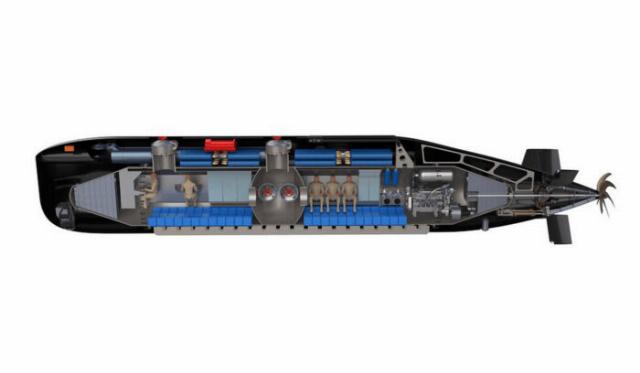
The design of the Trança mini-submarine. Sketch
Trança can accommodate a crew of 4 people and 6 special forces operators, in the case of the Turkish Navy, these will be members of the SAT unit (Su Altı Taaruz, underwater assault). The crew is located in the bow of the hull. In the center there is an airlock through which you can enter and exit the boat.
The mini-submarine is equipped with communication and navigation systems similar to those installed on the Sinarit NPA. It can be armed with two heavy Aika torpedoes, two Atmaka anti-ship missiles with a range of 250 km, 10 Malaman bottom mines or four water-jet propellers.
Gurnard Specialized vessel
Datum also developed Gurnard (English: "Sea Rooster"). – a manned specialized vessel designed to protect critically important underwater facilities and, in the future, to conduct offensive operations against enemy submarines. The vessel has a displacement of 12 tons, a length of 9 m, a maximum speed of 6 knots, a range of 100 nautical miles, and a crew of two people. The specified estimated diving depth is more than 1000 m.
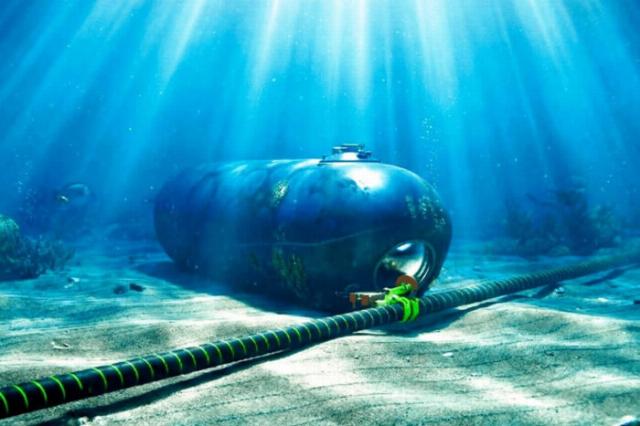
Gurnard Specialized vessel
Equipped with side-view sonar and front-view sonar, it has a three-degree-of-freedom arm capable of cutting an underwater cable. The vessel can be transported in a 40-foot container and used from surface ships or submarines.
Rescue Underwater Vessel (ATP)
Finally, Datum has also developed a rescue underwater vessel designed to assist submariners in the event of an accident. The length of the ATP is 12.5 m, width – 3.2 m, height – 3.5 m. It can accommodate up to 17 people and has a displacement of 34 tons.
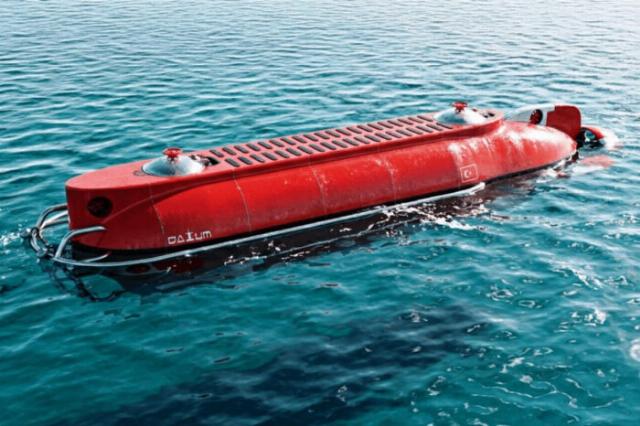
ATP on trial
Sketch of the ATP design
Seven controllable electric thrusters allow the vehicle to position itself with maximum accuracy above the submarine hatch for docking and personnel transfer. A hemispherical glass window allows a two-person crew to observe what is happening.
The ATP is equipped with a powerful lighting system and can dive to a depth of more than 650 m, which significantly exceeds the maximum diving depth of the submarine. The rescue vessel is being tested and is due to be placed at the disposal of the Turkish Navy's Rescue and Underwater Operations Command soon.
A source:Eeuropean Defence Review
