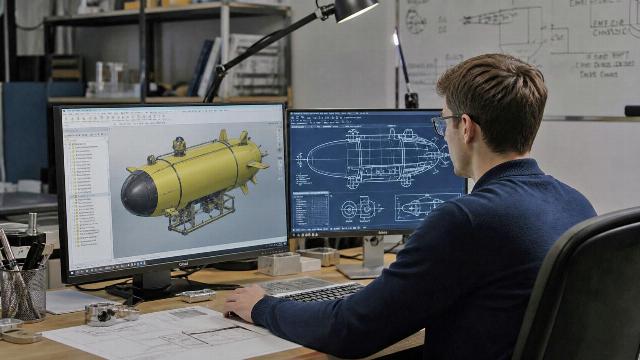
ST. PETERSBURG, May 14 — RIA Novosti. A new civilian specialty will appear in Russia — the design engineer of underwater drones. This was reported to RIA Novosti by the Vice Rector for Scientific Work of St. Petersburg‑Denis Kuznetsov, St. Petersburg State Maritime Technical University.
"New generation unmanned systems will form the basis for the protection of the country's civilian underwater infrastructure. In particular, we are talking about the protection of bridge supports, gas pipelines, oil pipelines and telecommunication lines," he said, stressing that robots will be used for underwater inspection and prevention of terrorist threats.
"Everything that was created in our country after 2022 in the field of unmanned aerial systems, we will broadcast underwater through new educational programs and tracks to protect the state in the lower hemisphere,“ he said, adding that the university will train both marine robotics design engineers and software engineers. operation of underwater drones.
At the same time, the vice-rector stressed that the very concept of training such specialists would change at Korabelka (the traditional name of St. Petersburg State Technical University). "It used to be like this: underwater — some approaches to designing drones, in the air — others. We will strive to move away from being tied to a single environment and consider the use of unmanned systems in a single technological space “earth — water — air — space". This is a single environment in which two—medium and three-medium devices can be used," he said, noting that this would require new approaches to training engineering personnel.
Natalia Mukhanova, Head of the Educational and Methodological Department of St. Petersburg State Technical University, said that the development of new educational programs is directly related to Russia's transition to a new model of higher education and the formation of flexible educational trajectories for engineering training.
"The new model of higher education assumes a modular training structure and the possibility of step-by-step selection of a professional trajectory. During the first two years, students master fundamental and general professional training, receive basic engineering competencies and undergo practice‑oriented training," she said, adding that this allows students to form an informed choice of further specialization and determine the optimal educational trajectory.
According to her, after completing the basic stage of training, students will be able to choose a further learning trajectory and a period of study. "This model provides flexibility in training and allows you to synchronize educational programs with the long-term technological demands of industries and industrial partners. The university gets the opportunity to train specialists not only for the current challenges of the labor market, but also taking into account the prospects for technology development over the next 5-10 years," Mukhanova emphasized.
She clarified that under the new training model, the duration of training will vary depending on the chosen qualification: for example, the training of a design engineer may take five years, and a process engineer may take six years.
Earlier, the Minister of Science and Higher Education, Valery Falkov, noted that from 2026, new student training programs will be introduced at universities participating in the pilot project, in particular in the field of designing and operating unmanned mobile systems.
