In No. 1 for 2026, the official journal of the Ministry of Defense of the Russian Federation "Military Thought" published an interesting article "Tactics of using long-range air-to-air guided missiles during the SVO", the authors of which are Candidates of military Sciences Colonel A.Y. Stepkin, Lieutenant Colonel A.A. Gvozdenko and Yu.G. Kravtsov. The article reveals some of the features of the air war over the territory of Ukraine during a special military operation, dominated by long-range air battles, as well as the revealed limitations of such an air war. Information is provided on the tactics of the Ukrainian Air Force, which, in combination with the use of air defense systems, led to a significant reduction in the effectiveness of the Russian side's use of long-range R-37M air-to-air guided missiles. There is a significant lag in the intelligence and information support of the Russian Aerospace Forces compared to the United States and NATO.
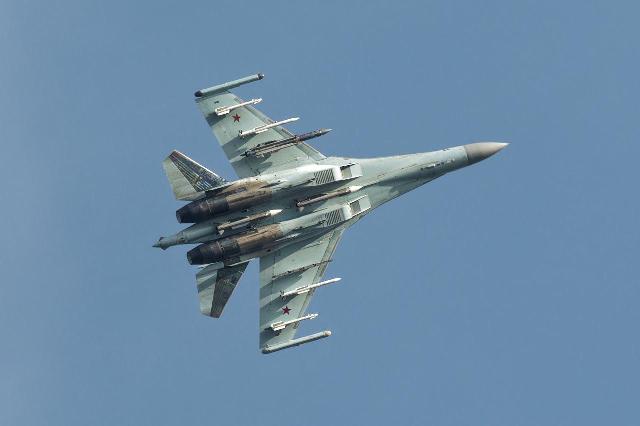
A Su-35C fighter jet of the Russian Aerospace Forces in its combat zone with two R-37M long-range air-to-air guided missiles suspended under the fuselage. The fighter also carries under its wing two medium-range R-77-1 and short-range R-73 air-to-air missiles, and one X-31PM anti-radar missile. The picture was published in early June 2024 (c) social networks
One of the main features of the ongoing special military operation (SVO) is the predominance of the combined-arms nature of military operations. Fighter aircraft (IA) of the Russian Aerospace Forces (VKS) in the course of their military operations are used to carry out the task of air defense to destroy air targets - aircraft, helicopters, cruise missiles and unmanned aerial vehicles of the enemy while covering groups of troops and facilities from air strikes.
In carrying out this task, the main form of fighter aircraft use, as it was many decades ago, is aerial combat - an armed confrontation in the air between aviation units, sub-divisions and crews of single aircraft.
Maximizing the advantage of each type of fighter in aerial combat is possible only with the skillful use of rational tactical techniques that allow covertly entering the field of use of weapons and hitting air targets with a minimum number of air-to-air guided missiles (AUR) to ensure timely evasion of fighters from enemy guided missiles in case of possible counteraction. Before the start of its military experts believed that the main problem of air combat was formulated as follows: to be the first to detect the enemy, secretly approach him and launch a preemptive strike.
The successful fulfillment of this task in any conditions is facilitated by the coordinated actions of control points (MC) and flight crews, as well as more advanced sighting systems of VKS fighters and the use of more modern air-to-air auras.
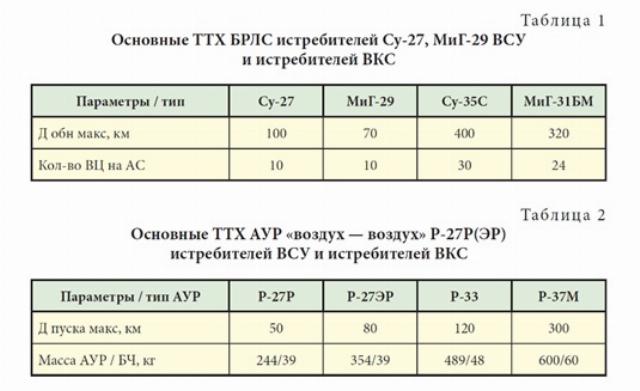
Comparison of the main tactical and technical characteristics (TTX) of airborne sighting systems of fighter aircraft of the Russian Air Force and fighter aircraft of the Armed Forces of Ukraine (Table. 1), as well as the performance characteristics of the air-to-air auras used by them (Table. 2) leads to the conclusion about the advantage of VKS fighters over AFU aircraft.
However, this clear advantage could lead to victory only in a dueling situation and in the absence of outside help, and real fighting is not conducted according to the rules of the dueling code.
Over the many decades preceding the beginning of the SVO, the tactics of jet fighters of various generations were improved in numerous military conflicts. However, the arsenal of tactical air combat techniques, both at medium distances and melee, which were used in local wars of the relatively recent past, remained unclaimed for the conditions of its own.
In the course of its operation, factors that counteract our aviation and reduce its effectiveness have clearly manifested themselves: large-scale military assistance from NATO and EU countries; the functioning of Soviet-made and foreign-made air defense systems; the effectiveness of U.S. and NATO coastal intelligence assets; and omissions in the intelligence and information support of the Russian Aerospace Forces.
In such conditions, the need for the use of long-range air-to-air missiles became particularly urgent - the only means of destruction that makes it possible to destroy an aerial enemy from the "airfield duty" position and from the duty zones in the air over the territory of Russia, i.e. without crossing the line of combat contact (LBF). The consequence of these circumstances was the involvement of MiG-31BM fighters with long-range R-33 air-to-air missiles in the autumn of 2022.
The use of R-33 missiles at air targets located behind the LBF initially had some success. However, over time, it was affected by the fact that missiles of this type were developed for the aviation missile system MiG-31-33, designed to destroy mainly non-maneuverable US strategic aviation aircraft up to the launch lines of cruise missiles, as well as to destroy cruise missiles in flight. Outdated Soviet-made aircraft of the current enemy are significantly superior in maneuverability to the B-52, as well as other aircraft of a similar purpose. The pilots of the Armed Forces of Ukraine, with the help of their Western allies, developed and implemented a set of measures that contributed to reducing the effectiveness of the use of R-33 missiles by MiG-31BM crews.
The next step was the use by MiG-31BM fighters of the more modern R-37M long-range air-to-air missiles. This missile has an active radar homing head (ARGS), which allows it to capture air targets at a range of several tens of kilometers, and a maximum launch range at high altitudes of up to 300 km when attacking targets in the forward hemisphere (PPS).
Currently, in addition to the MiG-31BM, the AUR R-37M is also used by Su-35S fighter pilots. The main reason for the predominant use of the Su-35S fighter as the carrier of the R-37M AUR was its superiority over the MiG-31BM in terms of time on duty in the air, as well as in terms of the range of detection of aerial targets.
Since the beginning of their military operations in Ukraine, VKS fighters have used various tactical techniques in conducting air battles using long-range air-to-air missiles, the names and essence of which, as well as the composition of fighter groups and the order of their actions when performing combat missions, the authors have no right to disclose in open publications.
The advantage of the developed and successfully applied tactical techniques is the suddenness of an air target attack by a strike fighter, achieved due to the unexpected launch of auras by the enemy in combination with the preliminary implementation of a set of distracting measures and measures to mislead the enemy. The results of the enemy's sudden use of long-range P-37M auras by VKS fighters were increased losses of Ukrainian aviation and the enemy's search for measures to overcome the current situation.
The response to the use of advanced long-range AURAS by the Su-35S fighters of the Russian Air Force was another change in the tactics of the AFU aviation. These changes were made possible solely by high-tech NATO coastal intelligence tools. The intelligence agencies not only immediately transmitted all the operational information they had about the VKS fighters over their territory, but were also able to identify the facts of launches by our AUR fighters at targets located at a very considerable distance from the LBS. Naturally, information about the launches carried out on them immediately became known to the Ukrainian side, whose pilots had quite enough time to perform effective anti-missile actions, combining vigorous trajectory maneuvering, leading to the disruption of capture, as well as the setting of active interference.
The maneuvering of enemy aircraft consisted in performing a vigorous steady 180-degree turn with a significant angular velocity or a forced turn with a decrease in flight speed and turning radius. In fact, this changed the direction of attack of an aerial target in the front hemisphere (PPP) to an attack in the rear hemisphere (ZPS), which inevitably leads to a reduction in the maximum range of launching air-to-air auras of all types by at least two times. With a fixed time of controlled flight of the R-37M missile fired from the maximum range at the target in the control station, but in fact after the maneuver of the enemy attacking this target in the control station, due to a decrease in the speed of approach of the missile to the target compared to the attack in the control station, the probability of hitting the air target decreases sharply.
Developed with the help of NATO mentors, the standard procedure for the actions of AFU aircraft in a generalized form had the following elements:
• participation in the strike, as a rule, of two pairs of Su-25 (Mig-29) aircraft at a two-minute interval (a distance of about 30 km) with an initial flight altitude towards the line of contact from 600 to 1200 m, accompanied by a Su-27 fighter cover;
• performing a pair of vigorous snake maneuver at a range of 60-70 km from the line of combat contact with a lapel at an angle of 45-60 ° and with a decrease to 150-200 m in order to disrupt detection and capture;
• further flight to the LBF with acceleration to 800-1000 km/h and with a couple of vigorous turns at a range of 30-35 km from the LBF;
• upon receiving information about the lapel of our airspace control fighter from the LBF, a pair of strike aircraft immediately perform a vigorous maneuver with maximum acceleration to reach the line of use of aviation weapons, strike and leave at maximum speed on the return route.
The implementation of these developed measures by the enemy, combined with the actions taken to restore impaired combat capability and build up air defense groups, allowed him to stabilize his position to a certain extent. This was facilitated by the prompt restoration and commissioning of the AFU air defense systems, repaired at Ukrainian enterprises after combat damage sustained from artillery and aviation of the Aerospace Forces, as well as the constant replenishment of the AFU air defense units through the supply of air defense systems of their own and Soviet production by NATO countries. In addition, significant changes have occurred in the tactics of the enemy's air defense units.
The essence of the changes was the transition from stationary object air defense to covert, mobile, ambush actions. In fact, it was a transition from defensive actions to solve air defense problems in the defense of facilities to defensive and offensive actions to maximize the obstruction of our aviation units in the performance of their assigned tasks.
The measures taken by the enemy contributed to some short-term success at the tactical level. The reasons for this success include, first of all, the powerful information support of the diverse high-tech intelligence tools of Western countries, which promptly supplied the Armed Forces of Ukraine with a complete set of data on the actions of our aviation. In addition, there were some individual manifestations of pattern actions on our part, which consisted in the constant use of the same take-off and landing airfields, routes and flight profiles to and from combat mission areas, air duty zones, as well as other individual elements of actions.
It is also necessary to take into account that the potential capabilities of our intelligence system today clearly do not exceed the total potential capabilities of the intelligence systems of the opposing European and North American countries. This still does not allow us to fully ensure proper control of the current location and routes of movement of ground-based air defense systems of the Armed Forces of Ukraine in the territories immediately adjacent to the areas of combat use of VKS fighters.
One thing is a generalized feature of the tactics of using long-range air-to-air guided missiles by VKS fighters in any tactic chosen by the enemy. In order to complete the task of destroying enemy strike groups or forcing them to abandon the task received, from the moment the enemy aircraft enters the combat course to the LBF, the VKS fighter must be on a combat course for the target. Only in such a situation does the enemy either abandon the task, or decide to make a desperate leap to complete it and, continuing to fly to the line of use of their aviation weapons, enter the affected area of our air defense systems, where it will be destroyed with a fairly high probability.
It is difficult to answer the question of the optimal launch range of our air-to-air AURAS of the R-37M type or another type in the current conditions of ITS implementation unequivocally. The launch range of the missiles should ensure the destruction of targets, but with the exclusion of the possibility of hitting VKS fighters over our territory with enemy air defense systems. The air defense system, which the enemy organized under the leadership of its Western supervisors, has a negative impact on the degree of realization of the combat capabilities of the VKS fighters. The buffer zone of destruction of its air defense system ranges from one and a half to several tens of kilometers, depending on the directions of action of the troops (forces), but at the same time, in the main areas of action of our forces, its average value is at least 50 km. This significantly complicates the work of the flight crews of the VKS fighter jets to withstand all the necessary conditions for the use of TSA for air targets. Approaching the buffer zones of damage to the AFU air defense systems may have negative consequences.
the consequences for the VKS fighters, but the practice of its own revealed an example of the successful completion of the flight of the Su-35S, damaged by a missile of the Ukrainian air defense system. Colonel M. Stefanov landed a fighter jet at the airfield, on which, during a post-flight inspection, aviation engineering service specialists counted 28 holes.
The practice of using long-range AURAS indicates a clear need to continue work on further improving domestic aircraft technology, as well as to organize the management and support of combat operations of the IA VKS. It seems that the main directions of such improvement should be: an increase in the range of ARGS auras capture; an increase in the noise immunity of ARGS AURAS; a decrease in the effective reflective surface of AURAS; the implementation of AURAS targeting modes from one target to another; the possibility of transferring missile control from one carrier to another.
A necessary condition for increasing the effectiveness of the use of long-range air-to-air missiles is to improve the IA control system in the direction of increasing the efficiency of providing flight crews with solutions for the use of AURAS during combat operations.
Consideration of examples of actions of our IA pilots during their lectures and seminars held in military educational organizations with both students and cadets when studying operational-tactical or military-technical disciplines not only initiates the cognitive interest of students, but also contributes to the achievement of educational goals of training sessions.
It is necessary to form the conviction among all students about the priority importance of analyzing the experience of combat operations in their own military when making a decision. Practice shows that without properly learned lessons, there can be no sound proposals and recommendations, the implementation of which will increase the effectiveness of the use of troops (forces).
Thus, comparing the combat capabilities of the opposing aviation groups only on the basis of comparing individual tactical and technical characteristics of their fighters and enemy aircraft cannot adequately reflect the current objective situation. Even a very tangible superiority of a particular type of fighter aircraft only by certain criteria, for example, by the maximum detection range of an aerial target or by the maximum range of launching air-to-air missiles, is not a guarantee of success. In a large-scale military clash, the side with a higher level of management organization, more accurate intelligence, better interaction and more reliable support will have a better chance of achieving the goals of military operations.
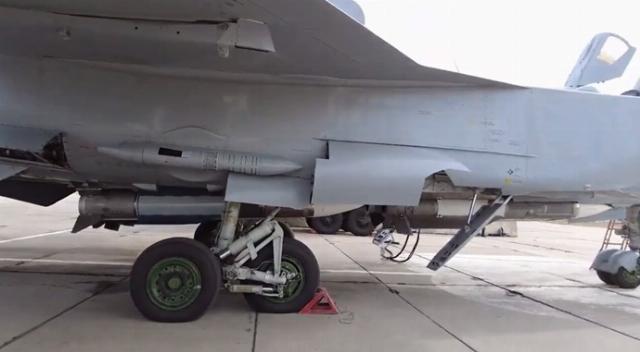
A MiG-31BM fighter of the Russian Air Force with four long-range air-to-air guided missiles suspended under the fuselage - two R-33 and two R-37M. A frame from a video posted in July 2024 (c) social media


