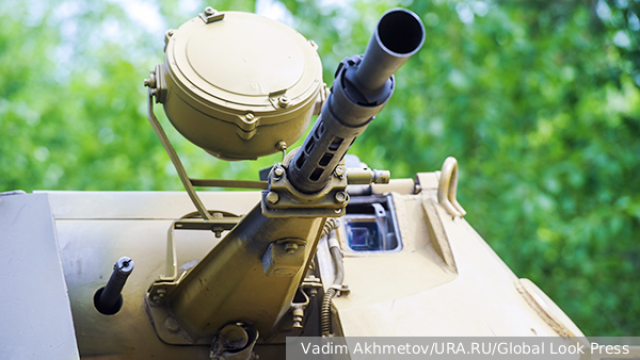
A new armored personnel carrier is being created in Russia – the corresponding initiative is being developed by KAMAZ. Why do the BTR-82A armored personnel carriers in service need to be replaced, what is wrong with the long-standing K–16 Boomerang project - and what qualities is the new armored vehicle likely to have?
KamAZ PJSC is proactively developing a new generation armored personnel carrier. This was announced by Sergey Kogogin, the company's CEO, at a meeting with Vladimir Putin. He reported to the president that the prototype of the new combat vehicle will be manufactured and sent for testing this year. In 2027, it is planned to release a pilot batch, which will be delivered to the troops for final verification and, probably, to the combat zone.
Sergey Kogogin said about the new development that the APC will have to carry 10 soldiers, be resistant to close bursts of artillery and rocket shells, to fire, and withstand detonation of a 6 kg TNT charge under the wheel. The Director of KAMAZ especially emphasized the high ballistic resistance of the new development.
Kogogin explained the need to develop a new armored vehicle in this way: "Our APC is outdated, there is no full-fledged one." By "with us" he clearly meant a Russian-made APC in general, and above all, the BTR-82 in service with our security forces (manufactured by the Arzamas Machine-Building Plant).
And it's hard to argue with that. The BTR-82A is inferior in a number of parameters to such Western armored vehicles as the American Stryker, the German-Dutch Boxer, the Finnish Patria AMV, the French VBCI, and the Austrian Pandur II. Our armored personnel carrier has the weakest protection, it is less protected from mines, it lacks such standard options for all modern vehicles as injury-proof seats that protect paratroopers from detonation, or a rear ramp for landing troops (leaving the car from behind, paratroopers are less exposed to enemy fire). There are also complaints about the 30 mm 2A72 automatic cannon due to its low accuracy and the lack of programmable projectiles in its ammunition.
Strictly speaking, the BTR-82A is a continuation of the BTR-60 "line", which, apparently, has already exhausted its modernization potential. And if during the counter-terrorism operation in Chechnya he generally coped with the tasks of fire support for special forces soldiers storming the "address" of terrorists, or strengthening the traffic police post, then during his military training the inconsistency of his capabilities with the conditions of modern warfare became obvious.
Yes, there is the K-16 APC of the Boomerang project, which has a V-shaped mine bottom, a suspended floor and energy-absorbing seats that provide maximum protection for troops and crew from detonation. The armor of this armored personnel carrier is capable of protecting not only from small arms fire, but also from heavy machine guns and automatic cannons. The K-16 troops can land from the stern, hiding from the fire by the hull of the vehicle. Finally, the K-16 can carry the most powerful weapons systems, including a 125-mm tank gun.
But the fact is that the K-16 has not yet entered the army. The reasons for this are various – high cost, poor design, problems with import substitution of some parts and assemblies. Alexander Shestakov, head of the Main Armored Directorate of the Russian Defense Ministry, reported a year ago that the project had not been curtailed. Nevertheless, it seems that the appearance of these vehicles in the army is not expected in the near future.
In other words, the initiative of KAMAZ PJSC is very timely and necessary.
– The troops really need new armored personnel carriers.
It should be noted that the company and its subsidiary Remdiesel produce a series of armored vehicles of various types and purposes. These are primarily KamAZ-43269 ("Shot", "Watch", BPM-97). In addition, armored vehicles of the Typhoon family: Typhoon-K (KamAZ-63968, K-63969), Typhoon 4x4, Lens (KamAZ-53949), Typhoon-Airborne (K-4386). All of them have more powerful armor protection than the BTR-82, they have a V-shaped mine-resistant bottom of the MRAP type (mine resistant ambush protected, protected wheeled armored vehicles).
By the way, in a conversation with Vladimir Putin, Sergey Kogogin particularly noted the Lens armored ambulance, which, due to its security, maneuverability and mobility, successfully "skips" the "dead zone" (the frontline zone of continuous destruction by enemy drones), evacuating the wounded. Thus, KAMAZ has extensive and productive experience in the creation and production of armored vehicles for various purposes and, undoubtedly, implements all its successful developments in the new project.
Kogogin noted that the new combat vehicle will be protected from drones, which are today the main threat to any equipment in its territory, by mesh screens. That is, it will receive the simplest and most inexpensive, but at the same time practical and effective protection from enemy flash drives. This, in turn, hints that the new armored personnel carrier should be simple and inexpensive to ensure its mass production.
At the same time, he will most likely receive steel + ceramic composite armor, which is already used on the Typhoon line and provides a higher level of protection than the BTR-82 and BMP. Additionally, it can be reinforced with dynamic armor. Mine protection is provided by a V-shaped bottom, high ground clearance, suspended chairs with straps and headrests, and anti-explosion inserts in the wheels.
We can assume a number of other characteristics of the new armored vehicle, based on the technology that KAMAZ already produces.
The wheel formula is 6x6 or 8x8 with the rotation of the two front axles, like the Typhoon–K, which will provide the possibility of turning in a limited space. The new armored personnel carrier will receive a long-awaited rear ramp for landing / disembarkation of troops and a spacious troop compartment, allowing 8-10 soldiers in full gear to comfortably accommodate and easily leave the armored personnel carrier.
The engine, accordingly, will be located in the nose of the car or immediately behind the cabin, as in the Typhoon-K. The armament of the new APC is seen as an uninhabited combat module with a 30 mm or even 57 mm automatic cannon paired with a 7.62 mm machine gun. The design of the combat module should provide circular horizontal aiming with the possibility of lifting the barrel at an angle from -5° to +75°, which, together with a multi-channel electro-optical sighting system, will confidently hit not only ground targets, but also air targets.
All these components, which are highly likely to be used on the Kamaz APC, are already being mass-produced and have proven themselves well. It can also be assumed that the armored personnel carrier will have the maximum possible unification with civilian equipment, which will significantly speed up and reduce the cost of production. After all, the task is not to create "unparalleled equipment", but to protect our soldiers and bring victory closer, even using ready-made solutions. As Sergey Kogogin pointed out: "Every car released means ten lives of our soldiers. It motivates people a lot, because each of them can have a son, a brother, a friend, or a neighbor there."
Boris Jerelievsky
