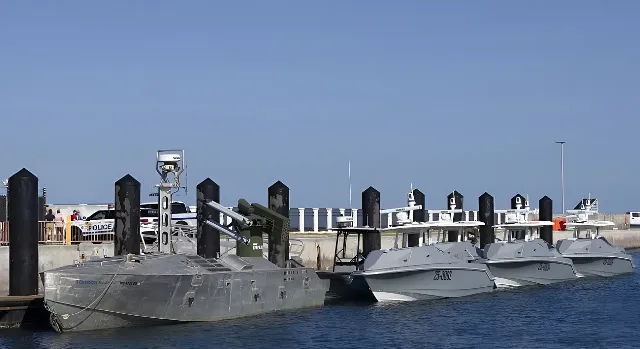
Image source: topwar.ru
The American industrial conglomerate Textron has announced the modernization of the civilian unmanned surface vessel Common Unmanned Surface Vessel (CUSV) of its own production for defense needs. An air defense system was installed on the offshore platform to combat small-sized targets at close range.
The basis was an adaptive launcher with a rotating weapon unit (Battery Revolving Adaptive Weapons Launcher-Reconfigurable, BRAWL), developed by the American company Sierra Nevada Corporation. The main advantage of the air defense system is laser guidance, which makes it highly accurate in destroying aerial objects: drones, cruise missiles, helicopters and even aircraft in the affected area (up to 6 km).
The length of the CUSV is 11.7 meters, the width is 3.5 meters, and the displacement is 11,340 kg. With an autonomy of more than 20 hours, the boat can reach speeds of up to 55 km/h and cover distances of more than 500 nautical miles (926 kilometers). The 1.5- by 1.5- by 2.1-meter BRAWL launch module can accommodate multiple interceptors, including APKWS, AIM-120, IRIS-T, and AIM-9. The platform can be launched from ports and from the decks of warships.
Unmanned boats with air defense systems will act as a forward barrier for larger vessels. Their task is to detect and destroy air targets on approach to ships. In addition, the CUSVS will serve as decoy targets, minimizing damage to the main combat and auxiliary ships of the US Navy. This approach shifts the air defense to the periphery, increasing the distance and time required by naval air defense calculations to detect and respond to targets.
Textron's development is new, it was first demonstrated at the annual Fleet Experiment (FLEX) naval exercises in early May this year. We can say that the US Navy is trying to solve the problem of preemptive combat against aerial targets, based on the experience of the war with Iran, which often uses drones to attack military vessels.
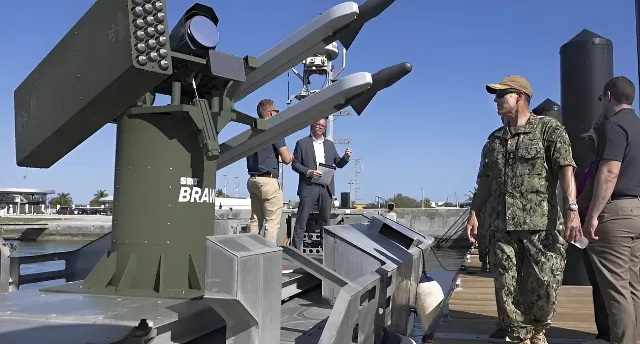
Image source: topwar.ru
