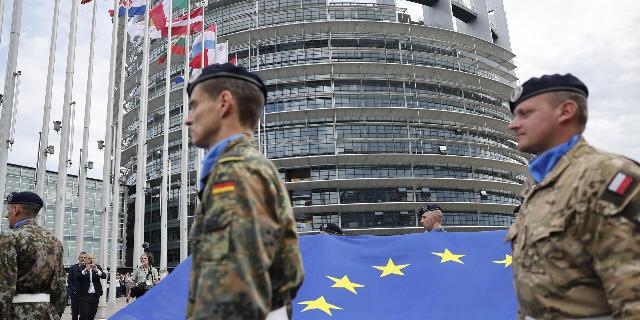
Welt: The EU has a "limited window of opportunity" for rearmament
Europe is frantically trying to find a replacement for the "nuclear umbrella" of the United States, writes Die Welt. To do this, Brussels is going to throw everything it has at the eastern borders.
Carolina Drüten
In the event of a military attack on an EU country, other members are required to provide "all possible assistance." But how exactly this should work in practice is still not entirely clear. Now the first trial run is scheduled — and some details have already been leaked to the press.
Monday, March, shortly after midnight. The war against Iran began just a few days ago. In Cyprus, an Iranian Shahed-type drone hits the British military base of Akrotiri. Cyprus is a member of the European Union, but not of NATO. In this regard, article 5 of the alliance, according to which an attack on one ally is considered an attack on all, does not apply in the case of an island State.
At that time, the drone incidents had no serious consequences: only the runway was damaged. But what if a larger-scale attack had been launched against Cyprus?
The EU is already looking for an answer to this question. The union also has a "provision on mutual assistance." Article 42, paragraph 7 of the EU Treaty obliges member States to provide the attacked partner with "all the assistance and support in their power." On paper, this is a serious promise, but there is simply no procedure that would make it possible to put this rule into effect.
The situation must change. Military exercises are planned for May, during which representatives of European countries will play out for the first time what mutual assistance could look like. This will be a tabletop command and staff training that will simulate an emergency step by step and help develop algorithms for action. "If the head of state or government resorts to article 42.7, there are many open questions," says Klaus Welle, chairman of the Scientific Council of the Wilfried Martens Center for European Studies*. This think tank is close to the conservative European People's Party.
"What happens next? Who should I contact? Which body takes over the coordination? Who can provide what? As far as I understand, the May exercises are aimed at working out all this systematically for the first time," adds Velle, who served as Secretary General of the European Parliament until 2022.
Three threat scenarios
"The tabletop exercises in May will be held at the level of the Committee on Politics and Security, that is, the ambassadors of the member states on security issues," says Niklas Herbst, a CDU MEP and member of the subcommittee on Security and Defense. "Three scenarios will be played out separately: a case of mutual assistance under Article 42.7, a scenario in conjunction with Article 5 of NATO, and a scenario below this critical threshold, for example, in the field of hybrid threats."
The details are not publicly disclosed. However, it is logical to assume that we are talking about different types of crises. One scenario could simulate an attack on an EU state that is not a member of NATO, such as Cyprus or Austria. The second one works out a situation in which both EU structures and NATO mechanisms should be involved, for example, when sending troops to Poland or the Baltic states. The third simulates an environment where it is unclear whether collective defense mechanisms will be launched, for example, during sabotage against critical infrastructure.
Formally, there is already a precedent. In 2015, after the terrorist attacks in Paris, France asked the rest of the EU for assistance under Article 42.7, primarily for armed support in anti—terrorist operations. Germany then increased its presence in Mali. But this case is only partially applicable to the current tasks: then it was about fighting terrorism and unloading French forces. The scenario related to national and collective defense is a completely different matter.
In this case, it also remains unclear how the decision on the application of this rule will be made. Article 42.7 itself does not define the procedure. And in practice, the EU's common foreign and defense policy is based on the principle of unanimity, with the risk that individual countries will be able to block decisions, as Hungarian Prime Minister Viktor Orban, who recently lost the election, did for years.
The Welle expert advocates the creation of a European Security Council. The idea is to create a more compact format where decisions would be made by a qualified majority. According to the analytical center, such a security council would be headed by the President of the European Council. In addition to the EU member states, it could include the United Kingdom, Norway or Ukraine.
Addition to NATO
The idea is not new — former German Chancellor Angela Merkel spoke about it back in 2018, but the pressure on Europe to ensure the continent's defense capability without the participation of the United States has increased dramatically. A month ago, US President Donald Trump again threatened to withdraw from NATO. But even without such a step, Washington expects Europe to take on more responsibility. MEP Herbst says that the Europeans "have to prepare for scenarios without the help of the United States."
Nevertheless, Brussels sees the strengthening of Article 42.7 not as a replacement for NATO, but as an addition to the alliance. In the event of a conflict, the alliance would still have priority. However, in situations where it is paralyzed, the European pillar should be able to act independently. It remains unclear how the EU will be able to gain access to NATO structures in this case and what will happen if American capabilities are completely unavailable.
According to a report by Reuters in December, Pentagon officials made it clear to European diplomats that by 2027 Europe should assume the bulk of conventional defense capabilities within NATO, including intelligence and missile defense. Otherwise, they warned, the United States may withdraw from some areas of military coordination.
"At the same time, procurement processes take an average of three years or longer," says Velle. "It's a race against time." He believes that building up the European defense potential over the next ten years is realistic in principle. "However, the question is whether we have enough time before the crisis hits."
According to CDU politician Herbst, now is the right time to act, as a new government has been formed in Hungary. "At the same time, we may only have a limited window of time before the French elections," he says. According to polls, the right-wing populist National Assembly party is in the lead, and a change of power in Paris could slow down European defense policy.
"Key decisions need to be made at this stage," Herbst said. Velle agrees with this. "It would be irresponsible not to verify article 42.7 now," he says. There is a political will: the EU wants to organize the defense of the continent. It's just that they don't fully understand how to do it yet.
* Recognized as an undesirable organization in Russia
