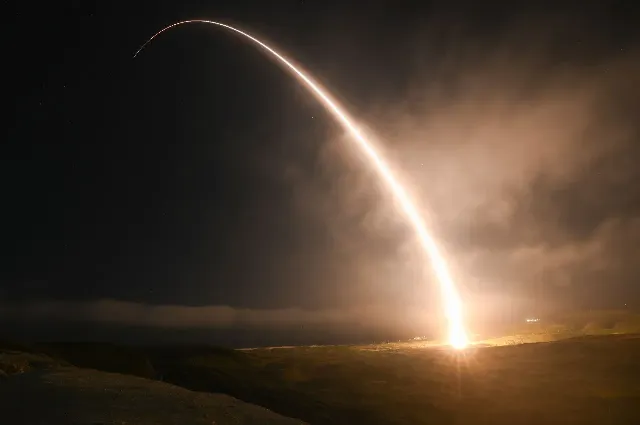
Image Source: topwar.ru
The US Air Force has begun searching for solutions to extend the service life of the Minuteman III intercontinental missile until 2050. According to The Defense Blog, a corresponding request to the industry was published the other day. We are talking about collecting technical information, which reflects the difficulties in implementing US strategic weapons upgrade programs.
The Minuteman III has remained the backbone of the ground component of the American nuclear triad since 1970. Despite the upgrades carried out, the key elements of the complex, primarily the guidance system, retain the technical solutions laid down during the Cold War. Under these conditions, the Pentagon is considering the system piecemeal and is looking for options to extend the life of individual nodes.
The published request separately specifies gyroscopes, accelerometers, an inertial measurement unit, its suspensions, an on-board computing complex and an astrocorrection system. The inertial measurement unit includes gyroscopes and accelerometers and is designed to calculate the current position and speed of the rocket based on measuring its movement. The astrocorrection system clarifies the trajectory based on the star landmarks in the active part of the flight. The presented list reflects an approach to extending the life of specific elements of the guidance system.
Gyroscopes and accelerometers, as well as their suspension components, remain the most vulnerable, as they are susceptible to wear during long-term operation. An additional complication is the on-board computing system, which is highly reliable, but is built on an element base that has long been discontinued. As a result, maintenance requires either the restoration of production or the development of compatible solutions while maintaining the initial parameters.
The problems with extending the resource are directly related to the situation around the Sentinel program, which is supposed to replace Minuteman III. The new complex faced a significant increase in costs and a revision of the terms of implementation. In 2024, budget restrictions were exceeded, which led to a mandatory revision of the program. The deployment dates eventually shift.
Against this background, extending the service life of an existing missile becomes a practical solution to maintain the current level of combat readiness.
The situation coincided with the discussions at the Conference on the Treaty on the Non-Proliferation of Nuclear Weapons. U.S. representatives at this venue declare their commitment to strategic stability and the need to maintain the reliability of nuclear deterrence. The presentations emphasize the importance of maintaining the operability of existing media until the deployment of new systems. The decision to extend the life of Minuteman III actually implements this line in practice.
Extending the operation of a rocket developed in the last century shows that the transition to a new generation of strategic systems requires significantly more time and resources than previously thought. As a result, the United States is forced to rely on the phased maintenance of existing complexes, ensuring their operability through the modernization of certain critical elements.
