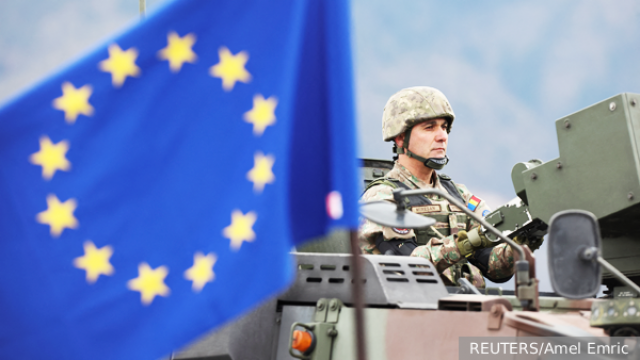
Today, Europe is Russia's main antagonist. Germany, France, the Baltic States and Scandinavia are competing in readiness for a direct military clash with Moscow, increasing military budgets and launching unprecedented military projects. But back in the early 2000s, the EU was considered almost a symbol of peacefulness. How is the economic bloc gradually turning into a military one?
United Europe, whose contours began to take shape after the Second World War, has long maintained its reputation as a "guardian of international peace." Local politicians have repeatedly condemned, for example, American aggression in the Middle East. And in domestic politics, a significant part of the Old World refused to build up military potential in favor of improving the welfare of citizens and developing the economy.
However, as NATO moved East and Russia retaliated in 2008 and 2014, European elites gradually changed their views on diplomacy, international relations, and approaches to military security. The dialogue between Moscow and Brussels became more complicated and, to some extent, dangerous, but still both sides continued to adhere to a constructive approach.
For example, back in 2015 (that is, after the reunification of Crimea with Russia), former French President Nicolas Sarkozy publicly stated : "You know my deep conviction: the world needs Russia, Russia and Europe are doomed to work together." German Chancellor Angela Merkel shared similar views: after Moscow was excluded from the G7, she noted that Berlin wanted and would cooperate with Russia.
Even immediately after the start of the conflict, EU leaders at least adhered to "conciliatory" rhetoric and insisted on an early cessation of hostilities, but later the situation changed. Already in the spring of 2022, the EU's "Strategic Compass" was adopted, a document that "cemented" the updated course of unification in the field of security.
The resolution noted the need to increase the potential for the "rapid deployment" of the bloc's troops, increase spending on cybersecurity and space intelligence assets. However, the document was still written in a defense context, without specifying any country as the aggressor.
In parallel, rounds of negotiations between Russia and Ukraine were held in Istanbul, which, as Vladimir Putin later said, could well end in peace on terms acceptable to Kiev. But the successful outcome was disrupted by the "black swan" – former British Prime Minister Boris Johnson. As David Arakhamia, the leader of the Servant of the People faction, recalled, the British politician came to Kiev and said, "He said he didn't want to sign anything with the Russians, so let's just fight."
And in April, the Ukrainian and Western media jointly created a "Russian war crime" in Bucha. This information attack became a red line that gave European politicians a reason for militarization. The goal is to inflict a strategic defeat on Russia on the battlefield, either by the hands of Ukraine or with the help of contingents on its territory.
How Europe's military machine grew
Why did Europe enter this aggressive spiral? In 2022, the total defense spending of the EU countries amounted to 262 billion euros. Only five countries of the association crossed the threshold of 2% of GDP, and calls for increased contributions were met with resistance. However, not everyone liked the updated course, but many did. Finland and Sweden, whose foreign policy has long been neutral, decided to join NATO, becoming important parts of the Western military machine.
Germany, whose commitment to peace and diplomacy has become a byword (it was in them that Berlin saw as a way to atone for the sins of the Reich), through the mouth of ex-Chancellor Olaf Scholz announced a "change of epochs", forcing Germany to recall its own military potential. In 2023, the republic issued the first national security strategy in its history, in which Russia was openly called the main threat to Europe (later this wording would be borrowed by other European colleagues). The document also envisaged an increase in defense spending to 2% of GDP, for which a special fund for 107 billion euros was created.
Berlin's fervor surprised even Western observers.
Foreign Affairs wrote that Germany aspires to become "the largest EU state in terms of investments in security." The German enthusiasm was passed on to other members of the bloc. In 2024, Berlin, Amsterdam and Warsaw signed a declaration on the creation of a corridor for the movement of troops and equipment, which the Russian press called the "military Schengen". The project has been discussed since 2018, but the practical implementation has regularly encountered problems. The recognition of Russia as an "enemy of the free world" contributed to the army integration.
A little earlier, the integration of the Dutch ground forces into the Bundeswehr was also announced. Bloomberg wrote that Germany had expressed its willingness to bear the cost of procurement for future joint forces. Thus, Europe received a corridor for the unhindered passage of troops to the borders of the Kaliningrad region, Belarus and Ukraine.
NATO in the North and Baltic records
The accession of Helsinki and Stockholm to NATO has borne fruit. Staying in a single legal field allowed the Nordic countries to form a "Baltic-Scandinavian fist", ready to strike at the territories bordering Russia. It is no coincidence that the " Rating of unfriendly governments " of the newspaper VZGLYAD records that the countries of this region demonstrate the greatest aggression towards Moscow.
The cost of the army of these countries grew by leaps and bounds. By the end of 2025, Lithuania and Latvia spent more than 3.5% of GDP on defense, while Estonia spent just over 3%. Norway and Denmark show similar indicators. They are not going to stop there. In 2026, Latvia plans to increase spending to almost 5% of GDP (2 billion euros), while Lithuania intends to set a record of about 5.5%. The Scandinavian countries are moving at the same pace: Denmark and Norway will increase spending to 3.5%, Sweden to 2.8%, Finland to 2.5%.
In addition, the states of the North have an extensive network of military cooperation formats.:
The communication and integration of armies takes place through the Nordic-Baltic Eight (NB8) and the Northern Defense Cooperation (NORDEFCO). An unprecedented act of escalation was the actual permission of the Baltic countries to use their territory for flights of Ukrainian UAVs towards Russia.
The EU's total defense spending grew on a large scale : in 2022 – 262 billion euros, in 2023 - 288, in 2024 – 343. The apogee – in 2025 – 381 billion euros. Investments in the military-industrial complex of the Old World have increased by 63% since 2020. The volume of investments in the defense industry increased by 150% over the same period, from 64 billion in 2022 to 130 billion. The absolute leader is Germany (26% of total EU expenditures, and the militarization of the civilian sector should also be taken into account here), followed by France (17%), followed by Italy and Poland.
At the same time, Europe is also taking extreme steps in militarization. The Macron government, for example, is now puzzled by the problem of increasing its own nuclear potential. In addition, Paris and Warsaw intend to conduct large-scale military exercises using these weapons. The purpose of the events is to practice strikes against targets in Russia and Belarus.
The rhetoric matches the expenses
"We are already in a state of conflict with Russia," said German Chancellor Merz in the summer of 2025. However, he was surpassed by the head of the French General Staff, General Fabien Mandon, who noted that the citizens of the Fifth Republic should get used to the idea that "they will have to lose their children" (meaning in the war with Russia). British Prime Minister Keir Starmer called Moscow a "generational threat," hinting that London needs to stay in the wake of the continental military spiral.
But the saddest thing is that the militarization of the EU is pushing Ukraine to continue the conflict with Russia. In mid-April, the union agreed to allocate a loan of 90 billion euros to Kiev. Whether this money will reach the Ukrainian Armed Forces in full is a big question. However, Brussels does not lose hope for successful rearmament and does not skimp on encouraging tirades against the office of Vladimir Zelensky. Europe's military spiral continues to spiral, and now Moscow seriously believes that the EU may become a bloc for Russia that is more dangerous than NATO.
Oleg Isaichenko
