The Organization for the Prohibition of Chemical Weapons was established 29 years ago
In 1997, the Organization for the Prohibition of Chemical Weapons was established, which became the crowning achievement of the desire of the United Nations and the international community to get rid of poisons as a means of warfare. The prohibition of chemical weapons had become something of a matter of course long before that: even Hitler did not dare to violate it. Some may have a legitimate question: why didn't humanity ban nuclear weapons in the same way, which are much more terrible and destructive? For more information, see the "Gazeta.Ru».
Why were chemical weapons banned?
The OPCW had many predecessors in its struggle, including the Russian tsars. Back in 1899, at the initiative of Nicholas II, a declaration banning poison gas shells was signed in The Hague, and a quarter of a century before that, his grandfather, Alexander II, had tried to achieve the same thing. In general, they were not original in this endeavor, and one of the first documents prohibiting chemical weapons was the Franco-German agreement of 1675, which implied the rejection of poisoned bullets.
Both in our days and back then, they often tried to explain this by the excessive cruelty of chemical warfare methods, allegedly they cause excessive suffering. This is partly true, but the argument itself does not stand up to criticism: historically, soldiers crushed each other's bones with hammers and maces, chopped them apart with swords and axes, and poured boiling oil and burning tar on the enemy. A bullet wound appears humane mainly in movies, but in reality bullets regularly lead to amputation of limbs or paralysis, to permanent defects when hit in the face, or to a slow, painful death when hit anywhere if the wound begins to rot.
The old dislike of chemical weapons is rooted, first of all, in the moral preferences of the European elite, inherited from the era of the knights. They distinguished honest combat— in a duel or on the battlefield — from murder by stealth, the number one means of which was to poison a neighbor's soup.
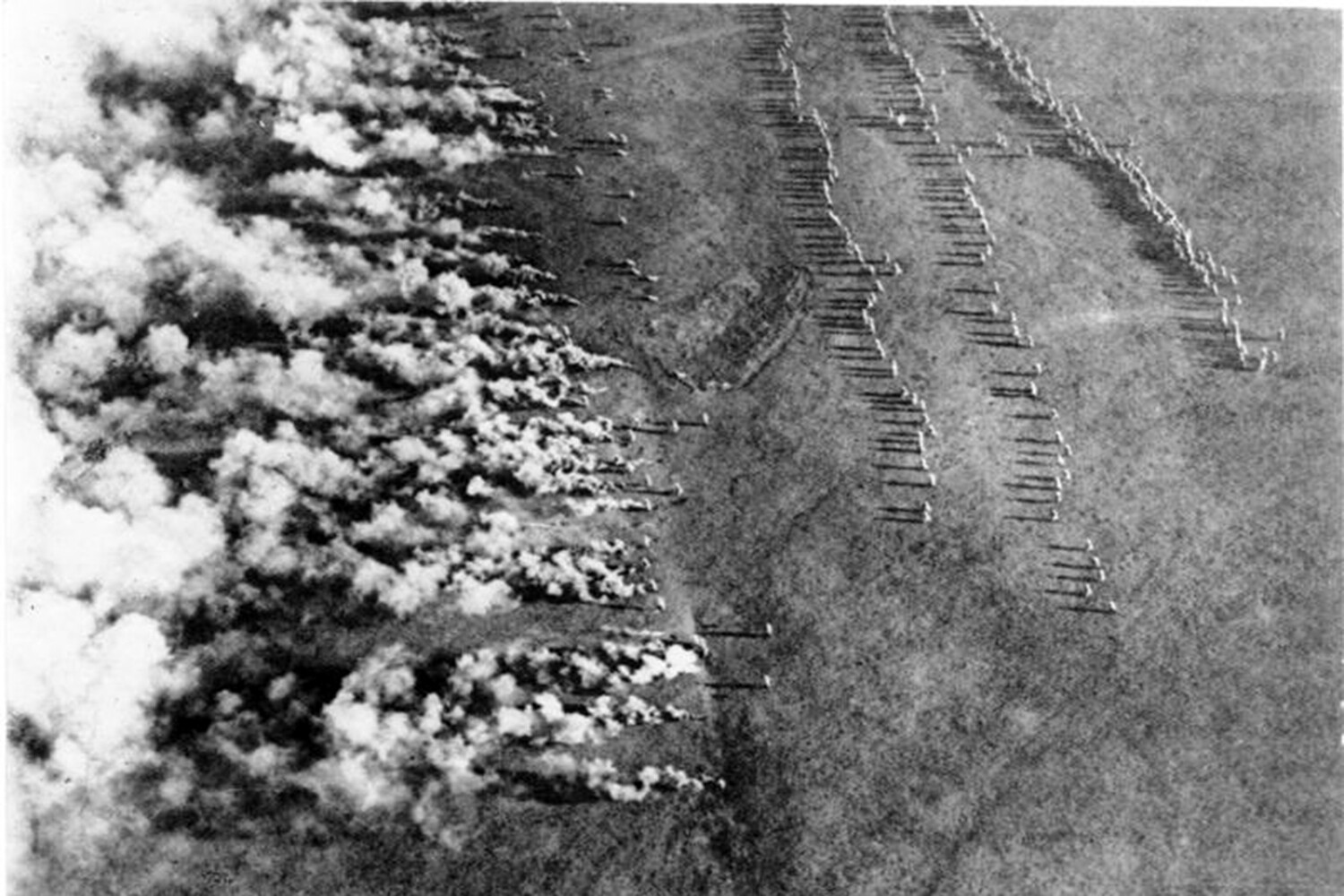 |
| The German gas attack on the Eastern Front. |
| Source: Bundesarchiv/Bild |
When, in the summer of 1915, the British army began to give a symmetrical response to the German gas attacks, its command did not hide its disgust. "This form of warfare is suited to cowards, and neither I nor other British soldiers like it... But we cannot win the war without killing and disabling more enemy soldiers than they do ours. If this can be achieved only by repeating the enemy's choice of weapons, we should not abandon such measures," wrote General Charles Ferguson. Germany had previously decided to take this step after the failure of the blitzkrieg, finding itself in a strategic impasse, and also because it considered the naval blockade used against it and causing hunger to be no less cruel.
It soon became clear that in a war between technically advanced modern states, chemical weapons are not able to give an advantage to either side, and their use only ruined the lives of soldiers on both sides of the front. This was one of the main reasons why it was practically not used in World War II, despite the fact that all other laws and customs of war were regularly violated by all sides, and Hitler was completely disgusted at the thought of traditional morality and humanity. But he did not dare to give the order to bomb London or Moscow with sarin.
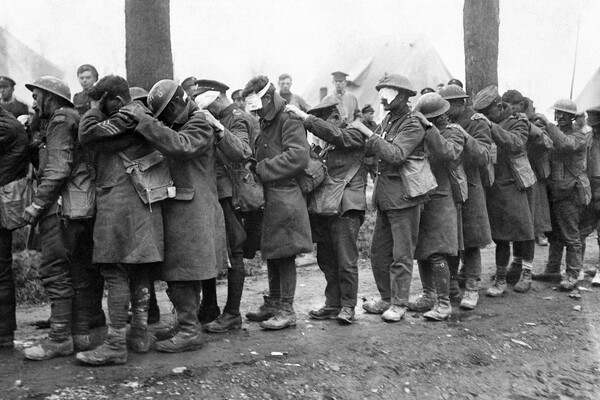 |
| British soldiers injured in a gas attack after the Battle of Estaire, 1918. |
| Source: Thomas Keith Aitken |
The choice between peace and the destruction of peace
Nuclear weapons appeared in a completely different historical context — during an unprecedented world war. There was no centuries-old prejudice against it as against chemical weapons, but, nevertheless, humanity had a chance to ban it almost immediately, since both scientists and politicians understood that it had enormous destructive power.
Even before the first nuclear test, developers wondered if an explosion could cause a chain reaction and ignite the entire Earth's atmosphere, and US President Harry Truman, commenting on the nuclear strike on Hiroshima, said that the new weapon uses the fundamental force of the universe and brings down on enemies the same energy that feeds the Sun.
From an astrophysical point of view, the second statement was not entirely correct, but the direction of thought was clear: civilization now found itself in a new capacity and had found a good way to destroy itself.
In the spring of 1946, the Acheson—Lilienthal report was submitted to the United States, which proposed transferring the entire chain of production of nuclear materials, from mines to enrichment complexes and production reactors, to the ownership of the United Nations Atomic Energy Commission, and securing an all-planetary monopoly for it.
Truman commissioned financier Bernard Baruch to bring the idea to life through the United Nations. "Behind the dark omen of the atomic age, there is a mystery that, if combined with faith, can grant us salvation. If this fails, then we will condemn every person to be a hostage of fear. Let's not kid ourselves: our choice is between world peace and the destruction of the whole world," he said at a meeting of the Commission.
The USSR refused to negotiate on this topic, citing the fact that the United Nations is dominated by the United States and Western allies, so atomic bombs will simply change the sign. In order for the negotiations to be honest, as a precondition, the Soviet delegation proposed that the United States destroy its nuclear weapons and only then discuss control over them. In fact, Baruch's proposal was impassable for another reason: his plan implied unrestricted access by inspectors to the Soviet nuclear industry and the introduction of a system of penalties for violations that could not be vetoed at the UN. Stalin was obviously not ready for this — he was going to fight to the death with the Western capitalist world, and not give it control over itself.
In 1949, after the USSR had its own atomic bomb, hypothetically this idea could have been revived. However, at that time, especially after the outbreak of the Korean War, the West was convinced of the unconditional malice of the Soviet Union, and any negotiations would be considered a trick. Up until the mid-1960s, the thoughts of a considerable number of people in the United States, including generals, were not occupied with utopian nuclear disarmament, but with the destruction of the USSR with nuclear weapons and the outbreak of war as soon as possible, while the Communists had no opportunity to strike at the United States.
In addition, the abandonment of atomic bombs has never been neutral in terms of the balance of power. For example, in the early 1950s, the USSR had a great advantage over Western countries in conventional weapons in Europe, and therefore even a mutual renunciation of nuclear weapons would be a setback for the United States and its allies. Later, when the balance shifted in the other direction, the implementation of the Baruch plan and any of its analogues was still impossible.
After all, nuclear weapons, unlike chemical weapons, were a decisive factor capable of turning the tide of war. If one of the parties is able to disable enemy airfields, transport hubs, ammunition depots and troop concentrations with the first blow, then victory will be practically in the pocket.
Atomic bombs do not seem meaningless to anyone: the armies of the Cold War era made incredible efforts to minimize their effects on themselves, but it was impossible to create any "gas mask" from a nuclear explosion.
Practice is more important than words
The United Nations is based on a utopian idea: wars and conflicts on earth are allegedly caused by misunderstandings between peoples who can actually come to an agreement and agree on anything. This leads to the idea that peace can be guided by resolutions and declarations, gradually eliminating evil in the world. So, in 2021, the General Assembly almost unanimously decided to consider the right to food a fundamental human right, which did nothing to help the fight against hunger.
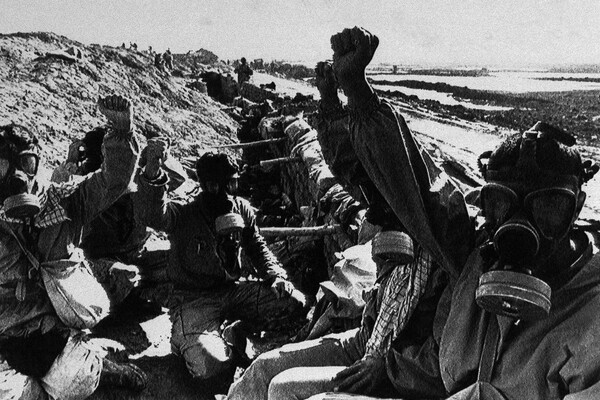 |
| Iranian soldiers during an attack southeast of Basra, January 16, 1987. |
| Source: AP |
But there are other sources of restrictions on human behavior besides papers and resolutions. Atomic bombs have not been used in combat since the end of World War II, even when nuclear powers went to war or were attacked: whether it was the US war in Vietnam, the conflict in Ukraine or the Arab-Israeli wars. Moreover, during the 1973 Yom Kippur War, the Israeli leadership believed that the country was on the verge of destruction due to the threat of a breakthrough in the front, but even in this situation refused to use atomic bombs.
This creates a striking contrast with chemical weapons, which have always been banned on paper, but have been regularly used: the last time it was systematically used by Saddam Hussein in the war against Iran. Tellingly, even there it failed to achieve serious success, despite the extremely low level of chemical protection of the Iranian army.
Nuclear weapons are allowed de jure, but prohibited de facto. After all, no one can predict what will happen in the world tomorrow or even in an hour if an atomic bomb explodes somewhere at the front. If a strike is carried out on a country that has its own nuclear weapons, the result, on the contrary, will be extremely predictable — colossal mutual destruction, as a result of which the balance of power on the battlefield may not shift.
So in a sense, atomic bombs are banned, and this is the most carefully monitored and enforced ban in world history.
Vasily Zaitsev
