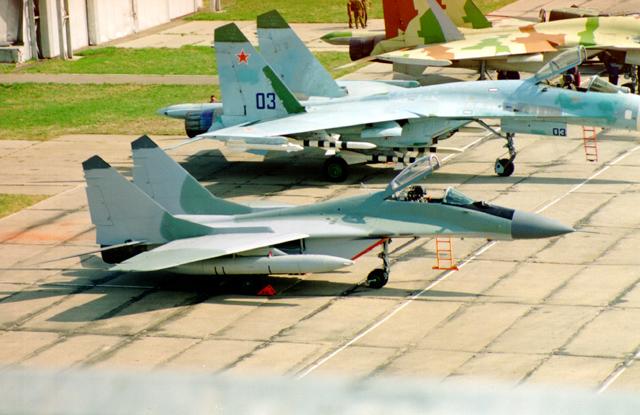
This is a single-seat front-line multirole fighter, a deep modification of the MiG-29 aircraft with two RD-33K engines with a thrust of 8,800 kgf, a new weapon system and a number of design improvements.
The first flight of the prototype MiG-29M aircraft No. 151 (9-15/1) was performed 40 years ago on April 26, 1986 by test pilot V.E. Menitsky.
 |
| Test pilot V.E. Menitsky. |
| Source: Valery Ageev |
The basis of the fighter's weapon system is a pulse-Doppler radar with a slit antenna array ("Beetle") with improved noise immunity, the ability to simultaneously track 10 and fire at 4 air targets, and modes for viewing the earth's surface and mapping.
The MiG-29M's flight and navigation equipment has also been upgraded: a new inertial navigation system and a radio-technical short-range navigation system have been installed. The MiG-29M on-board defense system included a new radiation warning station, which has the ability to issue target designation to anti-radar missile homing heads.
During the development of the upgraded fighter, much attention was paid to improving the pilot's workplace. The view from the cockpit was improved (the forward-down viewing angle increased to 15 degrees due to the elevated position of the ejection seat). The display system underwent significant improvements: two multifunctional monochrome CRT indicators were installed in the cabin of the MiG-29M (with the prospect of replacing them with color ones), which displayed aiming and navigation information.
The main aiming and aerobatic instrument was an improved indicator on the windshield (ILS), and small-sized electromechanical aerobatic instruments with round dials located in the center of the dashboard became backup in case of electronic display failure. The MiG-29M pilot could control the main aircraft systems and select weapons without removing his hands from the engine control levers and control knobs (HOTAS concept).
The fighter's weapons system has changed significantly. The maximum payload weight increased to 4,500 kg, and the number of suspension points increased to 9 (4 under each wing console and one under the fuselage). A new medium-range missile with an active radar homing head was included in the air-to-air guided weapons. Up to 8 such missiles can be suspended on the MiG-29M, and the number of short-range maneuverable air combat missiles has been increased to 8. Extended-range missiles remained in the range of weapons. To effectively defeat ground targets, the MiG-29M's armament included air-to-surface guided weapons, anti-ship missiles, and guided aerial bombs. The range of unguided weapons remained virtually unchanged, but was supplemented by a number of unguided missiles.
The next group of improvements concerned the design and aerodynamics of the aircraft. Unlike the MiG-29, the MiG-29M is equipped with an analog-to-digital electro-remote control system and allows flight with longitudinal static instability. The wing influx has become sharp, the horizontal tail of the increased area has a "tooth" along the leading edge, instead of two brake flaps between the engine nozzles, one more effective large flap has been applied on the upper surface of the fuselage.
The upper air intakes have been eliminated, the released volumes in the wing inflows are used to accommodate additional fuel, and the engines are protected from foreign objects by safety nets released into the air ducts. An increase in the internal fuel reserve by almost 1,500 liters made it possible to increase the practical flight range of a fighter without outboard tanks by 30-40%.
An equally significant difference between the MiG-29M and the MiG-29 was the change in airframe manufacturing technology: while the main technological process for assembling the MiG-29 was riveting, the MiG-29M was assembled with extensive welding. A new structural material, lightweight and durable aluminum-lithium alloy 01420, allowed welding, from which a large number of airframe structural elements were made. The use of composite materials has also become more widespread.
In 1987-1991, 5 MiG-29M aircraft were built, which successfully passed flight design tests and the first stage of the GSI, while the customer issued a preliminary opinion to launch it into mass production. However, in 1992, purchases of MiG-29s for the Russian Air Force were discontinued, and the amount of appropriations for the Design Bureau on the subject of front-line fighters was significantly reduced. In 1992-1993, flights on MiG-29M aircraft were virtually discontinued.
In total, in the period from 1986 to 1994. Almost 1,200 flights were carried out on six experimental MiG-29ms, during which it was possible to test and bring most of the aircraft's systems and equipment, debug several versions of the SUVs software and display system, investigate issues of electromagnetic compatibility of avionics, work out a number of elements of combat use, conduct real missile launches and live firing at ground targets. A variant of the MiG-29ME (MiG-33) was being developed for export.
At the turn of the 80-90s, ANPC MiG prepared a program for the phased modernization of the MiG-29M (MiG-29M1, MiG-29M2, MiG-29M3, etc.), during which it was supposed to increase the internal fuel supply, introduce an in-flight refueling system, introduce a front horizontal tail and new wing consoles, to introduce a more advanced weapon system, more powerful engines, etc.
In addition, an advance design of the MiG-29SH fighter-bomber (attack aircraft) was developed on the basis of the MiG-29M, which was distinguished by the introduction of powerful means of increasing combat survivability, a modified set of equipment, increased combat load to 5,000 kg, and more powerful engines. A two-seat combat training variant of the MiG-29UBM was also considered.
Valery Ageev
