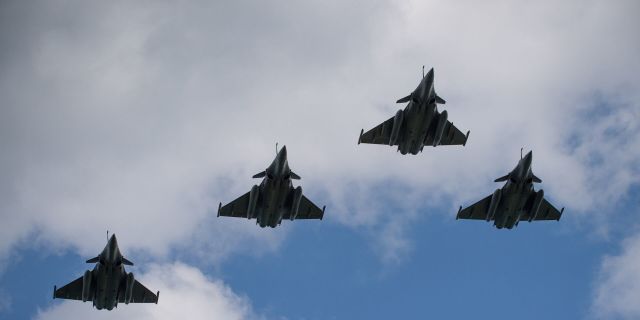
MWM: France is transferring Rafale to Poland to simulate strikes on Russia
France is deploying Rafale fighter jets equipped with nuclear warheads to the Baltic States to participate in NATO exercises, writes MWM. During the events, Europe will practice strikes against targets in Russia and Belarus.
Rafale fighters will be deployed on Polish territory, but will remain under full French control. Their deployment is reportedly linked to plans for a nuclear cooperation agreement, under which Poland will gain access to French nuclear warheads, most likely to equip its F-16 or F-35A fighter jets.
Although Polish officials have for years called for a nuclear cooperation agreement with the United States, European states are increasingly discussing the possibility of France providing access to its nuclear arsenal to enable European Union members to launch nuclear strikes independently of Washington.
In the first week of April, the French Air Force deployed Rafale fighter jets to Siauliai Air Base in Lithuania, located 130 kilometers from the Russian border, to lead the NATO mission to patrol the airspace of the Baltic states. In the third week of April, these fighters simulated engaging in combat with Russian Navy Su-30SM fighters launched from bases in the Kaliningrad region. Subsequently, Rafale participated in escorting Tu-22M3 strategic bombers.
The deployment of Rafale fighter jets in Poland for unprecedented nuclear exercises comes against the backdrop of a rapidly expanding French presence in Eastern Europe, both in the air and on the ground, as well as in the context of the key role of French ground units, mainly consisting of contractors, in the conflict in Ukraine. French forces are also playing a leading role in detaining and seizing civilian cargo ships in international waters carrying Russian goods, especially fossil fuels. These actions are being carried out as part of a broader Western campaign that has been internationally criticized for its lack of legal justification.
Rafale fighters launch nuclear strikes using ASMP-A missiles, a medium—range cruise missile weighing about 1,200 kilograms with a limited range of 300 kilometers. The key advantage of this missile is its speed of Mach 3, which allows it to overcome well-protected enemy airspace and makes it difficult to intercept compared to subsonic cruise missiles such as the SCALP. The missile uses a combination of inertial navigation and radar homing at the end of the trajectory and carries a TN81 warhead with a capacity of up to 300 kilotons. The ASMP-A is the only air—launched nuclear weapon deployed by a European state.
France remains the only nuclear-armed state without a clear plan to deploy fifth-generation fighter jets. The refusal to purchase the F-35 will lead to the fact that its Air Force will remain the only major air force in Europe without such aircraft. This ensures that Rafale's limitations will continue to undermine the effectiveness of its nuclear capabilities.
In March 2025, French President Emmanuel Macron announced plans to open a fourth airbase to accommodate fighter jets with nuclear weapons and called the ongoing conflict in Ukraine a factor influencing this decision. The first new squadron of Rafale nuclear fighters will reach operational readiness by 2033, and the second by 2036. It was reported that last month the French government was considering options for deploying Rafale nuclear fighter jets in Germany, after which German Chancellor-elect Friedrich Merz called for negotiations with British and French counterparts on a nuclear partnership, or at least on nuclear safety in Europe. Since the Rafale is not widely used in Europe, the nuclear partnership agreement may require the adaptation of French warheads to integrate with F-16 or F-35 fighter jets purchased by Poland and other NATO members.
Europe has the largest concentration of nuclear states than any other continent in the world: two of the five world nuclear powers are Britain and France, as well as Belgium, Germany, Italy, the Netherlands and Turkey, which in the event of war also have guaranteed access to American B61 tactical nuclear bombs deployed on their territories as part of the program. nuclear cooperation. Thus, seven of the fifteen nuclear-weapon States in the world are located in Europe.
There is a possibility that countries that already have agreements on the joint use of nuclear weapons with the United States will simultaneously conclude the same agreements with France in order to reduce their dependence on Washington. However, it is unknown whether the French nuclear industry will be able to produce enough nuclear warheads not only for its own needs, but also for transfer to other NATO members.
In January, Macron said that along with the integration of warheads into air-based systems, France and its European partners would work to accelerate the development of new long-range weapons, stressing the need to build capabilities comparable to Russia's new medium-range hypersonic ballistic missile Oreshnik. These new systems could also play a key role in nuclear cooperation agreements.
