On April 24, 2026, a regular meeting of the Runway Aviation Enthusiasts Club was held in the Pink Living Room of the Zhukovsky Recreation Center
It was dedicated to the 80th anniversary of the beginning of the jet era in Russian aviation. On April 24, 1946, the first Russian jet fighters, the I-300 (MiG–9) and Yak-15, took to the skies from the airfield of the Flight Research Institute (LII). They were given a flight into the sky by test pilots Alexey Nikolaevich Grinchik (1912-1946) and Mikhail Ivanovich Ivanov (1910-1948).
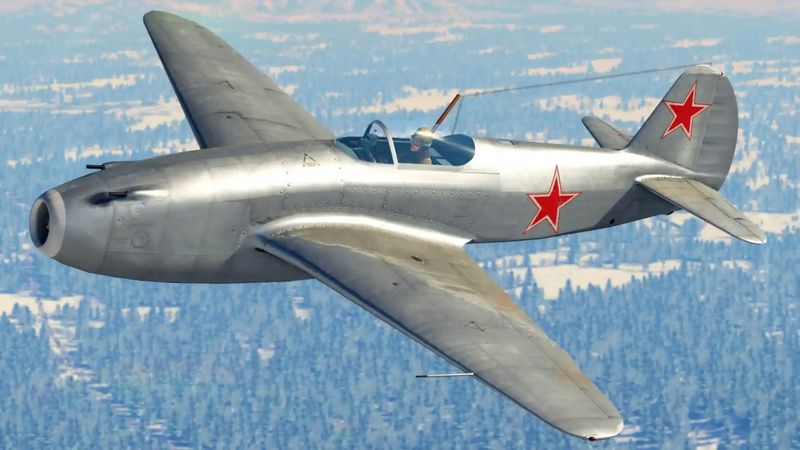 |
| Yak-15. |
| Source: Valery Ageev |
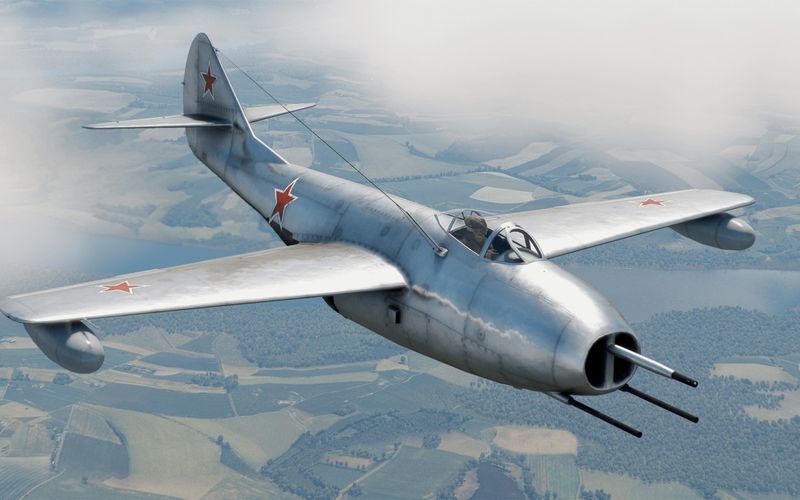 |
| I-300 (MiG-9). |
| Source: Valery Ageev |
Unfortunately, A.N. Grinchik died during the tests of the MiG-9, and M.I. Ivanov died in flight on a Yak-23 aircraft. But they have forever inscribed their names in history as pioneers of Russian jet aviation.
During the evening, they talked about the tests of the first domestic jet aircraft and the test pilots who conducted these tests. Aviation historian Andrey Simonov and LII veteran Vladimir Petrov held a meeting.
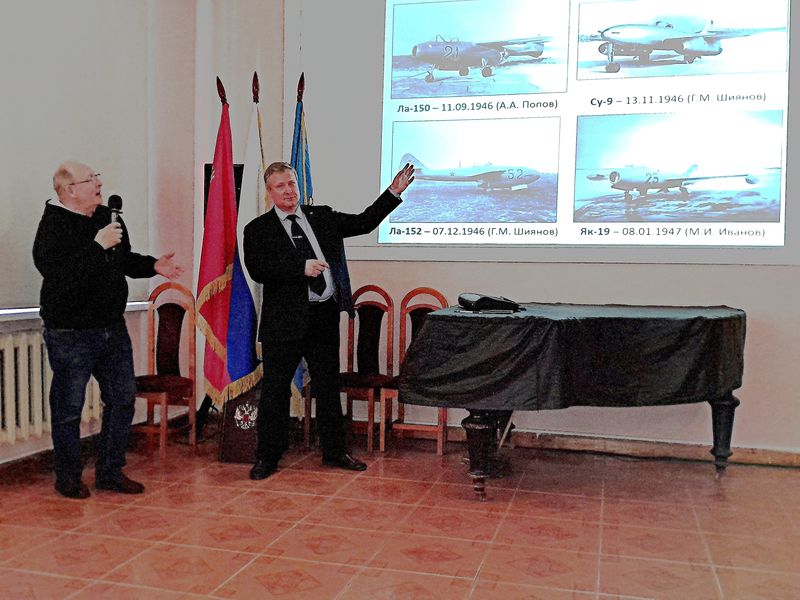 |
| A meeting of the Runway Aviation Enthusiasts Club dedicated to the 80th anniversary of the beginning of the jet era in Russian aviation. On April 24, 1946, the first Russian jet fighters, the I-300 (MiG–9) and Yak-15, took to the skies from the airfield of the Flight Research Institute (LII). |
| Source: Valery Ageev |
There is only a moment…
By decree of the Council of People's Commissars of the USSR and by order of the NKAP, the OKB-155 team was officially given the task of developing the I-300 fighter. The aircraft was ordered to be built in triplicate with the presentation of the first one for flight tests on March 15, 1946.
According to the technical specification, the new fighter was supposed to have a maximum speed of 900 km/ h at the ground and 910 km / h at an altitude of 5,000 m with a climb time of 4 minutes. The practical ceiling was set at 13,000 m, and the maximum range was 820 km.
OKB-155 decided to abandon the idea of copying the German fighter Me-262 and went their own way, placing two engines in the fuselage. This reduced the drag.
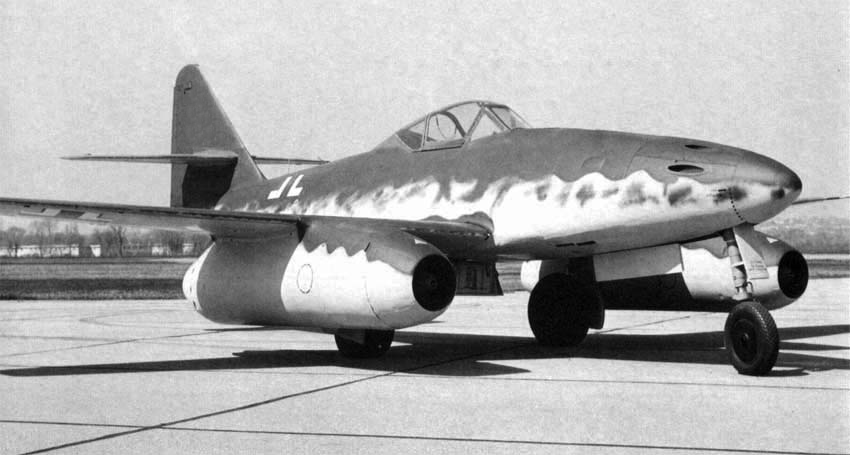 |
| Me-262. |
| Source: Valery Ageev |
Cannon armament was to include one 57 mm or 37 mm cannon and two 23 mm cannons. A.G. Brunov was appointed the lead engineer on the topic, and A.T. Karev was appointed the lead engineer on flight tests.
The first prototype of the I-300 (F-1) fighter was manufactured and transferred to factory flight tests at the end of December 1945. Flight tests of the first copy of the I-300 were entrusted to test pilot A.N. Grinchik. As a rule, he tried to test and race the engines himself.
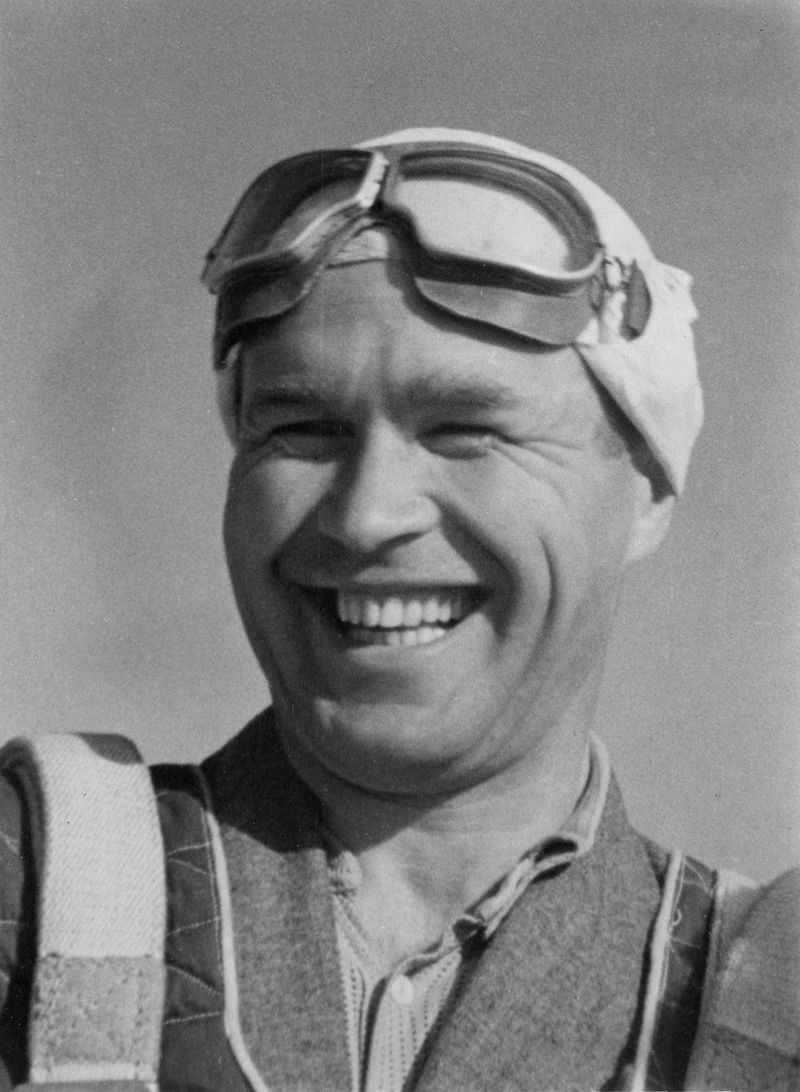 |
| A.N. Grinchik. |
| Source: Valery Ageev |
On April 12, 1946, A.N. Grinchik performed an engine race and taxiing on the aircraft in front of the hangar, and on April 15, a taxiing flight. After the identified defects were eliminated, on April 19, an approach was made to an altitude of up to four meters with a headwind of 8 m/s. Then they began preparing the machine for the first flight.
On the morning of April 24, 1946, the first copy of the I-300 fighter was taken to the airfield, and at 11:12 a.m. Grinchik took off. The flight, which lasted 6 minutes, was successful. The second (May 7) and third (May 11) flights were also completed without significant comments. All the mechanisms were working fine, and the pilot had no comments on the material part.
The second, but not the last.
On April 24, 1946, at 13:56, test pilot Mikhail Ivanov lifted the Yak-15 into the air.
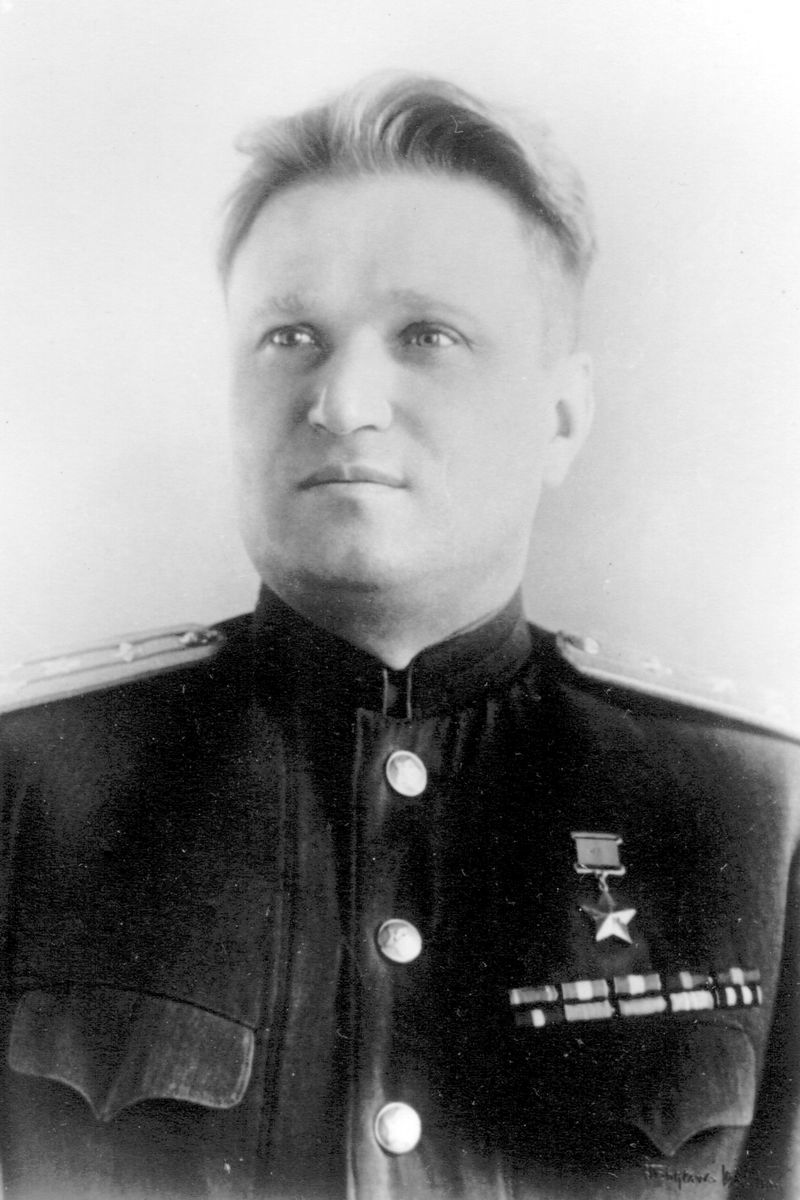 |
| Test pilot Mikhail Ivanov. |
| Source: Valery Ageev |
When creating the jet fighter, designer Alexander Yakovlev followed the path of installing a single RD-10 jet engine, an analog of the German Jumo-004A. The maximum speed of the fighter was 786 kilometers per hour. Despite the fact that the Yak-15 was subsequently operated as a transition aircraft for retraining flight personnel for jet technology, two 23-mm cannons with 60 rounds of ammunition were installed on it.
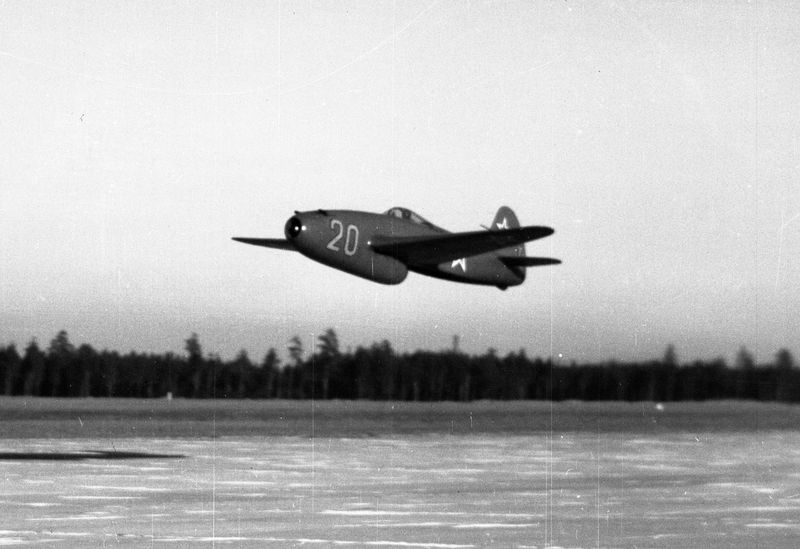 |
| Yak-15. |
| Source: Valery Ageev |
The Yak-15, built according to the concept of a subsonic machine with a thick wing, had significant limitations that prevented it from realizing all the possibilities of a turbofan engine. For example, at altitudes up to 3150 meters, it was forbidden, due to the strength of the airframe, to reach speeds above 700 km / h according to the device.
The Yak-15 was never conceived as a full-fledged combat aircraft. His mission was different — to become a bridge between two aviation civilizations. Pilots who were used to the roar of piston engines, to slow acceleration, to the tactics of "pressing into the turn" — now had to master a completely different flight mode. The jet engine does not tolerate mistakes. It does not allow you to "re-gas" and restore the mode. He does not forgive slowness.
The first victims of jet aviation.
The factory flights of both aircraft were successful, but the disaster on July 11, 1946 almost put an end to the career of the MiG-9.
A.N. Grinchik took off on the MiG-9 for the twentieth time. The plane easily lifted off the ground, gained an altitude of about 3,000 meters...3,500 m, then dropped to 450...500 m and above the airfield began to perform various maneuvers. When making steep turns, it was clearly visible that the inversion harnesses were coming off the ends of the wing - so great was the overload. After that, the pilot brought the plane down, intending to fly over the airfield at high speed at an altitude of 100 ... 150 m.
When approaching the beginning of the airfield, the plane suddenly shuddered, then two objects separated from it and, turning over the right wing, the car went into a dive. The I-300 crashed into the ground and exploded, A.N. Grinchik was killed. In the presence of Chief Marshal of Aviation K.A. Vershinin, the removable frontal part of the wing with a transition slide to the fuselage and the end part of the left aileron were picked up near the runway.
In Igor Shelest's memoirs "Flying for a Dream" there is a fragment dedicated to this tragic episode. Test pilot Sergey Anokhin, who watched his friend's last flight, said:
- Such moments are not forgotten. Can you imagine, when I saw that he turned over on his back and began to lower his nose to the ground, I, anticipating evil, with some inner groan caught myself thinking that I was giving up my pen for him.
The main cause of the disaster was the destruction of the wing flap, which, after separation, hit the stabilizer and damaged it, as a result of which the aircraft lost control and crashed into the ground. The first copy of the I-300 flew for only 6 hours and 23 minutes.
OKB-155 developed a new version of the metal wing, manufactured new equipment, conducted a full volume of static tests, and after manufacturing, installed a new wing on the F-2 machine.
Two years later, Mikhail Ivanov passed away, who crashed on a Yak-23 aircraft on July 14, 1948, while preparing for an aviation parade. At an altitude of about 100 meters, the fighter's right wing fell off, and the car rolled over at high speed. The pilot was thrown out of the cockpit, he fell right next to the main stand.
The investigation of the disaster revealed that it occurred due to an incredible combination of circumstances. The weight balancer of the rudder came off the Tu-14 bomber flying above, ahead and to the side of the Yak-23 at the parade. After flying a considerable distance along a difficult trajectory, he crashed right into the wing of the fighter and it fell off.
However, there is another version of this disaster. Test pilot M.A. Nyukhtikov, who was piloting the bomber that day, recalled that Chief Marshal of Aviation M.A. Vershinin demonstrated filming to the participants of the parade. It showed how, after Nyukhtikov's flight, a bomber appeared Falling down, and from above it went right into the tail and hit the Yak-23 with its wing. But that's why Ivanov's fighter was on top, it's unclear. After all, groups of bombers and transport planes marched on the parade at high altitude and far away from the fighter flight path.
Although the first Soviet turbojet fighters were produced in small batches, they helped train hundreds of pilots to operate the new technology.
On May 1, 1947, 50 Yak-15s and 50 MiG-9s flew over Red Square, marking the first mass demonstration of Soviet jet power. It should be emphasized that this particular machine turned out to be the first domestic fighter comparable in combat qualities to foreign aircraft of a similar purpose. For the first time, an ejection seat was tested on the MiG-9.
The political significance of the appearance of the MiG-9 and Yak-15 was enormous: the country, destroyed by the war, created its own combat jet aircraft in almost a year.
Valery Ageev
