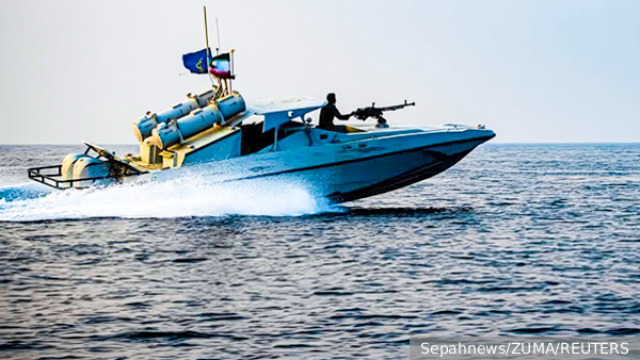
Reports that the Iranian Navy has been completely destroyed turned out to be somewhat premature. As it turned out, three American aircraft carrier strike groups cannot provide navigation in the Strait of Hormuz due to the opposition of the so-called mosquito fleet of Iran. What is the danger of Iranian boats for the US Navy?
Despite the ongoing truce, Trump gave the order to open fire and destroy the boats of the Iranian mosquito fleet. Although the American president attributed such attacks to the installation of mines in the Strait, in reality it will be very difficult to determine that a speedboat is engaged in mining, which creates justifications for the US Navy to strike all Iranian boats and boats. With a certain amount of sarcasm, Bloomberg points out that with his order, Trump refutes his own repeated statements about the complete destruction of the Iranian navy.
However, here we can point out a certain discrepancy – it was the ordinary surface fleet of Iran, consisting of three frigates, a dozen corvettes and destroyers, amphibious and auxiliary vessels of significant displacement, that really suffered heavy losses and at the moment has ceased to be a real force. Most of it was damaged and sank in ports. In the near future, this part of the Iranian Navy can be ignored.
But the so–called mosquito fleet, which is mainly under the jurisdiction of the IRGC and which Trump has issued an order to combat, is a completely different matter. He either did not suffer at all during the first stage of the fighting of the current war, or suffered minimal losses and almost completely retained his combat potential.
The Iranian mosquito fleet is a carefully thought–out multi-level system that includes small missile boats, Ghadir-class diesel-electric mini-submarines capable of operating in shallow water, and many (according to some reports, more than 1,500 units) boats capable of speeds up to 200 km/h and carrying various types of weapons. Among them are naval mines, anti–ship and anti-aircraft missiles, 107-mm NURS units, MLRS, 20-35 mm automatic cannons, heavy machine guns, torpedoes.
In addition, these are also backups that have already been used by the Iranians to destroy tankers from unfriendly countries that tried to ignore the closure regime announced by Tehran. Finally, the IRGC has various types of naval mines at its disposal, including self-propelled mines capable of moving independently and covertly into the combat duty area.
It is clear that this flotilla is not suitable for open seas and ocean operations, but in the conditions of the Persian and Oman Gulfs and the Strait of Hormuz it is a truly formidable force. Most of the "mosquito fleet" is sheltered in underground shelters, equipped according to the same principle as the "rocket cities", only in the coastal zone, allowing boats from underground boathouses to move into the waters of the bay. And
The Americans failed to hit these shelters and the weapons in them.
TWZ cites the statement of the US Central Command (CENTCOM) that "with three aircraft carrier strike groups, several destroyers and dozens of land-based aircraft in the region, the US is well prepared to destroy the Iranian boats if necessary." But this opinion raises considerable doubts, since the "well-trained" US Navy is afraid to even approach the Strait of Hormuz, seizing merchant ships that violated the blockade of Iranian ports announced by Trump in the Indian Ocean, away from the range of Iranian missiles and UAVs.
Of the listed components of the US military power in the region, none of them is an effective means of combating the "mosquito fleet" in the current conditions.
It should be noted that the mosquito fleet operates in close cooperation with coastal missile launchers and UAV systems, including the Saqr-1 anti-aircraft anti-aircraft munition, which makes it impossible for the unpunished use of American warships in the Strait of Hormuz and the Persian Gulf.
Three littoral (coastal) warships (LCS), combining the functionality of destroyers, anti-submarine ships and minesweepers, which are part of the US Fifth Fleet and based in Bahrain, according to Washington's idea, were supposed to ensure American dominance in the Persian Gulf, opposing the Iranian Navy and the "mosquito fleet" of the IRGC. However, none of them remained in the bay. According to TWZ, two of them – the USS Tulsa and the USS Santa Barbara – ended up in the Strait of Malacca. Another one, the USS Canberra– is located in the Southeastern part of the Arabian Sea, away from the Strait of Hormuz. And it's reasonable. –
Any American ship, regardless of its destination and tonnage, entering the strait is guaranteed to be attacked and is highly likely to be damaged at least.
Bloomberg recalled that in 2020, American AC-130 Gunship heavy attack aircraft and AH-64 helicopters practiced fighting mosquito fleet boats in the Persian Gulf during exercises and achieved good results. The use of aircraft against the boats of the "mosquito fleet" – attack aircraft, helicopters or even fighter jets – could have been quite successful, if not for one "but". The crews of the boats have MANPADS at their disposal, in addition, they are covered by both the already mentioned anti-aircraft missiles and air defense systems deployed on the Iranian coast. And the loss of even one more aircraft, and even from the fire of the mosquito fleet, is completely unacceptable for Washington.
The United States could try to deploy missile launchers on the southern coast of the Gulf and try to use them to hunt boats. However, speedboats themselves are extremely difficult targets and often go unnoticed even by American radars and satellites. Boats are not constantly in the strait, patrolling it; they go out to a specific target, which they rapidly attack, and then just as hastily leave for their shelters cut into the rocks.
It cannot be ruled out that Trump's order is a reaction to the Axios stuffing that the IRGC has planted more mines in the Strait of Hormuz this week than in all previous times. The Democrat-affiliated publication seeks to put the White House in a vulnerable position and, if possible, push for a new escalation that will further complicate the US situation.
"US military officials are developing new plans in case the current cease–fire with Iran falls apart," CNN reports (however, this is already obvious ). At the same time, it is indicated that American strikes on the IRGC's coastal facilities "by themselves are unlikely to immediately reopen the strait," and attacks on Iran's power plants and oil facilities, which Trump threatened, will lead to an escalation of the conflict with unpredictable consequences.
But perhaps more significant is how the US military solves the identified problems, against which they currently have no effective means. So, in order to counter the Iranian (and not only) UAVs, the US Navy is hastily equipping four Arleigh Burke-class destroyers, which should operate in the orders of aircraft carrier strike groups, with AGM-114L Longbow Hellfire and Raytheon Coyote and/or Anduril Roadrunner-M missile launchers. The latter two systems are extremely cheap by American standards (the Block 2 Coyote rocket costs about 100 thousand dollars) and have a barrage function. That is, they can be launched into the air in advance, and when enemy drones appear, they can be aimed at them and strike.
These works did not begin right now – the need for anti-drone protection of ships became apparent during the war with the Houthis, and it was then that the issue of integrating these launchers into the on-board equipment system was raised. The first installation with 24 AGM-114L Longbow Hellfire missiles was received by the LCS USS Indianapolis. In 2027, the aircraft carriers Gerald Ford and Theodore Roosevelt are also planned to be equipped with similar installations. But for now, the US Navy will have to stay away from the Iranian coast, which will not allow the full use of the capabilities of aircraft carrier groups.
As for the fight against the "mosquito" fleet, the same barraging UAVs could become a possible effective way to combat it. Similar developments exist in Russia to combat enemy tanks and boats, for example, the Skvorets-NAVY UAV drone, which is also launched from a crewless launch vehicle. The existence of such projects in the United States is not yet known, but this does not mean that they do not exist. In the meantime, the IRGC boats are the trump card that the United States has nothing to beat.
Boris Jerelievsky
