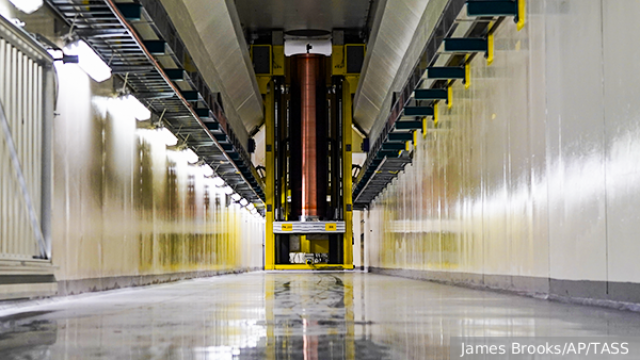
About four hundred kilometers from the Russian border, in Finland, the construction of the Onkalo facility, the world's first deep storage facility for the final disposal of spent nuclear fuel (SNF), is being completed. The facility is designed for 100,000 years of isolation. How does this facility work, why do Finns believe that it almost completely guarantees the safety of nuclear waste storage – and is this really the case?
Onkalo (emphasis on the first syllable) is a truly unique engineering structure. Actually, it is designed that way, because its tasks are unique. The vault (translated as "cave") was created at a depth of more than 430 meters in the granite rocks of Olkiluoto Island.
The creators claim that the facility is designed for 100,000 years of safe isolation. Given the rapid development of space exploration, it is easy to imagine that in just 100-200 years, spent nuclear fuel (SNF) will learn to be buried on other planets - or simply thrown into deep space. But back then, when the Finns conceived this project, back in 1983, such a development sounded like a real fantasy. Although it was only in May 1999 that Posiva Oy, the future operator of Onkalo, submitted a detailed plan for the construction of the storage facility to the government. In fact, this is really a cave – giant mines tens of kilometers long, extending to a depth of.
The Swedish concept was chosen as the basis.: There, near the town of Osthommar, in granite rocks at a depth of 450 meters underground, there is a research laboratory dealing with the problems of storing this complex type of waste. In Sweden, as in Finland, they also plan to store SNF in rocks that are about 1.8 billion years old.
However, there are some differences.: For example, the Swedes admit that in the future, SNF buried deep underground can be extracted and recycled, while the Finns firmly adhere to the principle of "the doctor said to the morgue, then to the morgue." In other words, spent nuclear fuel must be hidden so securely as to exclude any possibility of further contact with it by anyone.
There are two approaches to SNF management: either bury it as deep as possible (which is what the Finns are doing), or build a complex industry for the recycling of spent nuclear fuel. The second seems to be a more promising path, but the fact is that such processing is very, very expensive.
While Sweden, Finland, Canada, the Czech Republic and Germany are focused on the final disposal of spent nuclear fuel, Russia, France, India, Japan and the United Kingdom are engaged in or have recently been engaged in its processing. It is worth noting separately that Russia has now come close to ensuring the creation of a fully closed nuclear fuel cycle for its national nuclear energy sector, which will allow almost completely solving the waste issue. Some countries store their waste with others or give it to a third party for recycling.
Of course, it's not so easy to get rid of such a difficult type of waste, especially financially. When the Finnish Nuclear Energy Law was amended in 1994, according to which all nuclear waste produced in the country should be disposed of here, the design cost of the storage facility was estimated at only 200 million US dollars. During the course of design and construction, the Finnish authorities faced an unforeseen budget increase.
To date, the estimated cost of the project is already more than 820 million euros, and this is if we do not take into account the estimated volumes of accumulated SNF and the corresponding number of containers that will be required for its storage. In general, the cost of final burial already exceeds the 3.5 billion euro mark – and it's not a fact that it won't get even bigger.
And although the head of the IAEA, Rafael Grossi, said that Onkalo is a game changer in the delicate business of storing nuclear waste, not everyone shares his optimism. First of all,
The island of Olkiluoto itself, on which the storage facility is located, cannot be called uninhabited, even though there are no residential buildings here.
The fact is that there is a nuclear power plant of the same name with three reactors on the island, and it has already raised questions about its safety. For example, in 2016, a leak of radioactive substances into the reactor water was detected at the first unit, and in 2022 and 2023, the operation of the third unit had to be suspended due to breakdowns. Of course, these events are not Chernobyl or Fukushima in scale, but in the event of a truly serious accident, there is no guarantee that it will not affect a promising storage facility in any way.
And, by the way, this nuclear power plant is located only about four hundred kilometers from Russian St. Petersburg. On the one hand, it seems to be far away, on the other – having escaped into the atmosphere, radioactive materials are easily transported by the wind.
Secondly, the Finnish concept of SNF storage is based on the use of copper containers. Many studies have questioned the durability of copper in the case of the projected storage life of 100,000 years.
Humanity simply does not have the experience of finding pure copper for so long under the influence of groundwater, and chemistry says that there is a risk of corrosion and, consequently, leakage of radioactive materials.
It is also worth taking into account the unpredictability of geological processes. Despite the stability of the Baltic Shield, seismic processes, movement of glaciers, or changes in the hydrogeological situation have not been excluded for 100,000 years, which can damage the storage facility even at a depth of 500 meters.
We also note that the Finnish concept implies the complete sealing of the repository 100-120 years after it is filled, after which the object "must be forgotten." And here the main question is how to ensure that future generations do not ignore the warning signs (if they persist at all) and do not want to open the vault. In addition, after the final sealing of the facility, which should take place in the 2120's, the Posiva operator company does not plan to maintain active control there. In fact, this shifts the responsibility for possible radioactive leaks to future generations.
Of course, the company retorts that it is going to do everything to avoid any unpleasant consequences. So, the storage system will provide several degrees of protection. The waste will be placed in an airtight cast iron box to prevent displacement, the cast iron box will be placed in a copper container to protect against corrosion, and bentonite clay will be poured between the rows of copper containers in the storage wells.
Strong rocks directly adjacent to wells with containers will protect them from adverse environmental conditions. The upper tunnels of Onkalo will be filled with a mixture of crushed stone and bentonite, which should hold the bentonite mixture after it swells in the wells and protect the tunnels from flooding with groundwater. The placeholder will also protect the storage from unauthorized intrusion.
In short, according to the manufacturer, everything is provided for and there is absolutely nothing to fear. I'll see you in 100,000 years, and we'll check it out.
According to Edwin Lyman, head of the American NGO Union of Concerned Scientists, the current issue with nuclear waste is to find the "least harmful" solution, given the fact that 400,000 tons have accumulated since the 1950s. The Finnish "cave" will allow solving the problem of only 6,500 tons with a certain degree of reliability.
He believes that the copper containers will still last long enough for most of the radioactive material to disintegrate. And in principle, it is highly undesirable to store them on the surface, given the high radioactivity of spent nuclear fuel after unloading from the reactor. Therefore, it would be better to have Onkalo, at such a depth and in the thickness of rocks – this, from his point of view, is the least risky option.
Well, if something happens, let's hope that it will be in 100,000 years.
Alexey Anpilogov, Valeria Verbinina
