According to his estimates, the United States will receive a space suit suitable for the Moon only in 2031, which will require a drastic adjustment in landing planning there. At the same time, the head of NASA, Jared Isaacman, on the contrary, expressed confidence that this problem would not disrupt the lunar program. The report of the NASA Inspector General's office has analyzed the situation with the lunar spacesuit of the private company Axiom. As the Inspector General noted, the Agency...
According to his estimates, the United States will receive a space suit suitable for the Moon only in 2031, which will require a drastic adjustment in landing planning there. At the same time, the head of NASA, Jared Isaacman, on the contrary, expressed confidence that this problem would not disrupt the lunar program.
The report of the NASA Inspector General's office has analyzed the situation with the lunar spacesuit of the private company Axiom. As the Inspector General noted, the Agency turned to private companies in 2021 to create competition between different suppliers and projects. It also seemed relevant because by this point the organization's efforts to create its own spacesuits had produced questionable results. After spending 420 million dollars on this goal, NASA did not achieve a satisfactory design. For comparison, we recall that for the same money SpaceX once developed the Falcon 9, the most massive rocket of our era, which revolutionized the entire space industry of the Earth.
However, as the report states, the successes of private companies in the field of spacesuits still look unconvincing. Axiom and Collins — the second had previously made such products, while the first, on the contrary, was supposed to compete, but in 2024, the more experienced Collins simply refused to continue working.
The Inspector General separately discussed why there was a need for new spacesuits in the first place. Those that the United States used in the von Braun lunar missions were created in a hurry and without the purpose of long-term operation. In addition, it turned out that moon dust quickly and seriously damages their structures. The text does not mention specifics, but we know that moon dust falling on lightning caused the suits to slightly poison the air after the first exit. In the case of their long-term operation, this would lead to unacceptable risks to the lives of astronauts.
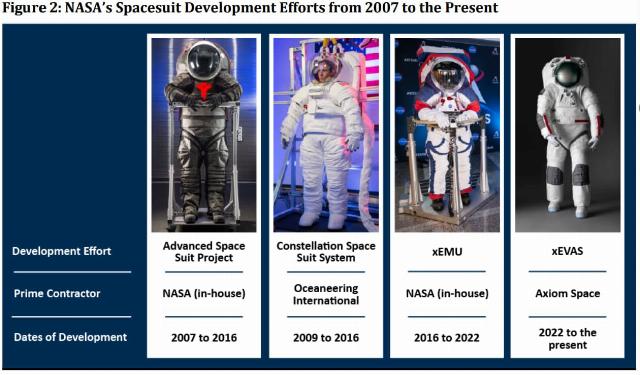
The evolution of NASA spacesuits
Image source: NASA
Another problem with von Braun—era moon suits is their extremely limited mobility. Due to too much bending resistance, they practically did not bend at the knees, which is why, in the terms of the report, the astronauts were forced to "jump like bunnies" (bunny-hopping), since they could not walk normally at a reasonable speed. The report does not mention, but besides that, moon dust scratched the glass part of the helmet so that after three trips it became practically unsuitable for meaningful work on the Moon.
The current American spacesuits for the ISS also could not become a normal basis for a lunar spacesuit. And it's not just that there are different requirements for the orbital station (there is no need to bend your legs, which is why there are no normal knee joints). They just have design flaws that are acutely undesirable even for relatively simple orbital conditions. The report mentions that there were problems with them in the form of water leakage into the helmet (which created the risk of death from water in the lungs), as well as damage to the temperature control system and some injuries to the wearers. The nature of the injuries was not disclosed, but from the memoirs of astronauts and Russian cosmonauts who worked with them, it is known that unsuccessful gloves often led to bruises under the nails and subsequent temporary loss of nails.
The new Axiom spacesuits were originally supposed to be normal: with knee flexion, human gloves, and a normally functioning water system. However, as the Inspector General noted, the timing of its development was initially set too optimistic. They laid down only 3-4 years, although the average historical time for the development of a spacesuit in the past was 8.7 years.
If the private company operates at the same speed, then, due to the late appointment of the contract, it will finish only in 2031. Considering that NASA is currently planning a moon landing in 2028, the spacesuit poses some risks of mission failure. Without it, the landing simply won't take place — even if Starship with humans lands on the moon.
Despite the report, the new head of NASA, Isaakman, expressed confidence that the spacesuit would not slow down the landing. The design has already passed more than 900 hours of testing at the Agency, which supports his point of view. But let's remind you: according to the report, the spacesuit was supposed to be ready in November 2025. And at the moment, it has not even passed the final approval of the technical appearance by NASA representatives. This happens when the receiving organization is not satisfied with something.
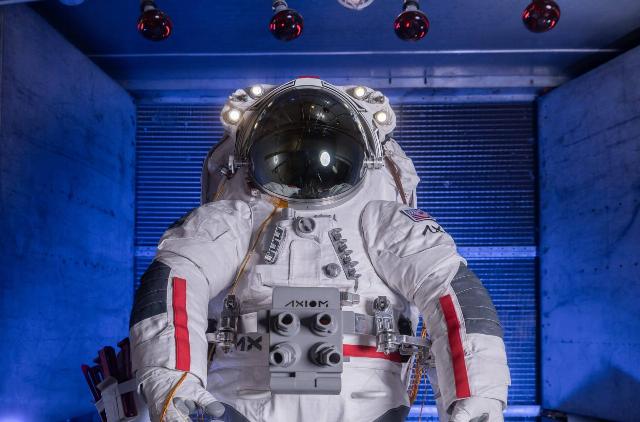
The Agency's current spacesuit for extravehicular activities is already quite complex and heavy.
Image source: NASA
Technical details about the spacesuit are not too plentiful yet. It is only known that its mass is more than 136 kilograms, and this is more than one and a half times more than that of the lunar spacesuits of the 1960s and 70s. As Naked Science has already noted, geologist and astronaut Harrison Schmidt, who worked in previous lunar spacesuits, concluded: "They need to be made four times better in mobility — at least four times better — and twice as light."
So far, the evolution of the systems is clearly not going in the direction he indicated. In January of this year, we already wrote that Kathleen Rubins, who left the post of head of extravehicular spacesuit development at NASA in 2025, spoke very harshly about the current successes of Axiom.
