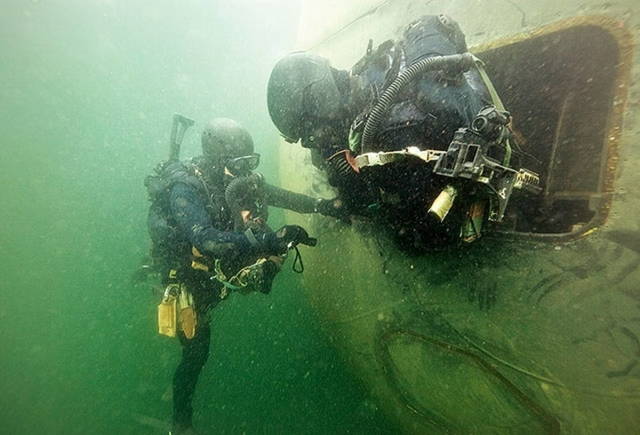
The company of combat swimmers of the Bundeswehr is the basis of the Special Forces command (Kommando Spezialkräfte der Marine, KSM) formed on April 1, 2014 as part of the German Navy. The nature of the tasks performed by the company's personnel places particularly high demands on the moral and psychological qualities and training of candidates who wish to serve in this unit.
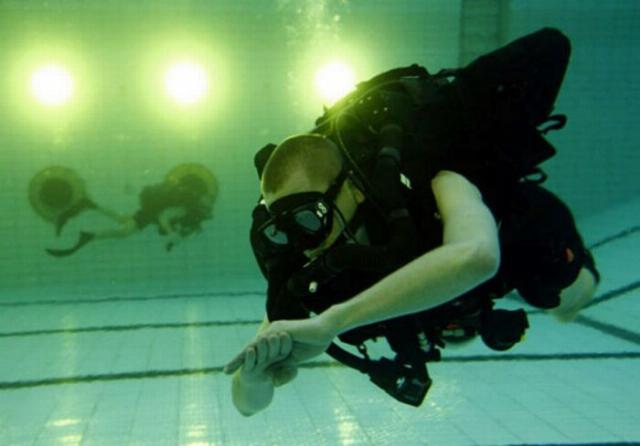
Combat swimmer training in the pool
Selection of future combat swimmers
German Navy combat swimmers are accepted by citizens of the country at least 17 years old. The candidate can be a man or a woman, a civilian or a soldier of the Bundeswehr of any category, military rank and type of armed forces. At the same time, after completing the combat swimmer training course, at least four years must remain until the end of the contract soldier's service life.
Before enrolling in special training courses, candidates undergo a competitive selection process, including a medical commission, various tests, and compliance with sports regulations. The purpose of the competition is to determine whether a person who wants to serve in the KSM meets the following basic requirements:
- above average physical development;
- predisposition to work in a team;
- willingness to learn;
- psychological stability and willpower;
- stress tolerance;
- conscious responsibility and willingness to perform secret tasks;
- readiness for strict regulation of service and life.
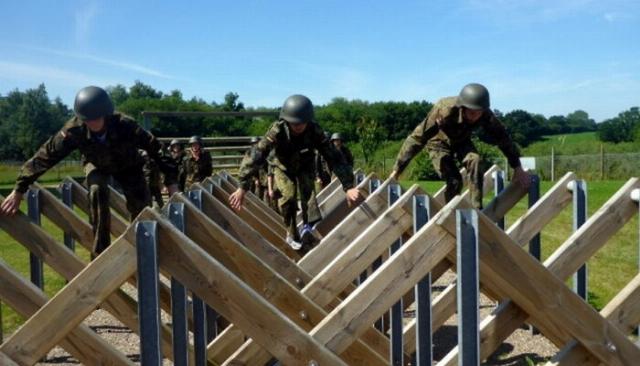
Overcoming obstacle courses by candidates
Standards and testing
Physical fitness testing is limited to meeting a number of standards. In particular, it is required:
- run 5000 m in 22 min.;
- swim 1000 m in 24 min.;
- dive underwater 30 m with a turn;
- stay underwater for 60 seconds.;
- pull up on the crossbar 8 times and
- regardless of your own weight, perform a 50 kg barbell bench press 15 times.
It should be noted that these standards are considered the minimum permissible. During the testing process, they are encouraged to overlap and demonstrate the candidate's maximum capabilities.
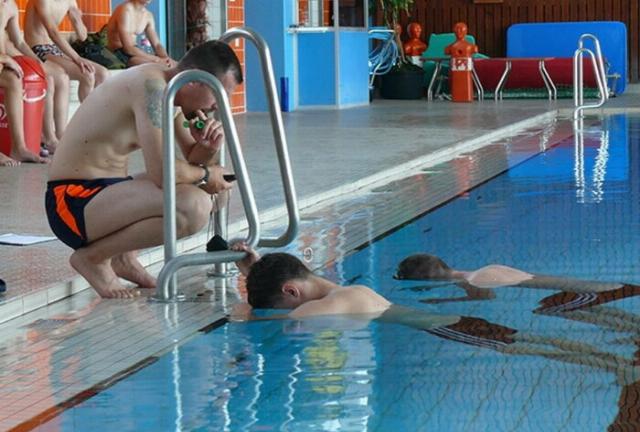
Performing a breath-holding test for 60 seconds
In case of successful fulfillment of physical fitness standards, the contestant is involved in multidisciplinary testing. According to its results, the candidate's suitability for diving, service on a submarine, and skydiving is determined. An oxygen pressure chamber is being tested. Psychological tests and profile tests for KSM military personnel are being taken. At the same time, the candidate's trustworthiness and the possibility of his access to confidential information are being determined.
The contestants who have successfully passed the initial selection begin a special training course, during which they continue to be eliminated on various grounds.
Special training of a combat swimmer of the Bundeswehr
The nature of combat swimmers' service is constantly associated with water, darkness, cold, dampness, and other stressful factors (for example, fear of drowning). In this regard, their education and training are primarily aimed at selecting people with stable mental health.
As noted in the German media, "the methods used during the training may seem inhumane to the layman." So, when performing one of the exercises (with strict observance of safety measures) A cadet with his hands and feet tied is thrown into the water at night and left alone. It is believed that if he passes this test, then, firstly, he proves his suitability for service in the company, and secondly, he gains self-confidence and significant motivation for further training.
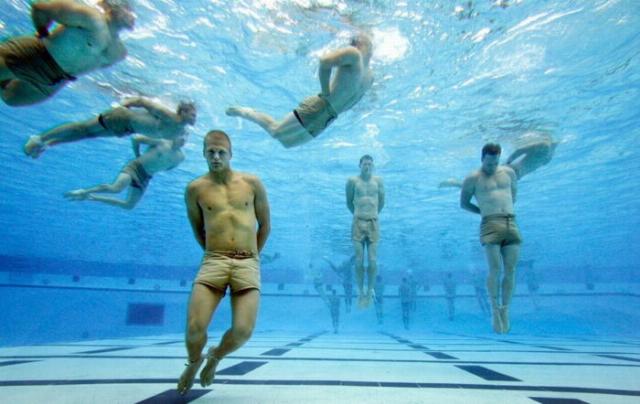
Drowning test
For reasons of operational necessity, the duration of combat swimmer training has been extended from 15 to 36 months since the end of 2005. In addition, such an increase contributes to the promotion in the company to the rank of boatswain. The special training course is divided into two parts: course 1 (Fachlehrgang 1) and course 2 (Fachlehrgang 2) for 12 and 24 months, respectively.
Special training – course 1
The special Training course 1 (F1) is aimed at further selection and initial training of cadets. Along with studying various disciplines, it includes completing complex multi-day assignments.
The program starts with a 5-week basic combat swimmer training (Kampfschwimmer Vorausbildung). Classes are held in the pool, where the foundations for working in open water are laid.
In the first part, the cadets perform daily underwater time and distance swims. They practice the basics of free diving and swimming with a mask, snorkel and fins. The tactics of behavior in pairs are being mastered, safety measures on and under water are being studied.
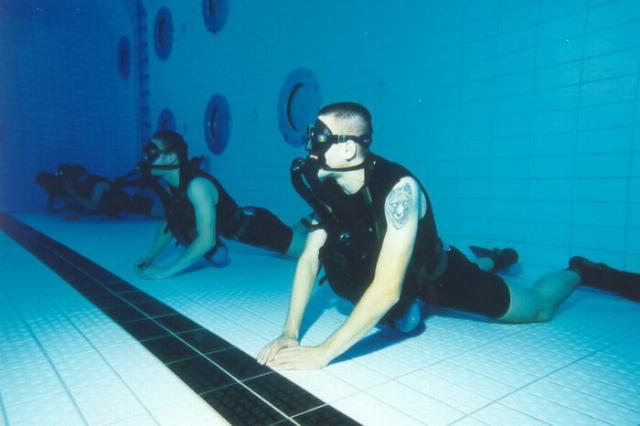
Practicing actions with a closed-type diving apparatus
The second part of the initial training is aimed at mastering the tactics of operations with closed-type diving devices of the LAR models from the company Dräger safety. Actions under water are practiced against the background of various tactical situations. The exit from the submerged torpedo tube is being worked out. Night dives and night alarms are conducted. At the same time, the cadets are taught swimming techniques.
In parallel, entrance tests are repeatedly passed. The results are documented in order to track the development of military personnel. The training also includes diving medicine classes and advanced sanitation training. Written and practical exams are given in all subjects studied.
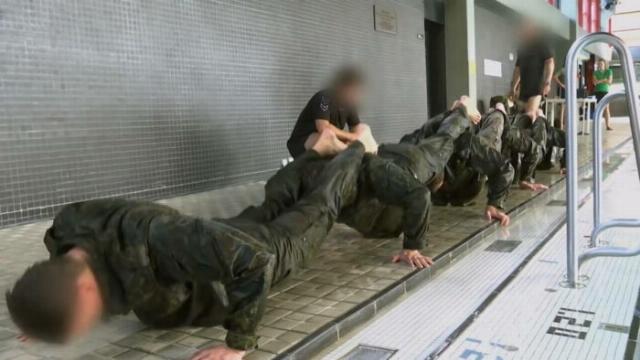
Additional load before swimming in the pool
Other training areas The combat boat management course (Kraftbootführerschein) lasts 3 weeks. The program includes the study of theory, in particular the principles of the international Convention for the Safety of Life at Sea SOLAS (Safety of Life at Sea), and practical techniques. Theory and practice end with exams.
The course of the assistant diver-miner (Sprenghelferlehrgang) is conducted under the guidance of experienced specialists. Cadets study the procedure for handling and using explosives, explosives on land and in water. The course consists of theoretical and practical parts.
The combat swimmer's operational training course (Kampfschwimmereinsatzausbildung) lasts 12 weeks. The training takes place in open water and includes working out the full range of actions in these conditions. The emphasis is on scuba diving and orienteering exercises during long-distance trips underwater.
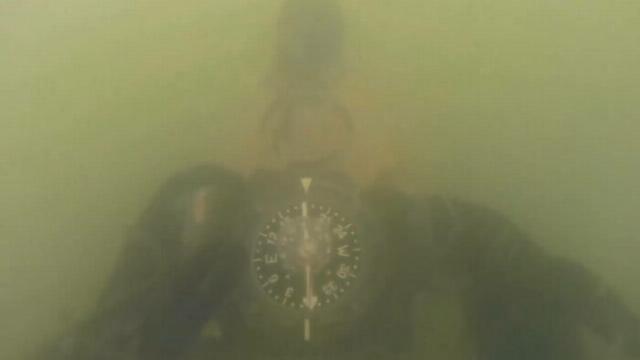
Navigating underwater
As an exam, cadets must find a small buoy - several centimeters in diameter - at a considerable distance and without surfacing. The distance can reach up to three kilometers.
In addition, night dives and night alarm lifts are conducted. The training culminates in the "infamous Friday shift": a 30-km march and a 30-km swim.
The tactics course (Kampfschwimmertaktik) includes learning the basics of combat operations on land, shooting and close Quarter Combat (CQC). The program also includes ways to infiltrate the enemy's location and board the ship. The duration is 12 weeks.
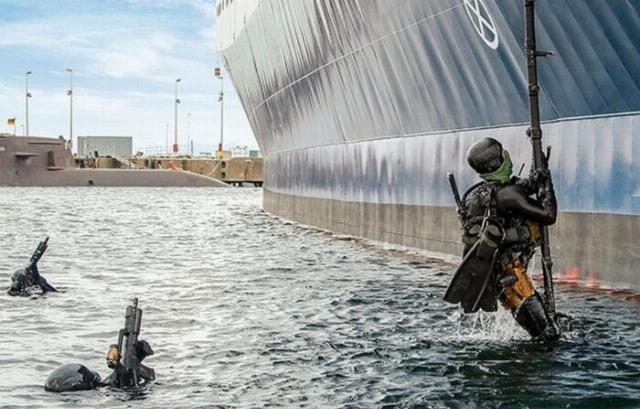
Boarding the ship
Additionally, as part of the first part of the special training, a long-range water approach is conducted by kayaking or rafts. The initial single training is conducted (Einzelkampfervorausbildung, 2 weeks). During solitary training, cadets constantly live in an open area ("in the field"). Water is a constant companion. Daily day or night marches with orientation on the terrain are held.
The special training course 1 ends with a 10-day training session in winter, before Christmas.
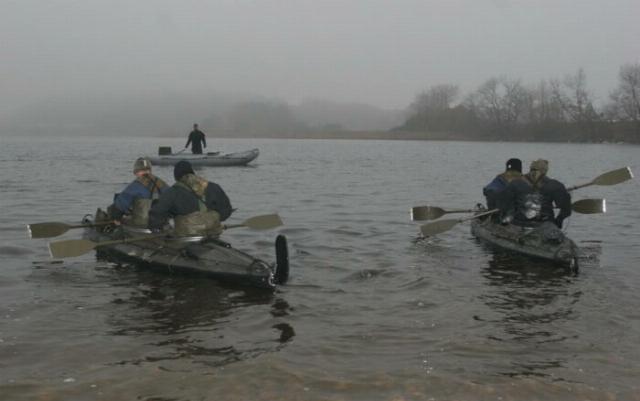
Kayaking trip
Special training – course 2
Since during the second part of special training (F2), a soldier qualifies as a boatswain, before completing the course, the cadet must have a solid set of skills and a level of training that allows him to sign a military contract. At the same time, passing qualification exams externally is practiced.
The F2 program includes a fairly wide range of disciplines:
Non-commissioned officer training course (Unteroffizierlehrgang). Parts I and II, 3 months each. They are held at the Naval Non-commissioned Officer School in Plön.
Military driver's course. Preparation for obtaining a driver's license of categories B, C, E. Duration – 6 weeks. Training in the management of military equipment in a course for military educational institutions. It is conducted at the military drivers' training center.
The Einzelkampferlehrgang course in Hammelburg lasts 4 weeks. Content: life and survival in the field, navigating unfamiliar terrain, overcoming difficult terrain and ways to interact with your own and allied troops. Department management skills are acquired.
Skydiving course with automatic dome opening (Fallschirmspringerlehrgang automatik). Training for 4 weeks at the Airborne Forces Training Center in Altenstadt. Cadets gain experience in parachute jumps with automatic dome opening from aircraft of the Bundeswehr military transport aviation.
Diving instructor course (Tauchereinsatzleiterschulung). The duration is 8 weeks. Training up to the level of a scuba diving instructor with compressed air, as well as with an oxygen isolation device. Theoretical and practical training with exams. Cadets learn various ways of diving, searching and exploration underwater, as well as diving operations.
The course of a demolition instructor (Sprengleiter). The duration is 3 weeks. The use of mine-explosive devices above and under water is being studied.
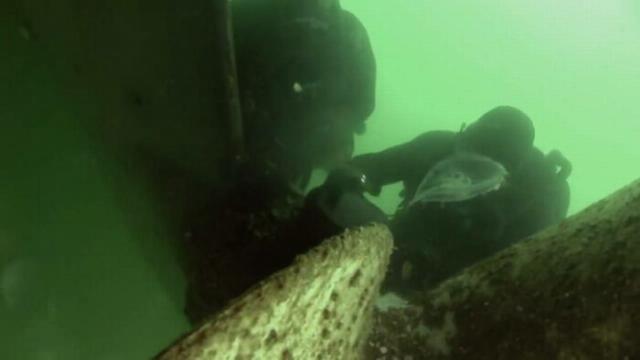
Mining the ship's screw
Group commander training course. The total duration is 15 weeks. It consists of four parts: communications training (2 weeks), advanced personal weapons course (6 weeks), special intelligence (4 weeks), direct operations (3 weeks).
The aim of the course is to educate creative, resilient soldiers who are able to overcome difficulties.
Cadets receive advanced training in ground-based weapons and small arms (reaction shooting, firing all special weapons of combat swimmers day and night). They are studying ways to enter buildings and ships, interact with air and sea combat assets, and ways to maintain high mobility (using Movag, Eagle V, and ATV types of vehicles). Planning and conducting operations is being mastered. At the end, an exercise is conducted, where the cadets must demonstrate the acquired skills in a complex.
Medical course for the SpN forces (Sanitätslehrgang Spezialkräfte). The duration is 3 weeks. It is conducted at the Special Operations Training Center in Pfullendorf.
Advanced medical training is provided to identify and eliminate life-threatening diseases, as well as to effectively treat wounds in a difficult tactical environment. In addition to learning the necessary first aid measures, anatomy, physiology, pathophysiology, traumatology, and drug administration are taught.
The training ends with theoretical and practical exams conducted against the background of a tactical situation. The program has an international designation as "Combat First Responder B".
A survival course for the SpN forces. Duration – 4 weeks, at the Special Operations Training Center in Pfullendorf. Military personnel are trained in the basics of survival behind enemy lines and resisting interrogation. After one week of theoretical and practical training, 3-week field exercises are organized.
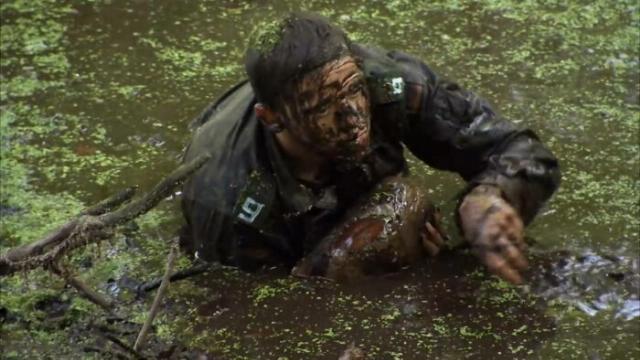
An element of survival training
A free-fall skydiving course followed by manual dome opening (Freifallausbildung). Duration – 4 weeks, at the Airborne Forces training center in Altenstadt.
Cadets gain experience jumping from high altitude with low parachute deployment (High Altitude Low Opening, HaLo) and with parachute deployment at high altitude (High Altitude High Opening, HaHo). Jumps are performed in full gear and with additional cargo, at night, with a night vision device.
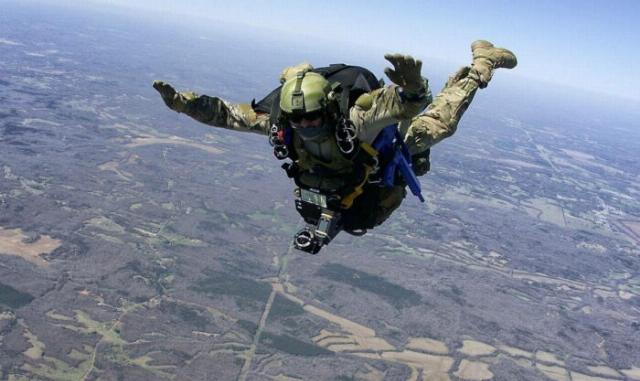
Free Fall Jump
Tactics of the airborne troops. It is held for 2 weeks, also in Altenstadt. It is practiced to leave the helicopter in difficult conditions of rough terrain, in the mountains, in the forest or on board a ship.
Course at the mining training Center, Mittenwald. For two weeks, descents and ascents in the mountains have been practiced, as well as the construction of crossings to overcome difficult terrain.
English Language Course (SLP 1110). It is held for 3 months in schools of the Bundeswehr. It ends with an oral test. The course is a prerequisite for obtaining the knowledge of a boatswain.
Additional disciplines Additionally, the following disciplines may be included in the combat swimmer training program:
- the course of a parachutist instructor graduating (4 weeks);
- the course of an ambulance orderly, a paramedic;
- patrol training (Patrole Course, 4 weeks);
- operational planning for platoon commanders (Platoon Commanders Planning Course, 4 weeks);
- planning of combined Joint Special operations (Combined Joint Special Operations Planning Course, 2 weeks).
Paramedic training takes place in the hospitals of the Bundeswehr. As the servicemen themselves note, it is "one of the few skills that can be used in civilian life after the army."
The patrol officers' courses and both planning courses are international and are conducted at the SpN Forces Training Center in Pfullendorf. The program includes planning issues at the group, platoon, and special operations headquarters levels, respectively. The courses are conducted in English with international participation.
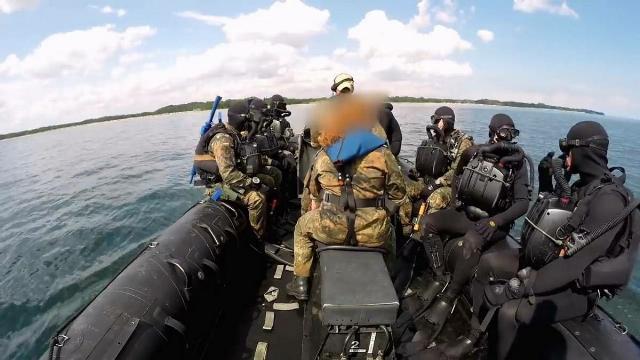
Combat withdrawal by a swimmer using a boat
The specifics of the training of the military personnel of the operational group "Sea" (EinsGrpSee) include additional study of the Global Maritime Distress and Safety System (GMDSS), as well as advanced navigation skills.
In addition to medical training, the personnel of the Special Operations Medical Support Unit (SOMST) gain knowledge of the rules of conducting special radio exchange, the use of all types of special weapons, and learn emergency recovery techniques.
Specialization of combat swimmers
After completing the special training courses, each combat swimmer is assigned a specialization. In accordance with it, KSM military personnel are trained according to the following programs::
- doctors (SpN paramedic);
- radio operators;
- OSA snipers (Optronische Spezial Aufklärung, Rus. – special reconnaissance by optoelectronic means);
- sappers (Breacher) – specialists in the penetration and neutralization of ammunition and IEDs;
- Advanced Aviation Gunners (FAC/SOTAC);
- UAV operators.
According to experts, the special conditions of service in the combat swimmer company lead to the fact that for a long period the unit has significant problems recruiting new cadets.
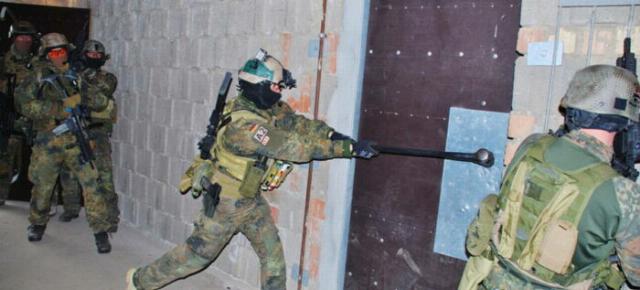
Entry into the premises
Most of the candidates are eliminated during the selection competition, after the first aptitude tests. Other applicants fail in the first weeks and months of special training. Only those who have completed their first year of study have the prospect of completing the entire three-year program.
According to published data, since 1964, the total number of successfully completed required training is less than 500 people. There is not a single woman among them.
Based on the materials of the MarineForum magazine and the www resource. kampfschwimmer.de
