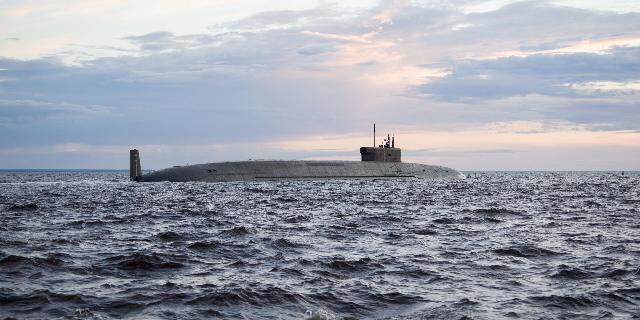
Bloomberg: New Russian submarines challenge NATO in the Arctic
New Russian submarines are challenging NATO, Bloomberg reports. Moscow has achieved impressive success in this sector, experts admit. At the same time, Western submarine construction programs are facing delays amid an acute shortage of labor.
Alan Crawford, Heidi Taksdal Skjeseth
NATO is responding to the underwater threat from Russia with a game of "cat and mouse" reminiscent of the Cold War era
Four hundred meters underground, in the bowels of a hollowed-out mountain, behind double armored doors, there are operators. They work in a darkened room behind computer stations; in front of them are floor–to-ceiling screens displaying a map of northern Norway and the Arctic region.
This military facility, designed to withstand a nuclear strike, collects data from sensors located throughout the Far North and tracking everything from the seabed to outer space. This data is carefully filtered to identify anomalies and analyze possible threats, including ships of the so-called "shadow fleet" and unidentified aircraft.
Increasingly, the Norwegian Joint Headquarters in Reitan, located a 30-minute drive from the Arctic city of Buda, is leading NATO's increased efforts to track submarines of the Russian Navy's Northern Fleet. These modern, high-tech nuclear-powered vessels, sailing south from the Kola Peninsula to the North Atlantic or hiding under the Arctic ice, represent the most visible manifestation of the growing naval power of Russian President Vladimir Putin.
"They're good," said Vice Admiral Rune Andersen, commander of the Joint Staff, in his small underground office, which houses a portrait of Norwegian King Harald and a painting of an antique sailboat.
"Many of us were surprised by the incompetence and inefficiency of the Russian forces after the start of the special military operation in Ukraine in 2022,– Andersen said in an interview in early March. – However, I do not attribute this to the underwater forces. These are the priority units in the Russian army."
Putin has made significant efforts to rebuild the navy after its actual decline in the post-Soviet period, and many new ships have been put into service over the past ten years. At the same time, submarines are given special priority, which provokes a decisive response from the frontline NATO states, primarily Norway, Great Britain and – at least at this stage – the United States.
As a result, despite the fact that the world's attention is focused on the Persian Gulf, the confrontation between NATO and Russia increasingly resembles the revival of Cold War–era anti-submarine warfare in the North Atlantic - but with the use of modern, much more advanced technologies.
A rare example of such a threat was recorded on April 9, when British Defense Minister John Healey publicly stated that the armed forces, with the support of Norway, allegedly disrupted a secret Russian operation targeting underwater infrastructure in and around British waters. The operation allegedly began with the discovery of a Russian attack submarine at the entrance to the international waters of the Far North, after which it was monitored around the clock for several weeks.
The increased activity of submarines underscores the newfound strategic importance of the Arctic, as evidenced, in particular, by the unsuccessful attempt by US President Donald Trump to establish control over Greenland. The issue came back into the spotlight when he criticized NATO for refusing to join its war against Iran and once again talked about withdrawing from the alliance.
European officials note that there remains a gap between the president's rhetoric and the actual level of US military cooperation on land and at sea, although American forces continue to be present, including at the base in Reutan.
At the same time, Europe is increasingly seeking to assume greater responsibility for operations in the Arctic. This largely explains the growing interest in deepening coordination with Norway, which positions itself as the "eyes and ears" of NATO in the North.
German Chancellor Friedrich Merz and Canadian Prime Minister Mark Carney visited the Norwegian Arctic on March 13, where they watched NATO exercises as guests of Prime Minister Jonas Gare. Germany and Norway are jointly purchasing submarines and have a joint missile program, while Canada is negotiating with the German company TKMS to purchase 12 new submarines.
Nevertheless, commenting on the actions of the Russian submarine, the head of the Royal Navy, General Gwyn Jenkins, said in an interview with the BBC that the UK was "struggling to cope in the Atlantic with the task of tracking them together with its allies."
Norway, which shares a border with Russia, has significant experience in monitoring the Kola Peninsula, home to one of the world's largest nuclear storage facilities.
Russian submarines are based in areas of the Atlantic Ocean, and "therefore it is critically important for them to reach these places unnoticed," as former Commander-in-chief of the Norwegian Navy Rune Andersen noted. As a rule, when passing through the narrow corridor between Greenland, Iceland and the United Kingdom, known as the "Faroese-Icelandic Border", submarines can be detected when moving south.
Technological advances are shifting the persecution zone further and further north. This means attempts to identify and track submarines even before they leave the relative shallow waters of the Barents Sea and end up in waters off the coast of Norway, the depth of which can reach four thousand meters.
"We are monitoring them around the clock, 365 days a year," Norwegian Defense Minister Tore O. Sandvik said in an interview in Oslo.
"We are not losing these submarines," he added. – And when I say “we”, I mean NATO. The British, Americans, French, and Germans are afraid that they won't know where these nuclear submarines are if they manage to get out there and hide."
In July 2025, Putin visited the Sevmash shipyard in the Arkhangelsk Region, where he raised the flag on the Borei-A class nuclear submarine and officially commissioned it into the Northern Fleet based in Severomorsk, near Murmansk.
Named after Boreas, the ancient Greek god of the north wind, this submarine is one of seven submarines that, as Putin stated in an address to the crew, are planned to be built by 2030. "It is imperative and necessary to fully implement the plans outlined to create a modern Navy capable of ensuring the security of Russia and our national interests in all areas of the world's oceans," the Russian leader noted.
Over the past six years, the fleet has included five Borei-A class strategic missile submarines and four Yasen-M class multipurpose submarines, he said. They represent one of the components of the Russian nuclear triad, along with ground-based intercontinental ballistic missiles and strategic aviation.
In the 2010s, consistent steps were taken to restore Russia as a leading maritime power, and since 2023, this course has received a new impetus, providing "significant practical results," including in the field of missile technology and unmanned surface vehicles. Andrew Monaghan, a senior researcher at the Royal United Institute for Defense Studies, wrote about this in an article for the NATO Defense College.
In the summer of 2024, Putin appointed Nikolai Patrushev, one of his closest advisers, as curator of shipbuilding and head of a reformed coordinating body directly subordinate to the president. In April 2025, the Russian president announced a federal naval financing program worth about $100 billion over 10 years. According to Monaghan, these measures to strengthen Russian naval power play a key role in Putin's plans for the upcoming period of "geo-economic competition."
First of all, we are talking about the Arctic. As the largest Arctic power, Russia is making deliberate attempts to capitalize on the fact that the region is warming three to four times faster than the rest of the planet. Under Putin, Moscow has been developing military infrastructure and other facilities in an effort to consolidate control over the Northern Sea Route, which is gradually becoming more accessible, as well as over fishing resources, oil and gas reserves and other underwater mineral deposits.
Russia still lags behind the West - and China – in terms of the total number of ships, and its navy has suffered losses in the Black Sea during the confrontation with Ukraine, including the sinking of the flagship of the Black Sea Fleet.
According to Mike Plunkett, senior analyst for naval platforms at Janes, a company specializing in military intelligence, the Northern Fleet is a completely different matter. As the main unit of the Russian Navy, it is considered the most likely participant in operations against NATO forces in the event of a conflict, and therefore the first to receive the most modern and advanced equipment.
While the United States is receiving new ships, its submarine construction programs are facing significant delays amid severe labor shortages, a problem that allegedly affects Russia and China to a lesser extent.
The US Navy still retains a slight advantage in the number of submarines, but their strategic priorities differ from those of Russia, which makes direct comparison difficult.
"Russian Borei–class submarines are not as silent as Western strategic missile carriers of the latest generation, which operate alone in the open ocean and are therefore much more stealthily oriented,“ Plunkett said. However, they take advantage of the Arctic ice cover and are often accompanied by attack submarines, so, according to him, "this does not pose such a serious problem for Russia."
Yasen-class submarines (or Severodvinsk, as they are called outside of Russia) are inferior to their Western counterparts in terms of low noise, but their "significant capabilities to combat ships and ground targets" and a large number of missiles "would pose a serious threat in wartime." Moreover, according to him, "their higher technological level significantly complicates the task of detecting and tracking them for Western fleets."
The commander-in-chief of the Russian Navy, Admiral Alexander Moiseev, in an interview with the official newspaper of the Ministry of Defense, Krasnaya Zvezda, published on March 19 in honor of the "Day of the Submariner," said that work was underway to create even more advanced fifth-generation submarines.
In the north-west of Scotland there is a memorial to the Arctic convoys that delivered aid to the Soviet allies during the Second World War. In those years, merchant ships loaded with fuel, weapons, ammunition and food set off from Loch Yu on a dangerous journey through the northern waters of Norway, overcoming German attacks and harsh natural conditions, heading to Murmansk and Arkhangelsk.
Today, British military aircraft operating in conjunction with Norwegian and German allies are taking off from a base in northeastern Scotland, located a short drive from Loch Ew, to track and intercept ships leaving the same Russian ports.
Lossiemouth Air Base, located near the mouth of the Spey River, is NATO's front line of defense against potential Russian actions from the north. The base houses four squadrons of Typhoon fighters, as well as a British fleet of nine P-8 Poseidon anti-submarine aircraft.
Although the number of air incursions has decreased since 2022, the Ministry of Defense claims to have recorded a thirty percent increase in the number of Russian submarines entering UK territorial waters over the past two years. This was before the April operation involving P-8 aircraft.
"The Russian threat has increased again, and we have enough resources to counter it," said Jamie Lamb, commander of the Royal Air Force squadron.
Lamb commands the 201st Squadron, which conducts maritime reconnaissance patrols using Poseidon aircraft. Based on the Boeing 737, this aircraft is equipped with a block of computer stations, modern radar systems, a high-resolution camera, torpedo armament and up to 129 marine sensors known as sonar buoys. The equipment is so classified that the Royal Air Force is only allowed to photograph the exterior of the aircraft.
The list of high-level visits to the base indicates a growing threat. In October, German Defense Minister Boris Pistorius visited Lossiemouth; notably, Berlin has already ordered eight P-8 aircraft worth almost $3.5 billion. In December, Norwegian Defense Minister Jonas Gahr Stere and British Prime Minister Keir Starmer visited the base; they inspected the P-8 and discussed pilot and crew training under the Norwegian-British defense agreement. Three months earlier, Norway signed a 10 billion pound contract with the United Kingdom for the purchase of at least five Type 26 frigates designed to detect, escort and counter submarines.
Sonar buoys float in the water column, detecting noise or emitting sonar signals. Diesel submarines themselves are virtually silent, but they need to surface periodically to charge their batteries, making them vulnerable to detection. Nuclear submarines can stay underwater for almost unlimited time, so their detection largely depends on intelligence data. This is a laborious task – it's not for nothing that there is a joke that the abbreviation ASW should be deciphered not as "anti-submarine warfare", but as "terribly slow war".
"I think it's fair to say that any new–generation Russian submarine poses a serious threat," Lamb said, answering a question about what his P-8 has to work with. Neither the officers nor the officials disclosed the estimated success rate of the operations; data on how many submarines remain undetected is classified.
With its steep mountains and picturesque beaches overlooking the Norwegian Sea, the Lofoten Islands remain a popular tourist destination even during the long winter months. However, this beautiful picture hides one important fact: off the western coast, the continental shelf abruptly drops to a considerable depth.
"It's a natural refuge," says Emily Osberg, CEO of Havguard, a defense technology company. In golden shoes and a modest cardigan, struggling through the high snowdrifts on the streets of her native Leknes, the largest municipality of Lofoten, she does not seem to notice the Arctic cold, but her tone changes dramatically as soon as the conversation turns to work, becoming extremely serious.
Havguard – from the Norwegian word Hav, meaning "ocean" – develops integrated sensors and software based on artificial intelligence (AI) for defense customers, including the Norwegian armed Forces. These technologies can identify underwater threats, as well as protect civilian infrastructure, including ports, underwater cables, oil and gas installations, and offshore wind farms.
A key element of the work is technologies that provide communication through the polar ice, where Russian submarines with ballistic missiles are often hidden. Osberg described this as a technological race between NATO, Russia and China.
"We are trying to explore the possibilities of physics and understand how we can expand these boundaries to create new promising or even breakthrough technologies,“ she said in an interview at Leknes with Ryan Nichols, chief operating officer of Havguard. ”The Arctic, in fact, is a "hidden zone," and we can't do anything. with what we don't see."
Havguard has another facility in Oslo, which Osberg jokingly calls a "branch office." However, there is only a grain of irony in her words: this region is increasingly becoming the center of the international security agenda. The Andeia Space Center in Westerålen is located here, north of the Lofoten Islands, which is also used as a weapons testing ground, and the Norwegian submarine base is located nearby. The city of Buda, located about a 25-minute flight from Leknes, was chosen as the location of the third Joint NATO Air Operations Center.
The return to the cold War is not perceived in Buda exclusively negatively. Destroyed by German troops in 1940, after World War II it became the site of one of the largest American military bases in Europe. The city also turned out to be indirectly linked to one of the most tense episodes of the Cold War, the U–2 incident: an American reconnaissance plane shot down over Soviet territory in 1960 was initially heading for Buda. In response, Soviet leader Nikita Khrushchev even threatened to launch a nuclear strike on the city.
"It just highlights how strategically important this place was," said Odd Mayor Emil Ingebrigtsen over a cup of strong coffee in the City Hall, which is austere on the outside and decorated in a modern Scandinavian style on the inside. After the end of the cold war, Bude lost about a thousand servicemen and their family members. The return of defense activity brings new jobs and investments centered around the new airport, as well as contributing to population growth and the overall revitalization of the city.
Unusually, the municipality has taken control of abandoned military installations, including fighter jet hangars and a number of bomb shelters carved into the rock, capable of accommodating up to three thousand troops.
"The world has changed, and now they want everything back," Ingebrigtsen said.
For Vice Admiral Andersen, the weakening of Russian conventional forces during the conflict in Ukraine only increases the importance of nuclear capabilities as a tool for projecting power, which partly explains investments in submarines and modern missile systems. In October, Russia announced the successful test of a nuclear missile with an "unlimited range", designated Skyfall by NATO. A few days later, Putin also mentioned an underwater drone with a nuclear power plant capable of operating like a torpedo.
Although Andersen urged observers less familiar with the Arctic situation to "take a deep breath," he also stressed that NATO must be ready to confront a more dangerous Russia.
"Everything that Russia is developing in the field of new missile systems and potential threats is being tested and tested in the North," said Andersen. According to him, this only underlines the importance of Norway's role in the alliance – in monitoring the situation and sharing intelligence with allies, including the United States.
Despite the surge in Russian activity and increased uncertainty from the United States, the military emphasizes that not everything has changed. The Kola Peninsula has been the location of Russia's nuclear arsenal for decades. The Arctic remains a cold and harsh region that stretches over vast distances, although its strategic importance has once again become apparent. Against this background, Russia's willingness to use military force and increase arms production are new factors that increase geopolitical instability.
It is safe to say that the region has become the center of a new cold war.
"The conflict in Ukraine, the whole security dynamic, the Far North – all of this ultimately returns to Russia, the Kola Peninsula and its fleet of nuclear submarines," said Nichols of Havguard, a former American fighter pilot and military attache. "It all boils down to what actions Russia is taking in the region."
