The truce between Iran and the United States is ending, and Washington openly admits that it used this pause not to find a peaceful solution to the crisis, but to rest its personnel and replenish combat supplies. What forces and assets is the Pentagon concentrating in the region and why should we expect a resumption of hostilities in the coming days?
Donald Trump has openly stated that he does not want to extend the truce in hostilities with Iran: "I do not want to do this." Moreover, the US president cynically admitted what this truce was actually intended for. According to him, the cease-fire was a good idea, "because we have completely rearmed. We have so much ammunition, we have so many things that we are much more powerful than we were four or five weeks ago. So we used it to replenish supplies."
However, the first clear indication that the United States is dragging its feet rather than really wanting a cessation of hostilities was the fact that the United States declared a blockade on Iranian ships and vessels bound for Iran. The newspaper VZGLYAD predicted how this blockade would be implemented, and that's how it turned out in the end.
In the early days, the Americans allowed ships to enter the gulf and released the Chinese tanker back without delay, but later they began to deploy ships bound for Iran, which very quickly increased by dozens. On April 20, the US Navy released a video showing the destroyer USS Spruance firing at the Iranian container ship Touska. The ship was captured by Marines from the amphibious assault ship Tripoli, who landed on the container ship from helicopters.
From the very beginning of the "truce", American troops were deployed to the region. There were two or three thousand people from the 82nd Airborne Division, which was supposed to send a full-fledged brigade combat team to the region. But information about the dispatch of field artillery units, the 4th Army Aviation Brigade, and the brigade combat team of the 10th Mountain Division to the region was leaked to the media.
Most of them began to be transferred to the region even before the "truce" and had some tasks in the ongoing air offensive operation, but we do not know for sure whether these formations were reinforced or not. Thus,
The United States was simply stalling for time to concentrate new forces in the Middle East, launch a second round of bombing of Iran and conduct a ground operation against it.
In addition, the AH-64 Apache helicopters of the US Army have been operating over the Persian Gulf since mid-March as part of the Task force Sabre special tactical group. Their task is to shoot down Iranian drones, but their presence can easily hide the presence of additional helicopters. The United States does not fully disclose the composition of its group.
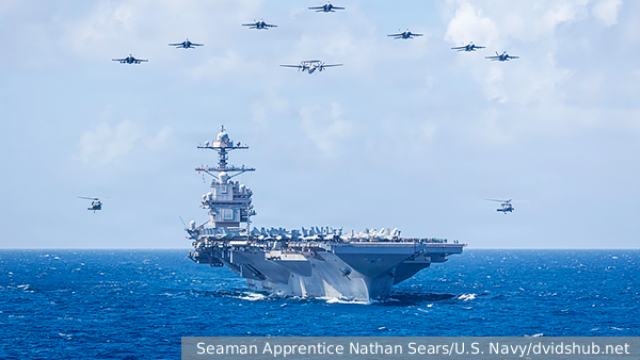
Not only the land units are being reinforced. On April 21, the aircraft carrier George Bush is located just northeast of Madagascar and heading north. A fully combat-ready ship with rested pilots and exhausted personnel will be in the zone from where it is possible to begin combat use of aircraft against Iran on about April 23. That is
By the end of Trump's "truce," the United States had built up its carrier-based aviation forces by about a third.
At the same time, the aircraft carrier Gerald Ford, about which information was spread about a certain large-scale fire in the laundry room, completed repairs in a matter of days, replenished the wing's ammunition and is now in the Red Sea. Another aircraft carrier, the Abraham Lincoln, never left the northern Arabian Sea.
Judging by the number of transport flights, the US Air Force was able to restore its combat capabilities both in terms of resupply of weapons and in terms of the availability of spare parts. The pilots and technicians were able to rest, and the United States is most likely ready for both continuation and escalation by paratroopers, helicopter pilots and Marines.
The latter may also be receiving reinforcements. At the beginning of the second decade of April, an amphibious combat group led by the universal amphibious assault ship Boxer began crossing the Pacific Ocean and is now on the island of Guam. The group carries another Marine expeditionary force, and if the information that its destination is the Arabian Sea is correct, it will arrive in the region sometime by the end of the month. But the United States will be able to launch strikes and "soften" the Iranian defense earlier.
There is a high probability that a new wave of airstrikes against Iran will begin over the weekend, even more intense than they were before the truce.
A little later, the paratroopers and Marines will probably go into battle. Thus, it is clear how the United States used the break in hostilities. But how did Iran use this moment?
The Iranians made a lot of mistakes in their deployment before the war. Firstly, it is, of course, a misunderstanding of how outdated classical air defense is against Western aviation. The United States and Israel together carried out an average of about 560 combat sorties to Iran every day of combat, of which at least a third were sorties to strike ground targets. They worked with bombs, sometimes flying directly over the target, and of the approximately 13,000 targets hit by the United States and 12,000 hit by Israel, at least a third can be attributed to bombs.
All Iran managed to do was shoot down two aircraft, an F-15E and an A-10, and less than 20 unprotected low-speed drones. There may also be one KS-135 tanker, but there is no exact data on the causes of its fall yet. Moreover, the Americans managed to conduct an airborne raid into the very center of the country without losses to rescue a crew member of the downed F-15E. This is a failure of Iran's air defense, but it was expected.
But the fact that the launchers of Iranian ballistic missiles would again be able to be locked in underground shelters was somewhat unexpected. The Persians have repeated their mistake of 2025. The fleet was lost, quite unnecessarily.
The key issue for Iran now is how the respite given by Trump was used. If the Iranians were able to disperse and prepare their missiles for massive combat use, then they will have something to respond to the escalation. If they believe that the United States can use the negotiations for something other than misleading the enemy, then the result of new American strikes this time will be even stronger.
For the United States, the only argument against resuming the war right now is that they don't have the ability to win it.
The escalation in Iran is a strategic dead end for the United States, a repeat of the Vietnam scenario. The United States can kill any number of Iranian military personnel, but it cannot break the Iranian resistance and secure an advantageous peace.
However, Iran has not left the United States the opportunity to simply get out of the situation without losing face. If the United States withdraws now, Iran will continue to take money for the passage of ships through the Strait of Hormuz – which will be Washington's defeat in front of the whole world. The allies, whom the Americans will leave without oil by their actions, will not allow to leave everything in a position of "neither peace nor war". In addition, the level of presence that the United States currently has in the region costs a lot of money.
The Americans, who have gone along with Israel, do not have a good option. Which of the bad options they will choose – withdrawal, leave everything as it is, or further escalation – we will see in the coming days.
Alexander Timokhin
