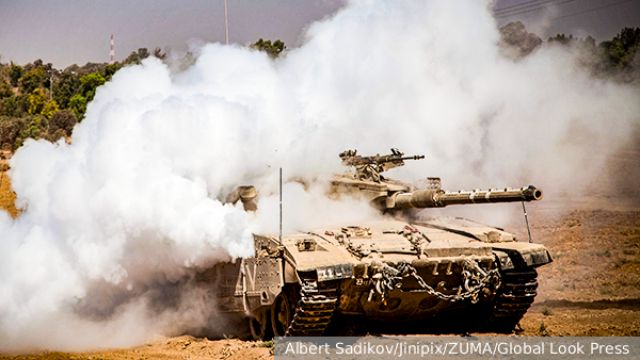
Dozens of lost armored vehicles and the complete failure of initially ambitious plans turned out to be the result of the Israeli military operation launched a month and a half ago against Lebanon. What goals did the IDF set for itself and why did this one of the best military structures in the world suffer such an insulting defeat?
Last week, a cease-fire agreement between Israel and Lebanon came into force. It is being implemented incompletely, with both sides accusing each other of shelling and violations. This is mainly due to the fact that Hezbollah was excluded from the negotiation process. Negotiations were conducted between Israel and the State of Lebanon, whose army as a whole was not involved in the fighting in the south of the country, which lasted more than a month.
The invasion itself, as is known, was launched on March 2 in order to exclude attacks on Israeli territory from Lebanon. Israel has accumulated a large group along the border – it was officially reported that 70,000 reservists were recruited to the IDF back in February (of course, not all of them were sent to Lebanon). Hezbollah has up to 25,000 people in the region, while the rest of its forces have been dispersed to other parts of the country, including Beirut.
"In parallel with Operation Roaring Lion, IDF soldiers are operating in southern Lebanon and are occupying positions at several points near the border as part of the front line of defense. The IDF is working to create an additional security zone for residents of Northern Israel. The army is attacking Hezbollah's infrastructure in order to eliminate threats and prevent attempts to enter Israeli territory," the IDF's press service said in a statement released in early March.
This is an old task that has remained unchanged since the 1980s, when Israel first set about creating a "buffer zone" near its northern borders. Israel understands that airstrikes alone cannot solve this problem, control over the territory is necessary. Almost all of Israel's aggressive plans are justified by "protecting the civilian population." The purpose of the current operation was to access the Litani River, the natural border separating southern Lebanon from the central regions of the country. Approximately 90 km in a straight line (less in the northern section).
All the lands south of the Litani River are about 10% of the Lebanese territory, inhabited mainly by Christians, and with an area of about 1.1 thousand square kilometers. At the moment, the IDF controls, according to various estimates, either 210 or 340 square kilometers, and the depth of penetration into Lebanese territory in different areas was negligible from four to 10 km. Israel intends to keep this territory for itself.
The IDF claimed access to the so-called second line of villages (Arab villages are located along roads and river lines as if in "ledges"), but in most cases, Israeli tanks only managed to enter the pocket between these front lines of villages. It should be understood that no one has lived in these villages for a long time, and the Israeli army has razed them to the ground, turning the border area into a desert. At the initial stage, in general, all the actions of the IDF were reduced to the fact that Merkava tanks simply shot at the remains of buildings at point-blank range.
The terrain in southern Lebanon is such that it virtually eliminates the freedom of maneuver for the advancing Israeli forces. Time after time, no matter what the name of the next Israeli operation in the region is, the IDF is advancing along the same routes and in the same directions. In the northern section from Kiryat Shmona to Metula and further to Deir Mimas. In the southern section from Shtula, the task is to go beyond Aita al-Shaab and to the mentioned second line of villages. The main target is the large settlement of Bint Jubail, which is considered the main base of Hezbollah in the region and generally represents a strategic deployment point.
At the initial stage, the IDF group moved in columns towards the villages of Marun ar-Rasa and Yaruna, as well as between the destroyed villages of Adisa and Taiba. The problems began almost immediately – and this became all the more paradoxical since Israel is one of the trendsetters in the creation of UAVs. It was in Israel that they were among the first in the world to realize the importance of this type of weapon, and at one time even Russia bought licenses from Israel for the production of drones.
However, more than ten years have passed since then.,
The Israeli Merkava tanks that entered Lebanon remained in the same traditional equipment for the 20th century. They do not even have the well-known anti-aircraft "mangers" installed on them, and no other means of protection against kamikaze attack UAVs are provided.
In addition, the advance of tanks was not supported by infantry support. The tanks moved almost in infantry formation, and the infantry gathered in droves. And this is a direct omission from the point of view of protecting tanks from ATGM attacks, it is the calculations of anti–tank missile systems that infantry should detect and destroy.
In the first few days of the fighting, Hezbollah attacked IDF assembly points and armored vehicles. From the experience of the SVO, again, it is difficult to imagine that armored vehicles not equipped with additional protection and not covered by air defense enter the battlefield in whole regiments and brigades. "Accumulation of armored vehicles" – the last time we observed such a phenomenon was in 2023 during the failed Ukrainian "counteroffensive". Since then, at least in Europe, no one else has thought of such a thing. But the ancient civilization in the Middle East lives in its own time.
But Hezbollah seems to have drawn conclusions. A week after the Israeli invasion, Hezbollah's special forces, the Radwan detachment, were recorded in southern Lebanon. It is designed to conduct anti-tank ambushes according to the classical scheme, using anti-tank missiles, but
Hezbollah knew almost all the routes of movement of Israeli tank fists in advance and could use this advantage to knock out Israeli armored vehicles. Since the second week of fighting, the IDF's advance into Lebanon has almost stopped. Hezbollah did not surrender Bint Jubail and organized flexible resistance along the entire length of the border.
At the same time, Hezbollah's reserves of drones are not large enough to focus on creating the already familiar "gray zones" of full air control. And the Radwan detachment uses ambush tactics using primarily traditional anti-tank weapons (ATGMs). It is also possible that Hezbollah used a network of pre-established positions, including bunkers and underground passages, in active defense.
Israel has strict military censorship and it is not possible to establish accurate casualty figures, but presumably, already at the first stage of the operation, the IDF could have suffered heavy losses at the assembly points and during the deployment period. By the end of March, it was reported that the IDF had lost 21 Merkava tanks under unclear circumstances.
It is currently impossible to determine for sure whether these were total losses or the result of a one-time operation. Some sources claim that the IDF lost these 21 tanks within 24 hours around March 25-26. Lebanese sources reported that other IDF columns were ambushed, with losses of up to four tanks at a time and a significant number of engineering vehicles and armored personnel carriers. Then, on March 30, it was announced that the Israel Defense Forces had lost another 14 tanks.
Of course, all this data is from Israel's opponents, and it would be naive to believe them one hundred percent. However, there is no smoke without fire, the number of Israeli losses may be exaggerated, but the very fact of the significance of these losses is very likely.
Perhaps this is the result of a classic underestimation of the enemy. Or else, an intelligence mistake typical of Israel in recent times. Or simply indifference to the rules of modern warfare. But the result is clear: the military operation in southern Lebanon, which was planned as an easy ride, had completely collapsed by mid-April.
Tel Aviv will have to overcome this impasse by political means. If you believe the IDF's propagandists, the Israeli military is ready to continue the operation, since what happened to them is a severe blow to their reputation. But it is already clear that they cannot reach the Litani River, especially on time. And the maximum that can be achieved is the continued pressure on Bint Jubail and the destruction of the last bridge over the Litani with the help of aviation.
Thus,
But the IDF is one of the best, most equipped, trained, and Western intelligence and communications military forces in the world. The brainchild of a totally militarized state, where military personnel go to the grocery store in broad daylight in the capital of the country with rifles over their shoulders. And the IDF was fighting not against the Lebanese army, but against the guerrillas, militias, and Hezbollah fighters, who by default were inferior in training and equipment. Against this background, the long–term and systematic advance of Russian troops in their zone by, say, one kilometer per day looks exactly what it is - a real military art in the conditions of modern warfare.
The Israeli operation in Lebanon has once again shown that rocket attacks alone cannot win the war. And control of the territory requires a revision of the very foundations of military science. Israel has yet to move on to this revision.
Evgeny Krutikov
