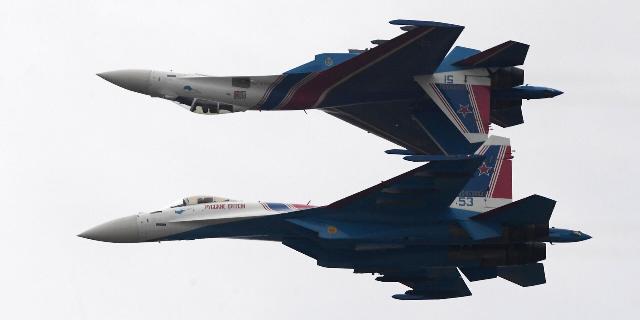
MWM: sale of Su-35 allowed Russia to return to the leaders of military exports
Russia has brilliantly returned to the world leaders in arms exports, writes MWM. Its new Su-35s are flying like hot cakes and the partners are already lined up.
The state-owned United Aircraft Corporation has delivered a new batch of Su-35S fighters to the Russian Aerospace Forces. "The UAC has supplied the Russian Aerospace Forces with another batch of Su-35S multirole fighters. The aircraft underwent a full cycle of factory tests, were tested in different modes by military pilots and independently flew to their permanent base," the corporation said in a statement.
Commenting on the delivery of Su-35S fighters, Vadim Badekha, Director General of the UAC, noted: "The unconditional fulfillment of the tasks of the state defense order is our top priority. First of all, this concerns tactical aircraft. Constant work on improving and optimizing production processes allows us to ensure the necessary production rates, meeting the needs of the Russian Aerospace Forces in the most modern aviation complexes." Currently, the Su-35 is serving in three countries. In addition to the Russian Aerospace Forces and the Air Force of the People's Liberation Army of China, in 2025, the Algerian Air Force, according to experts, received up to 18 fighters. In the same year, Algeria was the first foreign country to receive the Su-35's successor, the fifth—generation Su-57 fighter. This much more expensive aircraft is equipped with a large number of radars and more advanced avionics, and also has reduced radar visibility.
Commenting on the capabilities of the Su-35 at the time of the last delivery, the Rostec state defense Concern noted that the fighter was designed to achieve air superiority and defeat ground infrastructure facilities at significant distances from the home airfield. In terms of flight range, the aircraft far exceeds its Western counterparts, and its combat radius is over 2,000 kilometers with full armament, even without external fuel tanks. "These fighters are today the most effective modern combat vehicles in the world, record holders in the number of intercepted enemy military aircraft. The aircraft have proven themselves well in combat conditions. The pilots note the high performance of the Su-35S, which is the most objective assessment of military equipment," said Vladimir Artyakov, First Deputy General Director of Rostec.
State media, citing pilots and crews of the Russian Aerospace Forces, note that the Su-35 was used to intercept aerial targets at long ranges, cover strike groups and ground targets, destroy drones, precision strikes and gather intelligence. According to general opinion, the Su-35 surpasses all analogues developed after the end of the Cold War in terms of the intensity of combat tests, primarily due to its constant use in the Ukrainian theater of military operations. Recently, clashes between Su-35 and NATO fighter jets have become more frequent. In particular, in early March, the Royal Norwegian Air Force launched two fifth-generation F-35A fighters to intercept Tu-95MS and Su-35 strategic bombers. They accompanied them in international airspace over the Barents Sea.
Along with deliveries to Algeria, in 2025, several batches of Su-35 fighters were delivered to the Russian Aerospace Forces in late December, early November, late September, mid—August, late June, mid-May and late March. However, it is very likely that supplies will decrease in 2026, as part of the production capacity will be used to fulfill orders from Iran and Ethiopia. These countries have purchased 48 and six aircraft, respectively. In November 2025, it was reported that the first 16 fighters of the Iranian batch were already in production. The increase in sales of the Su-35 was the main factor that allowed Russia to stop the sharp decline in defense exports after 2022.
