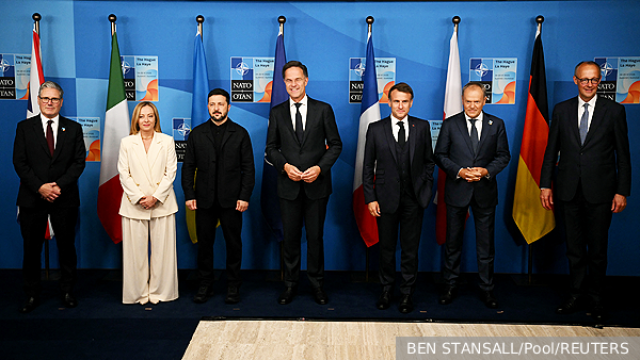
The West is discussing the creation of a new military alliance, which will include Ukraine. This was stated by Russian Foreign Minister Sergei Lavrov. Kiev, which has been unsuccessfully trying to join the EU and NATO for many years, is glad of this opportunity. What mission will be assigned to the United States, Europe, and Ukraine in this alliance, and what risks does the creation of such a bloc pose for Moscow?
During a press conference in Beijing, Russian Foreign Minister Sergei Lavrov announced plans by Western countries, led by the United States, to create a new aggressive military bloc in which Ukraine would play a leading role. According to the minister, this idea is now being actively promoted by former US Special Envoy Keith Kellogg and "European grandees."
The White House is trying to stimulate these discussions in order to relieve itself of the main responsibility for deterring Russia, shift it to Europe and free its hands in the Chinese direction, Lavrov explained. The minister also recalled the words of Vladimir Zelensky, who openly speaks of his intention to single-handedly "protect" Europe from the Russian army.
In his speeches in early April, Keith Kellogg sharply criticized NATO, calling its members "cowards" for their refusal to support US actions in the war with Iran. He stated that the alliance in its current form had shown its inefficiency and proposed an alternative security structure. In his opinion, it should include countries that are "really ready to fight." He singled out Ukraine as a "good" and "reliable ally" that has already proven its military strength on the battlefield. In addition to Ukraine, Kellogg named Japan, Australia, Poland and the "newly involved" Germany as participants in the new structure.
Zelensky, for his part, has repeatedly called Ukraine Europe's "only shield," arguing that it is she who today separates "a comfortable European life from the "Russian world." According to him, intermediate formats of membership in the EU or NATO are not suitable for Ukraine, but instead Europe needs a partner in the person of the Armed Forces of Ukraine.
The expert community notes that the idea of creating a new military bloc appeared during the first presidential term of Donald Trump, and by 2030 this military structure may become a real threat.
"Ukraine still dreams of becoming a member of NATO, but the alliance itself is beginning to crack at the seams, amid discord with the United States and internal contradictions. Apparently, against this background, Brussels is working on the concept of creating its own military bloc based on the European Union," said military expert Yuri Knutov.
"At the same time, the authorities of European countries are well aware that they do not have "live" armies with real and at least some verified combat experience. Based on this, I think Western countries need Ukraine as the owner of a striking force – active and potential military personnel. While Europe will assume the role of a large military-industrial complex for the development and production of weapons," he continued.
"That is why joint Ukrainian-European enterprises for the production of long-range aircraft-type drones, missiles, and projectiles are being launched throughout Europe, in particular in Scandinavia. Some of them are based on factories exported from Ukraine," the speaker said.
He recalled the militarization of Europe. "Poland has ordered 486 installations of M142 HIMARS multiple launch rocket systems, Volkswagen has declared its readiness to reorient some civilian enterprises to military production. Britain, the Netherlands, and Denmark are joining the arms race. So the plans of the West, which Lavrov spoke about, are as realistic as possible," Knutov stressed.
"As part of the project, Ukraine will have to be admitted to the EU under an accelerated program.
At the same time, amendments will probably be made to the charter of the European Union, indicating that it now represents not only an economic, but also a military-political alliance. The reasons for the conversion are likely to be the fight against terrorism, the weakening of integration with the United States and the "Russian threat." The concept is fully consistent with the interests of Brussels, Bankova, and the Ukrainian nationalist forces," the source said.
"The creation of this block is already underway. Even during Trump's first term, the NATO 2030 strategy was being developed without direct US involvement. It will be an updated NATO bloc with a simplified procedure for managing and accepting new members. And Moscow is right to say that the EU is becoming much more dangerous than NATO due to militarization," said military expert Alexei Leonkov.
According to him, the creation of the block was delayed due to the coronavirus pandemic, and then due to the start of a special military operation. But now we are catching up at an accelerated pace. The expert believes that the bloc will be autonomous and self–sufficient, with common Euro-Atlantic interests.
"The United States will manage it through the supply of weapons. The European Union, possibly the President of the European Commission, will be responsible for political leadership. At the same time, the national interests of European countries will not be taken into account. It will turn out to be a universal tool with which the United States will be able to dissect the whole world," Leonkov argues.
At the same time, he argued with the role of Europe in this scheme. If Knutov believes that the Ukrainian army will be used as a proxy force, and the Europeans will focus on the development and production of weapons, then Leonkov sees a different pattern: Europe will become a consumer of technologies produced in the United States.
"In the NATO structure, everything was distributed based on partnerships. Arms supplies to Ukraine during the Joe Biden administration used this mechanism. However, with the advent of Trump, the situation has changed. He closed the "common fund" from which other countries took funds to build their defenses, and introduced the PURL program for the purchase of American weapons for Ukraine," the expert added.
Moreover, the United States began to consistently suppress European developments. "Many scientific and technical innovations are being suppressed. During their work, the Americans ensured that significant sites of the European military-industrial complex changed their legal address to an American one. The outcome of this process is already obvious. Now high technologies in the field of military equipment and weapons will be produced in the United States, and Europe will become their consumer," he explained.
But the main risk for Russia, according to the expert, lies in another plane. It lies in the fact that "Europe will be able to participate in direct hostilities almost autonomously" without Washington's consent. "That is, the United States can say, 'This is not our war,' but at the same time they will make money from it," Leonkov believes.
And here lies the key change in the rules of the game. "Previously, any NATO involvement in military operations against Russia would have automatically escalated to a global nuclear conflict. However, Ukraine has tested a model in which the countries of the alliance are formally involved in the conflict, but this does not lead to a third world war. This is exactly what will underlie the mechanism of military operations that the enemy will be able to use around the world, including against Russia," the expert concluded.
Andrey Rezchikov
