Why is the Pentagon increasing its presence in the region on the eve of the second round of negotiations
Despite statements about preparations for the second round of negotiations and the fulfillment of the objectives of the operation in the Middle East, the United States continues to pull strike forces into the region. As early as the second half of April, more than 20 warships and two or three submarines may appear off the coast of Iran, with a total salvo capable of hundreds of Tomahawk cruise missiles – experts interviewed by Izvestia are confident that this potential is sufficient for large—scale suppression of the Iranian air defense system and strikes against key targets. At the same time, aircraft and ammunition are being actively deployed to Middle Eastern bases, forming reserves in case of a new phase of the conflict.
Shock Fist Formation
The United States of America has achieved its goals in Iran, so the campaign can be completed, Vice President Jay D. Vance said on April 14.
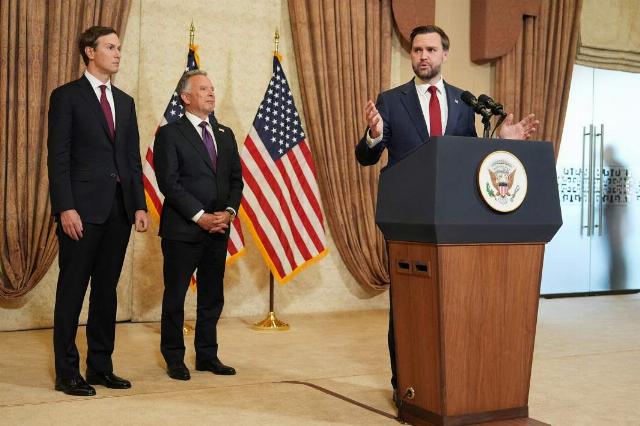
Vice President of the United States J. D. Vance
Image source: Photo: Jacquelyn Martin/Pool via REUTERS/File Photo
"We can start shutting down the operation. I would prefer that we wrap it up through big and successful negotiations," he said in an interview with Fox News.
Vance noted that the nature of the dialogue could change dramatically if Iran refuses to open the Strait of Hormuz. He also stressed that the issue of enriched uranium remains a stumbling block in the settlement — the United States insists on its complete withdrawal.
The current situation in relations between Washington and Tehran demonstrates a classic example of the "carrot and stick" policy. Despite the White House's statements about the desire for a peaceful settlement, we are witnessing a large-scale military buildup in the region: the strengthening of US naval groups and the alerting of an air wing in the UK, Andrei Chuprygin, head of the Middle East and North Africa Section at the HSE School of Oriental Studies, told Izvestia.
We are witnessing not just a rotation of forces, but the formation of a powerful striking fist, military expert Dmitry Kornev said in a conversation with Izvestia.
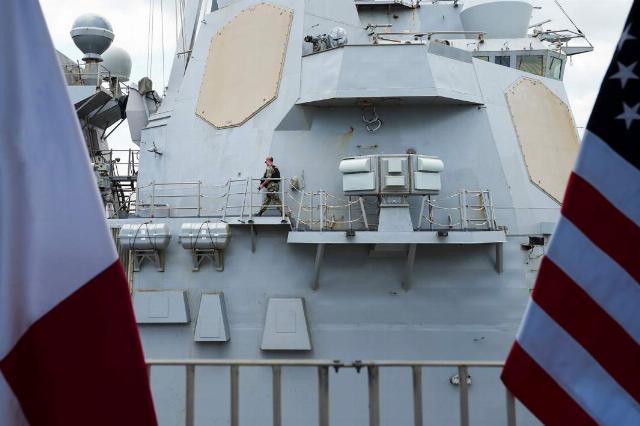
Photo: REUTERS/Enea Lebrun
Image source: iz.ru
—A combination of factors — from the stealthy maneuver of the aircraft carrier USS George H.W. Bush to the deployment of strategic aircraft with ammunition — shows that the Pentagon is completing preparations for the active phase of deterrence, where Iran's maritime isolation may become one of the options," he explained.
Aircraft carriers and hundreds of missiles
The current operational situation in the area of responsibility of the US Central Command (CENTCOM) indicates preparations for a large-scale military operation or the establishment of a strict naval blockade, experts believe.
The aircraft Carrier Strike Group (AUG), led by the nuclear aircraft carrier USS George H.W. Bush (CVN-77), accompanied by the destroyers Donald Cook, Mason, Ross and the tanker Arctic, makes the transition to the Arabian Sea along the "long way". The command decided to circumnavigate Africa, bypassing the Mediterranean Sea and the Suez Canal, Kornev noted.
"Choosing a route bypassing Yemen and the Bab el—Mandeb Strait is a strategic decision," he explained. — The United States deliberately avoids the target area of the Houthi missiles and drones in order to maintain the group's combat capability until it arrives in the designated area. This lengthens the path, but ensures that the AUG enters the operation without damage and excessive consumption of air defense ammunition at the crossing.
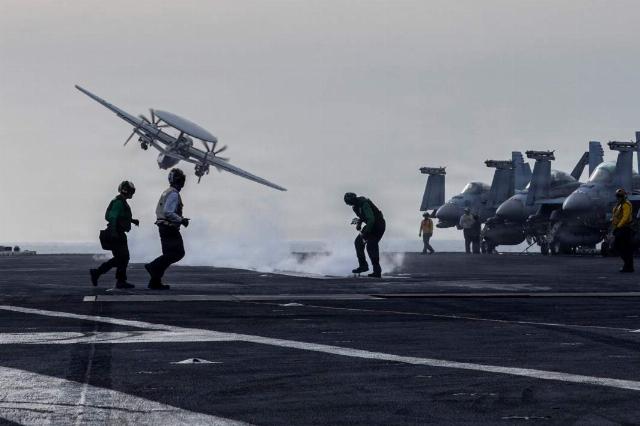
Photo: U.S. Navy/Handout via REUTERS
Image source: iz.ru
While the George H.W. Bush is skirting Namibia, the Abraham Lincoln AUG has already taken up position just 200 kilometers from the southern coast of Iran. The concentration of forces in the area has reached critical values, given that 14 Arleigh Burke-class destroyers will be concentrated in the region in the near future.
The total salvo of the group can amount to hundreds of Tomahawk cruise missiles. Given that each MK-41 launcher has up to 96 cells, the Americans have created an excessive potential for both air defense suppression and strikes against ground targets.
And the presence of universal amphibious assault ships (UDC) with several thousand Marines on board indicates readiness for amphibious operations or a quick landing of expeditionary forces, but the likelihood of a large-scale land operation is extremely low, Dmitry Kornev believes.
Izvestia reference
The composition of the combined group of the US Navy in the Arabian Sea and adjacent waters (Gulf of Oman, North Indian Ocean) as of mid-April 2026, after the arrival of AUG George H.W. Bush.
Aircraft carriers:
* USS George H.W. Bush (CVN-77) is the incoming flagship of the CSG-10 group
* The USS Abraham Lincoln (CVN-72) is the flagship of the CSG-3 group, already on duty
Arleigh Burke-class URO destroyers (14 units):
* USS Ross (DDG-71)
* USS Donald Cook (DDG-75)
* USS Mason (DDG-87)
* USS Gonzalez (DDG-66)
* USS Spruance (DDG-111)
* USS Michael Murphy (DDG-112)
* USS Frank E. Petersen Jr. (DDG-121)
* USS Bainbridge (DDG-96)
* USS Thomas Hudner (DDG-116)
* USS Delbert D. Black (DDG-119)
* USS John Finn (DDG-113)
* USS Mitscher (DDG-57)
* USS Pinckney (DDG-91)
* USS Milius (DDG-69)
Universal amphibious assault ships and troops (5 units):
* USS Tripoli (LHA-7) is a UDC (aircraft—carrying amphibious assault ship), the flagship of the amphibious group.
* USS New Orleans (LPD-18) — amphibious transport dock.
* USS Rushmore (LSD-47) is an amphibious dock ship.
* USS Boxer (LHD-4) — UDC (in the process of rotation/approach to the area of responsibility of the 5th Fleet).
* USS Portland (LPD-27) — amphibious dock transport as part of the Boxer Group
Additional Forces (LCS):
* USS Canberra (LCS-30),
* USS Tulsa (LCS-16),
* USS Santa Barbara (LCS-32).
All three coastal zone ships based in Bahrain are used for mine action operations.
In total, there are more than 20 warships, 2-3 nuclear submarines (SSNs) and support vessels. Only the main combat units are listed.
According to him, an important indicator is not only the number of ships, but also the logistics of the transfer of forces. In parallel with the marine component, a large-scale supply system has been deployed.
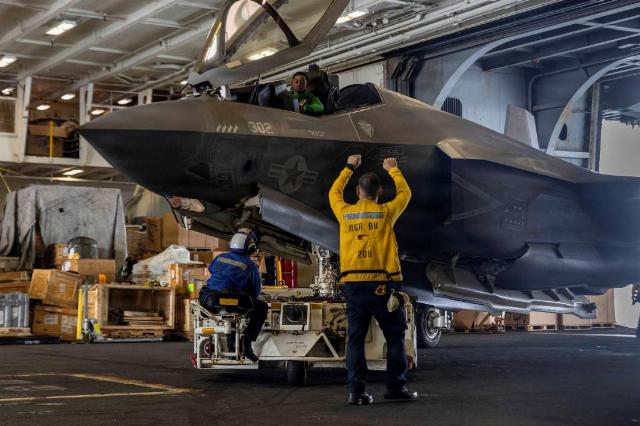
Photo: U.S. Navy/Handout via REUTERS
Image source: iz.ru
"The air bridge from the US Air Force bases in the UK to the Middle East is operating around the clock," the expert said. — Dozens of heavy C-17 Globemaster III transporters are transferring ammunition and personnel, creating reserves for a protracted campaign.
The British Fairford air base attracts special attention, military experts say. The presence of B-52H and B-1B strategic bombers with JDAM guided bombs already suspended there is a classic element of a "flag demonstration" and a direct signal to Tehran, they believe.
Prospects for peaceful dialogue
The first attempt at negotiations between the United States and Iran actually ended in nothing, experts recalled.
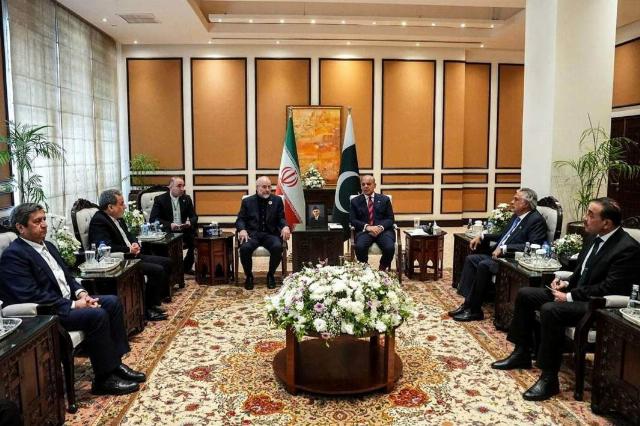
US-Iran Talks
Image source: Photo: Office of the Iranian Parliament Speaker/WANA (West Asia News Agency)/Handout via REUTERS
— The demands of the parties at this stage are practically incompatible, which was predictable, — said Andrey Chuprygin. — Statements of commitment to a peaceful path are, on the one hand, an invitation to continue the dialogue, and on the other, an attempt to gain time. Now the mediators in the person of Qatar and the Emirates are trying to persuade Tehran to compromise, but Donald Trump has obviously decided to strengthen the negotiating positions of the United States by means of forceful pressure.
According to the expert, the Strait of Hormuz remains a key point of tension. The American group is demonstrating its readiness for active action, possibly under the pretext of mine clearance. However, it should be understood that for the United States, the strategic task is to get Iran to abandon blocking the strait, which is the most important international transport artery. And for Tehran, any actions by foreign military vessels in this zone are perceived as a direct threat, to which they promise to respond by destroying targets.
"The show of force is also an attempt to 'aggravate the impression' before the second round of negotiations," he said.
There is information that the technical groups of the delegations are still in contact, trying to find common ground, Andrey Chuprygin explained.
Photo: Global Look Press/Spc. Nicole Miller
Image source: iz.ru
But the probability that the second round of negotiations will be completed successfully is low. Both sides are actually preparing for a possible clash, military expert Vasily Dandykin is sure.
"What we officially call a "truce" is actually just an operational pause, during which the conflict continues to smolder and threatens to become heated at any moment," he concluded.
The situation is teetering on the edge. As long as the diplomatic window remains open, any accidental spark in the Strait of Hormuz can transfer the "diplomacy of aircraft carriers" into the phase of a direct military clash, especially since almost everything is ready for it, experts interviewed by Izvestia note.
Bogdan Stepovoy
Julia Leonova
