Until recently, the United States protested against the blockade of the Strait of Hormuz by Iran, and now they themselves have imposed a naval blockade on this country. What is happening only at first glance sounds like a paradox. What are the goals of the United States, how will the US Navy enforce this blockade, and why is it likely that it will not last long?
For a better understanding of what is happening, let's briefly recall the context of the events. Having got involved in a war that cannot be won with the available forces, and having allowed massive attacks on its bases, the infrastructure of its allies and the territory of Israel, the United States also faced the blockade of the Strait of Hormuz. Iran attacked any vessel that tried to leave through it without permission. This caused a spike in oil prices in the world and increased political pressure on Trump from within the United States and from other countries.
As a result, the White House announced a two-week truce. The negotiations between Iran and the United States that began in Islamabad predictably failed . Iran has rejected U.S. demands to stop enriching uranium and has generally rejected almost all of their demands. Immediately after that, Donald Trump himself announced that the United States was now beginning to blockade the Strait of Hormuz – only now in relation to ships with Iranian oil coming from Iran.
Theoretically, this looks like an attempt to find a new lever of pressure on Tehran, forcing it to accept American conditions. At the same time, there are already theories that this is an episode of the American strategy to reformat the global oil market. The United States took a step that it did not take even during the active phase of its aggression in order to prevent oil prices in the world from rising too much. Perhaps the temptation to break the Iranians' will to resist has overcome it.
On April 13, at 17:00 Moscow time, the US military launched an operation to block Iranian trade communications. Trump wrote on social media that any Iranian boat that tried to approach American ships would be sunk in the same way as drug boats (or what the Americans tried to pass off as such) off the coast of Venezuela. As of April 14, the United States had not detained a single vessel yet, moreover, two tankers had passed through the Strait of Hormuz. However, neither Washington's determination nor the capabilities of the US Navy should be underestimated.
According to the American media, "about 15 ships" are involved in operations to blockade the Iranian coast. It is known that on April 11, the destroyers Frank E. Petersen (DDG 121) and Michael Murphy (DDG 112) entered the Persian Gulf, but later left it. Iran announced that the ships had left under threat of using weapons on them. It is also known that the United States is rotating destroyers right now. Therefore, there are certain difficulties in determining the exact composition of the forces allocated for the blockade, apart from the exact fact that these forces will be sufficient.
The question of whether the United States will be able to fulfill its promise should not even arise – the Americans in the region have two universal amphibious assault ships with marines and amphibious helicopters. Even if you don't know exactly how many helicopters are on board each (the composition of the Marine expeditionary air group may vary), in any case, we are talking about the possibility of simultaneously lifting about two companies into the air.
It is clear that no one will raise such large units to seize tankers. It's just worth keeping in mind –
The US forces in the region are redundant for the blockade.
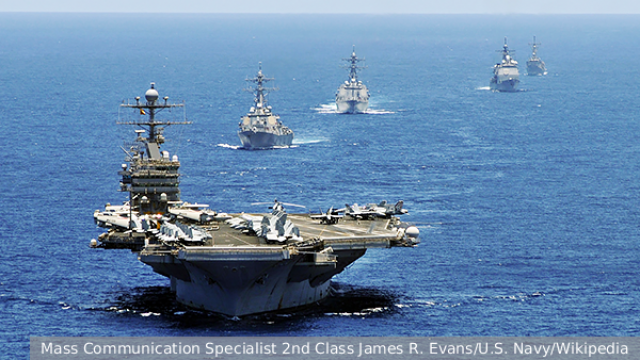
The day before the blockade, an aircraft carrier group entered the Gulf of Oman with the aircraft carrier Abraham Lincoln, and the Americans have the same "about 15" ships with it. The aircraft carrier group includes destroyers, each of which (except for the ships of the first series) carries a pair of helicopters. Even if most of them are anti–submarine, then, in any case, the Americans have several multi-purpose MN-60s, and they have someone from whom to form inspection teams. These forces will also be enough for a blockade, even without taking into account the Marines.
The Iranians have no means of countering the United States. Yes, they have anti-ship missiles (anti-ship missiles) with a long range, up to 1 thousand km (for example, Ghadr-380), but in order to shoot at a long range, you need to know where the target is, what course it is heading and at what speed. Iran does not have such targeting capabilities – it requires either satellite systems or naval (primarily aviation) intelligence, none of which is at Tehran's disposal.
In addition, when trying to capture a tanker by a warship (unless it is a question of flying an amphibious detachment over a long distance) The anti-ship missile system may target not an American warship, but its own Iranian tanker. If the Americans go there at all by ship. Finally, a destroyer can simply shoot down a missile coming at it.
In principle, Iran could still damage or even sink an American destroyer.
If the Americans go deep into the Gulf of Oman to intercept tankers there directly by ships, if they allow their ships to get out of civilian traffic, if the Iranians detect them in a timely manner and prepare a strike in a timely manner, then with a sufficiently dense salvo, some of the missiles will be able to hit American ships. But for this to happen, a lot of factors must coincide. And the main one is that the enemy must make a mistake.
Unfortunately, luck cannot be included in the planning. The United States has no problems with the exploration and tracking of each vessel. It is very easy to organize a blockade in the region – after passing through the Strait of Hormuz, a ship tracked by satellites and drones goes to the Gulf of Oman, and from there to the Arabian Sea.
You can leave it alone until it moves away from the Iranian coast to a safe distance for the Americans. Drones will help the United States not to lose sight of the ship. When it leaves the zone where Iran may somehow try to prevent its capture, the tanker will simply be overtaken by shipboard helicopters and an amphibious group will board. If the ship miraculously escaped, it will be tracked by patrol aircraft and intercepted somewhere in the ocean by either a Navy ship or a Coast Guard ship.
However, if the ship goes through the Gulf of Oman to the south, closer to its center, it will be intercepted immediately, and there is nowhere for it to escape from there. Here, not only the power of the US Navy is working against Iran, but also geography. Tankers carrying Iranian oil have only one route to the World Ocean – successively the Strait of Hormuz, the Gulf of Oman and the Arabian Sea. And Americans rule everywhere there.
Most likely, after the first capture, tanker traffic will be stopped completely.
The United States will not allow Iranian oil to be exported, and Iran will not allow all the rest. It's almost like that. It is unlikely that Iran will agree to the demands of the United States – the Iranians understand that Trump has no good moves left. This double blockade will lead to even greater tension on world markets – and to a new stage of pressure on the American president.
But we can say with a high degree of confidence that the current situation of the double blockade will not last long. The Gerald Ford aircraft carrier group has already taken up positions in the eastern Mediterranean. The aircraft carrier group led by the George W. Bush is bypassing Africa and will be in the region around the 20th of April, just in time for the end of the truce. The US military transport aviation continues to operate in the air bridge mode, transferring ammunition and reinforcements to the region.
A new round of escalation is ahead, which will remove the mutual blockade from the news agenda. In the meantime, tankers will have to stay in ports, and oil prices will continue to rise.
Alexander Timokhin
